People who regularly wash up after breakfast
If you’d rather not wash a bowl, cup and cutlery by hand every day, check whether they all fit in the basket together.


A mini or tabletop dishwasher could be worth it if you regularly have a cup and cutlery to wash alongside your breakfast bowl, and the basket, connections and available space suit your routine. If you only need to wash one bowl, weigh up the space it will take and how often you may need to run it. The consumer advice centre and the Federal Environment Agency base their efficiency comparisons in favour of machine washing on fully loaded appliances.
If you’d rather not wash a bowl, cup and cutlery by hand every day, check whether they all fit in the basket together.
A model with a water tank could be an option. As well as finding space for it, you’ll need to plan for filling it and draining the wastewater appropriately.
If you have more dishes to wash than just your breakfast things, you could compare a larger tabletop dishwasher with a slimline freestanding model.
First, check that your dishes fit in the basket and that you can arrange the water inlet and drain at the chosen location. Then weigh up the space required and running costs for the load you expect to wash.
| What matters | What to look for when buying | Who this matters most to |
|---|---|---|
| Fit and loading | Compare the basket layout and the maximum dish dimensions in the model’s documentation with your own bowls. | If I want to wash a bowl, cup and cutlery together, they all need to fit in the basket. Around 36% of consumers put fit and loading first. |
| Water inlet and drainage | Check both water connections, hose routing and positioning for the specific appliance. A tank does not replace the need for a drain. | If you can’t use a permanent water connection, you’ll need a practical way to fill the appliance and drain the water. Around 29% of consumers say the inlet and drain are their main concern. |
| Space | Check the appliance’s dimensions, door clearance and room for the water connections at the intended location. | In a small kitchen, I need to know whether the appliance will fit permanently on the worktop. Around 21% of consumers say available space is their main concern. |
| Consumption and load size | Consider the kWh per 100 Eco cycles, litres per Eco cycle, programme duration and the load you expect to wash. | If I want to avoid unnecessary or partly loaded cycles, I should consider the consumption figures in relation to how I expect to use the appliance. Around 14% of consumers prioritise running costs and how often they’ll need to run it. |
The stated number of place settings and the appliance’s dimensions don’t tell you whether a particular deep or wide breakfast bowl will fit in the basket.
Compare the basket layout and the maximum dish dimensions in the documentation for the specific model with your own dishes.
If your bowl doesn’t fit, you’ll still need to wash it by hand.
A tank can replace a permanent water inlet, but you’ll still need to fill it and safely drain the wastewater. Models that connect to the mains need suitable inlet and drain connections.
Before buying, check the manufacturer’s instructions, both water connections and the intended location.
With a tank model, manual filling is part of the regular routine.
EU energy label figures are based on standardised Eco cycles. General efficiency comparisons in favour of machine washing assume a full load.
Consider the consumption figures in relation to the load you expect to wash and how often you’re likely to start the appliance.
Frequent cycles with small loads may mean more washes than you’d planned for.
The examples below refer to specific product ranges and models. They are not a general assessment of the brands or a statement about availability.
For the DWT30 (MD370022) and DWT20 (MD37763), the manufacturer specifies a small capacity and operation with or without a permanent water connection.
The MDWMT0305EW-WE is described as having three place settings and operating with or without a water connection; Midea lists six place settings for the MDWTT0602MW-WE.
The TSG 5701 is documented as a tank model, while the connected TSG 7405 is listed as having six place settings.
For the compact AE-TDQR03, the manufacturer specifies an integrated 5-litre tank and the option to connect it to a water supply.
This selection focuses on tabletop dishwashers, including models with an integrated water tank for situations where there’s no permanent water connection. The key considerations are whether your own dishes fit and whether you have a suitable drain.
 No image available
The integrated tank is an option if you don’t want to use a permanent water connection and can fill the appliance by hand.
Specifications include a 5-litre tank, 9 wash programmes, dimensions of 37 × 50 cm and energy class D. The product information states that it holds up to 4 place settings, but this doesn’t confirm that your bowl will fit.
If you use the tank, you’ll need to plan for filling it and arranging a suitable drain.
 No image available
The specifications list both tank and connected operation, so you can choose the water supply option that suits your set-up.
Listed features include 3 place settings, 7 programmes, a 24-hour delay start, 56,3 dB and energy class C. The stated capacity doesn’t confirm that your bowl will fit.
If you use the tank, you’ll still need a way to fill the appliance and drain the water.
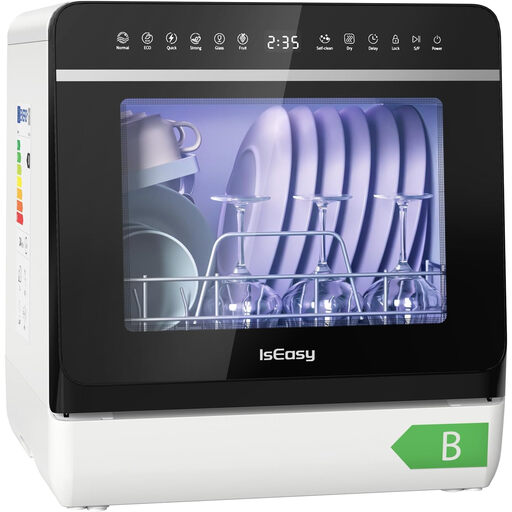 No image available
An integrated tank could be a good option if you don’t have a permanent water supply and can arrange filling and drainage at the chosen location.
The product information lists up to 3 place settings, 7 programmes and a 5-litre tank. The stated capacity doesn’t tell you whether your bowl will fit in the basket.
Tank operation still requires you to fill the appliance by hand and arrange a suitable drain.
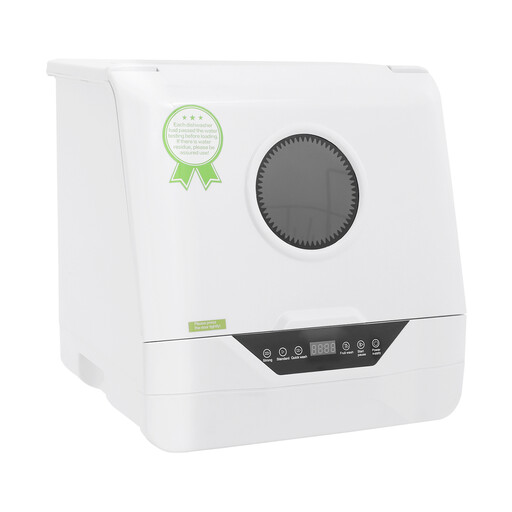 No image available
This tabletop model could be worth considering if you’re looking for an appliance with hose connections and its stated electrical specifications suit your location.
Specifications include 220 V, 800 W, four wash modes and dimensions of 15,24 × 14,69 × 15,43 inches. Before buying, check the appliance’s connections and make sure it will fit in your kitchen.
 No image available
The integrated tank is an option if you don’t want to use an appliance with a permanent water connection and can collect other dishes to wash as well.
The product information lists a 5-litre tank, 6+3 programmes and energy class D. The product title names households of 2–3 people as its target audience; this doesn’t confirm that your bowl will fit.
If you use the tank, you’ll need to fill the appliance and arrange a suitable drain.
You can’t work this out from the Eco figure per cycle alone. The Federal Environment Agency and the consumer advice centre base their guidance on economical machine washing on a full load. For your own routine, also consider how many cycles you’re likely to need.
An integrated tank can replace a permanent water supply, but you’ll still need to plan for electricity, filling and drainage. Check the manufacturer’s instructions and make sure you can safely drain the wastewater at the intended location.
The Federal Environment Agency recommends running a full load, using the Eco programme and avoiding pre-rinsing by hand, particularly with hot water. Also follow the care instructions for your specific appliance and check that your bowls are dishwasher-safe.
The EU energy label for household dishwashers uses a scale from A to G and lists, among other things, Eco electricity consumption per 100 cycles, water consumption per cycle and capacity. If something is faulty, your statutory rights against the seller are separate from any voluntary guarantee. Before buying, check the information for the specific model and the guarantee terms.
No. According to the consumer advice centre, the symbol indicates that an item is suitable for contact with food; it doesn’t mean it’s dishwasher-safe. Check the bowl manufacturer’s care instructions.