
Lieferung heute & morgen

Qualitätsgarantie

Willkommens-Angebote freischalten: KOSTENLOSE Lieferung | Bis zu 80 % RABATT | Kostenlose 30-Tage-JoyPlus-Testphase
App herunterladen
A mini dishwasher without a water connection can be a practical alternative to a large built-in appliance in a rented flat, student accommodation or motorhome. The integrated tank makes installation more flexible, but there are still several points to check before buying a countertop dishwasher. If you only look at the number of programmes or an especially compact design, it is easy to overlook limitations relating to space, drainage and loading.
A dishwasher with a water tank does not require a fixed water inlet, but the used water still needs to be drained away. Depending on where it is installed, the drain hose can be placed in the sink or in a sufficiently large container. If you plan to use it in a motorhome, you should therefore check that a safe drainage solution and a stable surface are available.
A compact dishwasher may look space-saving on the outside but only hold a few plates, cups and pieces of cutlery inside. Check the stated capacity, the maximum plate size that will fit and the number of baskets. Some models also need additional space above the appliance so that the integrated tank can be filled easily.
A high number of programmes may initially sound versatile. However, the key factors are the running time, temperature, water consumption and drying function. A 19- or 30-minute programme is generally more suitable for lightly soiled dishes. Heavily dried-on food residue usually requires an intensive or standard programme with a longer running time.
Do not just measure the available width on the worktop; check the depth and height as well. The appliance must stand level and securely. You should also allow for hoses, door opening and ventilation. Some countertop dishwashers require sufficient clearance above the casing for filling the tank.
One example is the AIRMSEN Large Slim Countertop Dishwasher. According to the product description, it has a depth of 36.1 cm. However, a minimum height of 59.7 cm is specified for filling the tank. Details like these are particularly important for narrow shelves or wall cupboards.
A model with around three to four place settings may be sufficient for singles and couples. Small families should check whether four to six place settings can realistically be accommodated. Also pay attention to the maximum plate size: some appliances accept plates up to 26 cm, while other models without an upper basket can accommodate plates up to 30 cm.
The term “place settings” is a useful comparison figure, but it does not replace checking your own crockery. Large frying pans, tall glasses or kitchen utensils with long handles can reduce the usable capacity.
A dishwasher with a 5-litre water tank does not necessarily use exactly five litres in every cycle, depending on the programme. Manufacturer specifications should therefore be read in relation to the individual programme. For example, product listings for various models state consumption of around 4.2 to 5.3 litres per wash cycle.
Energy consumption, programme duration and drying method are also important for running costs. An energy-efficient dishwasher cannot be identified solely by a short running time. The EU energy efficiency class, consumption per 100 cycles and consumption in the Eco programme provide a more meaningful basis for comparison.
Hot-air drying can leave dishes drier after washing, but it often extends the operating time and affects electricity consumption. Automatic ventilation after the programme ends can be useful if the appliance is left unused for a longer period, but it does not replace regular cleaning of the filter and seals.
The following recommendations group the appliances by usage situation and objectively stated features. Details of programmes, dimensions and consumption are taken from the respective product descriptions.

Why this product fits the profile: The integrated 5-litre water tank allows the appliance to operate without a fixed water inlet. Measuring 45.8 × 42.8 × 42.5 cm, the appliance is described as suitable for flats, small kitchens and motorhomes.
The description specifies both water supply options as well as a separate drain hose. This makes it clearer before purchase that a suitable drainage solution is also required when operating from the tank.
Five wash programmes plus automatic drying, tank operation and, according to the description, space for dishes up to 26 cm.

Why this product fits the profile: The 37 cm-wide model is aimed at users with limited worktop space who still need several operating modes.
The product description specifies the dimensions, four place settings, tank operation and a required adapter for direct tap connection. These installation details should be checked before placing your order.
Seven wash programmes, two additional functions, a 1–24-hour delay-start timer and automatic ventilation as described by the manufacturer.
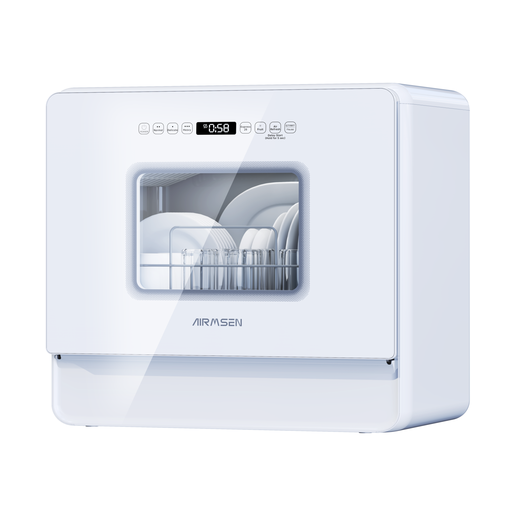
Why this product fits the profile: According to the product description, the appliance is designed for up to five place settings, which may make it suitable for families or frequent washing cycles.
The stated minimum height for refilling prevents the appliance from being placed accidentally beneath a cupboard that is too low. The maximum plate size of 30 cm is also clearly specified.
Three spray arms, seven programmes, a delay-start timer and integrated water softening using the specified regenerating salt.
We have put together a complete, regularly updated list of products that fully meet these strict selection criteria and the safety regulations applicable in the EU.
Water is poured manually into the integrated tank. During the wash cycle, the appliance pumps the water through the spray arms. The wastewater must then be directed through the drain hose into a sink or suitable container. Alternatively, many models can be connected directly to the tap.
Consumption depends on the model and the selected programme. The product specifications available here state around 4.2 to 5.3 litres for several tank models, as well as 6.5 litres for another countertop dishwasher. Always compare consumption per wash cycle and take into account whether a drying programme requires additional energy.
There is no reliable one-size-fits-all answer regarding service life. It depends on factors including frequency of use, water hardness, maintenance and correct loading. Regular filter cleaning, using the right detergent and adding regenerating salt where water softening is available can help reduce deposits and operating problems. Before buying, also check the warranty and service conditions.