
Lieferung heute & morgen

Qualitätsgarantie

Willkommens-Angebote freischalten: KOSTENLOSE Lieferung | Bis zu 80 % RABATT | Kostenlose 30-Tage-JoyPlus-Testphase
App herunterladen
A mini fitness trampoline for home can provide cardio exercises, coordination training and gentle bouncing in a compact space. However, for an indoor trampoline to become a practical part of your daily routine, you should look beyond the price and eye-catching marketing claims. Key considerations include weight capacity, stability, dimensions, suspension and whether a handlebar or folding function suits your living space.
The stated maximum weight capacity is not a recommended training weight, but the upper limit for the individual user's body weight. A trampoline up to 70 kg is therefore not automatically suitable for every adult. If your body weight is close to the limit, there is also less leeway for dynamic movements.
It is also important to remember that only one person should use a mini trampoline at a time. Children require continuous supervision. The models in this selection are intended for home use and are not suitable for acrobatic jumps or somersaults.
Training creates noise from the springs, frame, mat and floor. Rubberised feet can reduce contact with the floor and protect the surface, but they cannot eliminate every training sound. In a rented property, a level, stable surface is recommended, along with a suitable protective mat, provided this is permitted according to the manufacturer's instructions.
Before buying, check that the room offers enough space to move around freely and sufficient headroom. Even a compact indoor trampoline needs clearance from furniture, walls and other obstacles on all sides.
A folding trampoline is practical if you want to store your fitness equipment in a cupboard or against a wall after exercising. Nevertheless, you should check how the folding mechanism is secured and whether the handlebar needs to be correctly attached before every use. Quick assembly is only an advantage if all locking mechanisms work clearly and reliably.
Common sizes range from around 40 to 48 inches. A 40-inch model requires approximately 102 cm of floor space, while a 48-inch model takes up around 122 cm. You should also allow for a safety zone. For smaller homes, a 40-inch rebounder trampoline may be sufficient; taller users may benefit from a larger bouncing surface, provided the room allows for it.
The models listed feature a steel frame with a powder-coated finish and a polypropylene jumping mat. The number of springs alone does not describe the overall user experience. The frame construction, how the mat is attached and the condition of the springs are also important.
An integrated foam pad over the springs can cover the transition area. Before each workout, check the mat, frame, springs, feet and, where applicable, the padding for damage.
Depending on the model, the stated maximum user weight ranges from 70 kg to 80 kg, 100 kg and 120 kg. Always choose the right version based on your actual body weight and the range of movement you plan to perform.
A trampoline with a handlebar can give beginners additional support and orientation during slow movements. However, the handle does not replace a secure standing surface and cannot prevent every risk of falling. For rehabilitation-related exercises, the following applies: before starting training, consult a medical professional to establish whether jumping or bouncing movements are suitable for you. A general suitability for rehabilitation cannot be inferred from a product description.

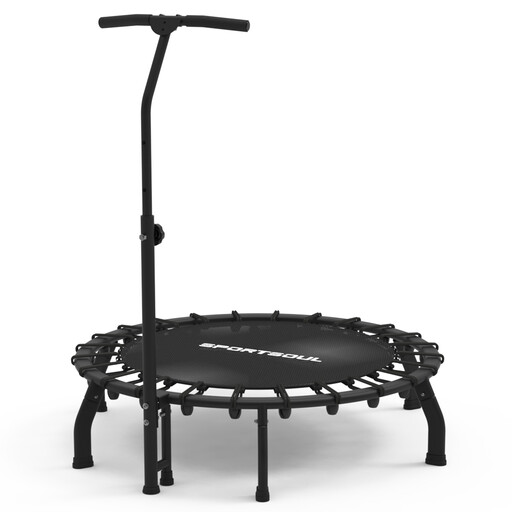
Why this product matches the profile: This folding model is designed for users with limited storage space and features an adjustable-height handlebar. The stated maximum user weight is 70 kg.
The folding mechanism and pre-assembled components reduce the effort required for assembly and storage. The handlebar must be securely fixed in place before use.
Folding design, adjustable-height handlebar and pre-assembled springs, mat and foam cover.
Why this product matches the profile: This 42-inch model has a stated weight capacity of 120 kg and comes with elastic resistance bands. It is designed for home cardio and lower-impact exercises.
The specific 120 kg weight limit makes it easier to choose the right model. According to the product details, it is made from steel, polypropylene and elastic bands; no environmental certification is claimed.
Steel frame, pre-assembled jumping mat and elastic resistance bands; stated standards include EN ISO 20957-1, GB 17498.1-2008 and ASTM F2276-10(2015).
Why this product matches the profile: This model combines a larger 48-inch version with a folding function and handlebar. The stated maximum user weight is 80 kg.
The 40- or 48-inch size specification makes space planning straightforward. Pre-assembled parts reduce the number of assembly steps.
48-inch version, adjustable-height handlebar, 40 steel springs and integrated foam cover.
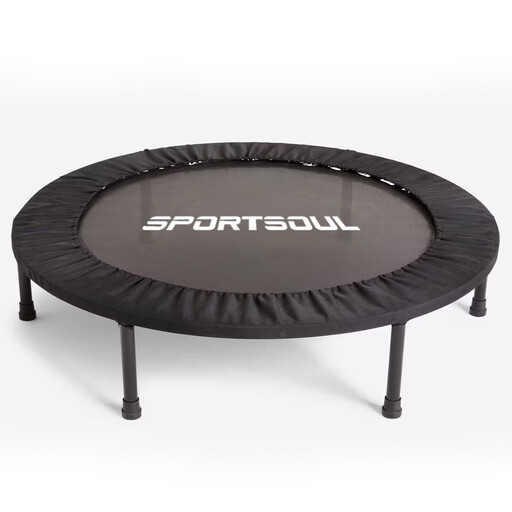
Why this product matches the profile: This compact 40-inch model is aimed at users looking for lightweight, pre-assembled fitness equipment with a stated weight capacity of 100 kg.
According to the product details, the feet are fitted with non-slip, noise-reducing covers. This may limit contact with the floor during exercise, but it does not make the equipment silent.
Product weight of 6.6 kg, 36 steel springs, non-slip feet and, according to the supplier, no assembly required.
We've put together a complete, regularly updated list of products that fully meet these strict selection criteria and the safety regulations applicable in the EU.
Before your first workout, place the fitness trampoline on a level, stable surface. The area above the equipment must be clear. If your model has a handlebar, also check that all connecting parts are securely fastened. Start with slow bouncing movements and short sessions rather than attempting high jumps straight away.
The lifespan depends on body weight, frequency of use, storage and care. Regular visual inspections are more important than a generalised durability claim:
In addition to the actual diameter, you should allow clearance from furniture and walls on all sides, as well as sufficient headroom. A 40-inch model is approximately 102 cm wide, while a 48-inch version is around 122 cm wide.
Some product descriptions mention low-impact exercises and rehabilitation as possible uses. This does not establish individual medical suitability. Anyone recovering from an injury, experiencing discomfort or undergoing rehabilitation should consult a doctor or the relevant physiotherapist before using one.
The equipment normally uses no electricity, as it operates mechanically. Potential follow-on costs include replacement parts, cleaning and, where necessary, a floor-protection mat. It is therefore worth checking the availability of spare parts and the care instructions for the model in question before buying.