
Lieferung heute & morgen

Qualitätsgarantie

Willkommens-Angebote freischalten: KOSTENLOSE Lieferung | Bis zu 80 % RABATT | Kostenlose 30-Tage-JoyPlus-Testphase
App herunterladen
A mini fridge is your ticket to chilled drinks in the office, fresh snacks in the gaming room, or perfectly tempered cosmetics in the bathroom. But the market is vast, and not every model lives up to its advertising claims. Many buyers end up frustrated by excessive operating noise, poor cooling performance, or an unexpectedly high electricity bill.
As your Joybuy Product Recommendation Officer, I'm here to help you avoid these pitfalls. We'll focus on the facts and technical features that truly matter, so you can make an informed decision and find a model that's a perfect fit for your requirements.
Before we dive into our recommendations, it's crucial to understand the typical issues that can lead to purchase regret.
To make the right choice, you should focus on three core technical aspects. These determine performance, suitability, and ongoing costs.
The choice of cooling technology is the most important decision and depends directly on your intended use.
The usable capacity is specified in litres and should match your needs.
Pay attention to the EU Energy Label. The scale ranges from A (very efficient) to G (less efficient). A Class E appliance can consume significantly less electricity per year than a comparable Class F or G model.
The noise emission is specified in decibels (dB). Values below 40 dB are considered quiet and are recommended for use in living rooms and bedrooms.
Here are some models tailored to specific usage scenarios that take the aforementioned pitfalls into account.

Why This Fits Their Persona: This model is designed for mobile use. With its 12V connection, robust, shock-resistant housing, and integrated battery protection, it's a reliable companion for long drives, camping trips, or use in a truck.
Thanks to its compressor technology, it offers genuine cooling and even freezing performance down to -20°C, regardless of the outside temperature. This bypasses the performance weakness of thermoelectric models.
The 3-stage battery protection system prevents the vehicle's battery from being drained. The shockproof design allows for operation even on rough roads.
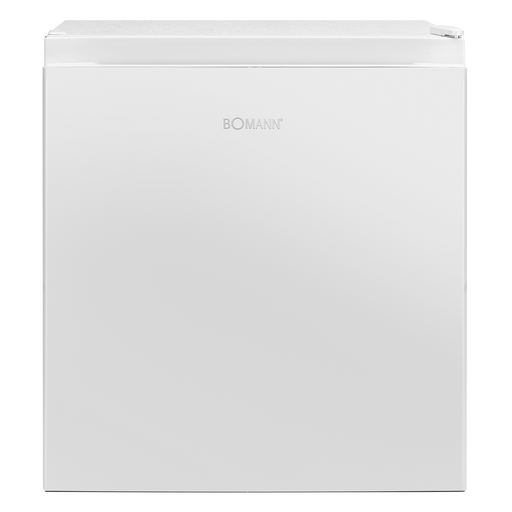
Why This Fits Their Persona: With a 45-litre capacity, this model offers enough space for drinks and snacks in the office or a first apartment. Its compact design and quiet operation make it a discreet addition to small spaces.
The noise emission is clearly specified at 39 dB, making it suitable for living areas. The compressor technology ensures reliable cooling between 0°C and +8°C, without being dependent on the room temperature.
It offers an integrated 4-litre freezer compartment for ice cubes or frozen snacks. The reversible door hinge and adjustable feet allow for flexible adaptation to any environment.
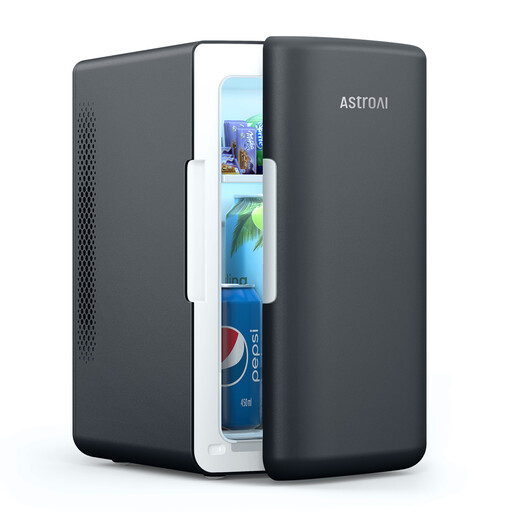
Why This Fits Their Persona: This ultra-compact 6-litre model is specifically designed for storing skincare products and cosmetics. Its quiet, vibration-free thermoelectric system protects sensitive products and its modern design fits on any vanity table.
In this case, thermoelectric cooling is an advantage. The quiet operating noise won't disturb you in the bedroom, and the moderate cooling performance is ideal for cosmetics. The dependency on ambient temperature is non-critical for this purpose.
It features both an AC and a DC (12V) connection, so it can be used at home as well as in the car. An additional warming function is also integrated.
We've compiled a complete, up-to-date list of products that fully meet these strict selection criteria and all relevant safety regulations.
The noise level depends on the cooling technology.
Consumption is indicated on the EU Energy Label in kilowatt-hours per year (kWh/a). A modern Class E appliance with a volume of about 80-100 litres consumes around 80-100 kWh per year. With an electricity price of approx. 30 cents/kWh, this corresponds to annual costs of about €24 to €30. Older or less efficient models can consume significantly more.
No. Only models that explicitly feature a 12V DC connection for the cigarette lighter socket are suitable for use in a car. Never attempt to operate a standard 230V household appliance in a vehicle using a simple voltage converter, as this can damage the appliance or the vehicle's electronics. Look for the product designation 12V car fridge.