
Lieferung heute & morgen

Qualitätsgarantie

Willkommens-Angebote freischalten: KOSTENLOSE Lieferung | Bis zu 80 % RABATT | Kostenlose 30-Tage-JoyPlus-Testphase
App herunterladen
A mini fridge can provide practical additional cooling space in a small flat, office or bedroom. However, compact appliances vary considerably in terms of interior layout, freezer compartment, noise levels and energy consumption. If you focus only on the low purchase price or particularly compact external dimensions, you may later discover that bottles cannot be stored upright, the freezer compartment is barely usable or the door opens on the wrong side.
This buying guide explains which details are relevant before purchasing a small fridge, tabletop fridge or under-counter fridge, and which models suit different usage situations.
A width of around 44 to 45 centimetres may initially appear similar. However, there can be major differences in usable capacity: a 45-litre mini fridge is suitable for drinks, snacks and a small amount of fresh food. An 88-litre fridge provides considerably more storage space, but requires more floor space and usually consumes more energy.
So, do not look only at the product name. Check:
A fridge with freezer compartment in a mini format often has just 3 to 5 litres of freezer space. This is enough for small amounts of frozen food or ice cream, but not for larger supplies. The temperature range and defrosting method may also differ from those of the fridge compartment.
Product specifications should therefore clearly distinguish between fridge and freezer capacity. A model with a 5-litre compartment should be assessed differently from a drinks cooler without a freezer section.
A fridge’s noise level is given in dB or dB(A). Values of around 39 to 41 dB are considered relatively unobtrusive in many homes. However, perceived noise also depends on the floor, distance from the wall and vibrations.
For a bedroom, gaming room or office, look for a specific manufacturer’s rating. Statements such as “whisper-quiet” without a decibel value are not very useful for comparison.
A 45-litre mini fridge will often fit on or under a table and is suitable for individuals, students or use as an additional appliance. Models offering around 43 to 46 litres usually have a small interior with a shelf, door compartments and, in some cases, a freezer compartment.
An 88-litre appliance is more likely to be an under-counter fridge or freestanding compact appliance. For example, the COMFEE' RCD92BL2EUY(E) measures 44.5 × 47 × 82.7 centimetres. Before buying, check whether the height will fit beneath a worktop and whether there is enough ventilation clearance around the appliance.
The energy efficiency class is shown on the EU scale from A to G. Class E appears several times among the appliances listed here. For running costs, the annual consumption in kWh is also important.
A simple guide:
Annual consumption in kWh × your electricity price per kWh = approximate annual electricity cost
Actual consumption depends on factors including room temperature, how full the fridge is, the temperature setting and how often the door is opened. A compact fridge with lower annual consumption may be more economical over time than an apparently cheaper appliance with higher consumption.
A fridge with a reversible door can be adapted more easily to the layout of your room. This feature is particularly useful in narrow kitchen runs, beneath worktops and in small flats. Check whether you can change the door yourself and what information is provided in the instruction manual.
The following practical rules also apply when positioning the appliance:
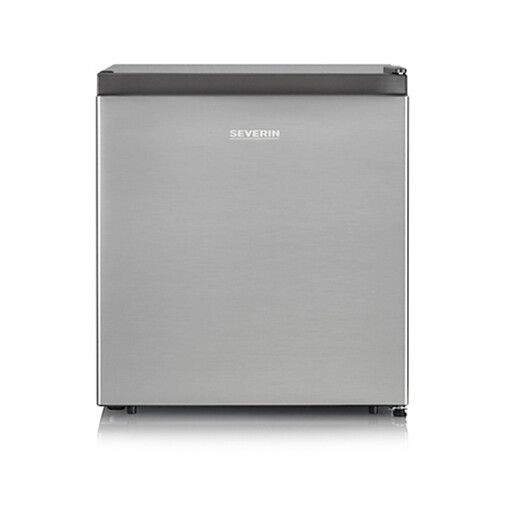
Why this product suits this profile: This 45-litre tabletop fridge is designed for individuals, students and small households. A separate 5-litre freezer compartment accommodates smaller frozen products.
The capacity is clearly divided into 40 litres of fridge space and a 5-litre freezer compartment. The door is reversible and the noise level is specified as 39 dB.
Annual consumption of 80 kWh according to the product specifications, automatic defrosting and an adjustable thermostat.
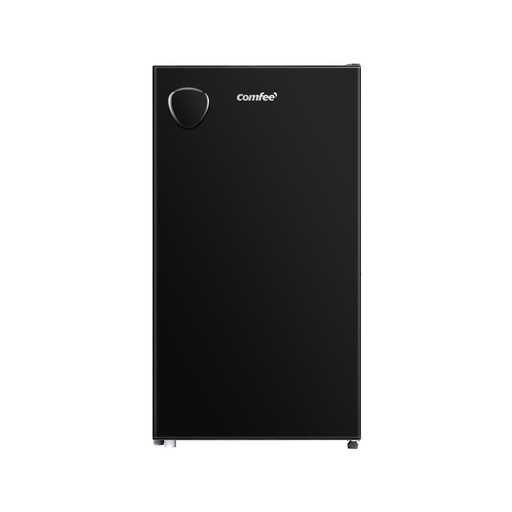
Why this product suits this profile: For flats, offices and kitchens requiring more storage space, this appliance offers greater usable capacity while remaining just 44.5 centimetres wide.
Adjustable glass shelves, interior lighting and a reversible door make it easier to adapt the appliance to different locations and types of food.
88 litres of capacity, a salad drawer, a separate cooling zone for drinks and energy efficiency class E according to the product description.
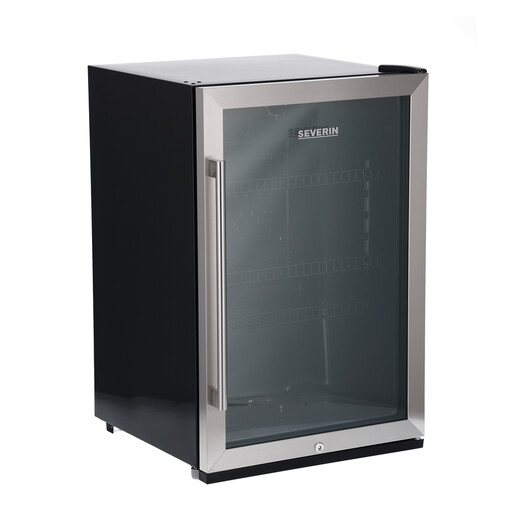
Why this product suits this profile: This drinks cooler is suitable for commercial premises, shared areas and households with a substantial supply of drinks.
The temperature control is specified as ranging from 0 to 10 °C. A lockable glass door and visible bottle storage support use in shared spaces.
118 litres of capacity, LED interior lighting and partly height-adjustable metal shelves; stated annual consumption is 358 kWh.
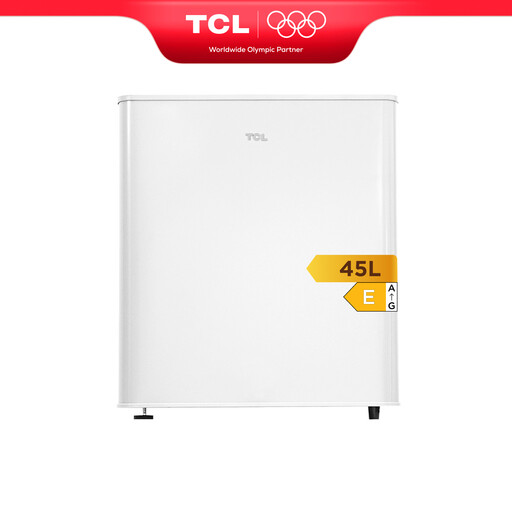
Why this product suits this profile: With 42 litres of fridge space and a 3-litre freezer compartment, this model is suitable for offices, bedrooms, student accommodation or gaming rooms.
The technical specifications state 40 dB, temperature control from 0 to 10 °C and adjustable feet for a stable position.
Adjustable glass shelf, large door compartment and energy efficiency class E according to the manufacturer’s specifications.
We have put together a complete, regularly updated list of products that fully meet these strict selection criteria and the safety regulations applicable in the EU.
Even a compact fridge needs air circulation. If it is placed directly against a wall or beneath a tightly enclosed worktop, heat cannot dissipate as effectively. Follow the manufacturer’s specified clearance requirements.
After transport, the appliance should initially be left standing upright in accordance with the instruction manual. Only then should it be connected to a suitable, earthed socket. Flammable materials must not be placed in the fridge, and the ventilation openings and refrigerant circuit must not be damaged.
Consumption depends on the model, how it is used and the ambient temperature. The product data available here, for example, lists 80 kWh per year for several 45-litre models and 110 kWh per year for a 43-litre COMFEE' model. A drinks cooler with a capacity of 118 litres is specified as using 358 kWh per year. The key factor is the combination of annual consumption, electricity tariff and the capacity you need.
There is no universally applicable personal comfort limit. For noise-sensitive rooms, specific manufacturer ratings of around 39 to 41 dB provide an important basis for comparison. You should also look for a level position, adjustable feet and sufficient clearance from the wall, as vibrations can amplify noise.
Its lifespan depends on the design, how it is used, cleaning, ventilation and maintenance. Regularly cleaning the seal, keeping ventilation openings clear and avoiding unnecessarily long periods with the door open can help ensure reliable operation. If the power cable or refrigerant circuit is damaged, the appliance should not be used further.