
Lieferung heute & morgen

Qualitätsgarantie

Willkommens-Angebote freischalten: KOSTENLOSE Lieferung | Bis zu 80 % RABATT | Kostenlose 30-Tage-JoyPlus-Testphase
App herunterladen
A mini fridge can be practical in a student flat, office, bedroom, motorhome or as an additional appliance in the garage. However, compact refrigeration appliances vary considerably in terms of cooling technology, capacity, noise levels and energy consumption. A cheap purchase can prove unsuitable if the appliance does not fit the intended niche, fails to keep food sufficiently cold or causes constant disturbance in the bedroom.
A portable fridge with thermoelectric cooling often lowers the temperature by only a specific amount below the ambient temperature. The AstroAI Mini Fridge 2.0 Gen, for example, is specified as reaching 18 to 22 °C below ambient temperature. At a room temperature of 30 °C, the interior may therefore reach approximately 8 to 12 °C. This is not comparable to the precise temperature control of a compressor fridge.
For sensitive or highly perishable food, buyers should therefore pay attention to the stated cooling technology and intended use. An appliance with cooling and warming functions is more suitable for drinks, snacks or certain cosmetic products than for long-term storage of temperature-sensitive goods.
A small fridge with a narrow cabinet may offer less storage space than expected because of door compartments, the evaporator or a freezer compartment. So do not just check the external dimensions, but also:
A tabletop fridge also needs sufficient clearance all around to release heat. If the back is placed directly against a wall or inside a cramped shelving unit, the compressor may run for longer.
The energy efficiency class E is specified for several of the appliances featured here. Running costs also depend on the annual consumption in kWh. A 43-litre fridge using 110 kWh/year cannot be compared directly with a chest freezer using 165 kWh/year, as the design, usable capacity and target temperature are different.
This calculation provides a simple guide:
Annual consumption in kWh × your electricity price per kWh = estimated annual electricity costs
Actual consumption depends, among other things, on the room temperature, ventilation, how full the appliance is and how often it is opened.
For a kitchen or office, a compact compressor fridge is usually the sensible choice if food needs to be kept reliably and continuously chilled. A model with a freezer compartment is useful if you also need space for small quantities of frozen food. However, the freezer compartment in a small appliance is no substitute for a separate freezer.
A cooler box with cooling and warming functions often uses thermoelectric technology. It can be used flexibly in a car or connected to a mains socket, but it requires good ventilation and may not reach a fixed target temperature.
If you want to freeze larger quantities, consider a small freezer or a convertible chest freezer instead of a traditional mini fridge.
For drinks, snacks and a few personal-care products, 5 to 15 litres may be sufficient. A 43- to 45-litre appliance offers considerably more space for a single-person household, office or guest room. For regular food storage, models with a capacity of around 90 litres or more are more suitable.
Before buying, measure:
With a built-in appliance such as the Beko B1754FN, the intended 88 cm niche must be compatible with the installation method and ventilation requirements.
The stated decibel levels are important for bedrooms and workspaces. The Beko B1754FN is specified at 35 dB(A), while the Severin KB 8879 is specified at 39 dB. These figures provide a technical guide; perceived noise also depends on the surface, vibrations and room acoustics.
A reversible door makes it easier to position the appliance in confined spaces. Mechanical thermostats are straightforward to use, but offer less precise adjustment than digital controls.
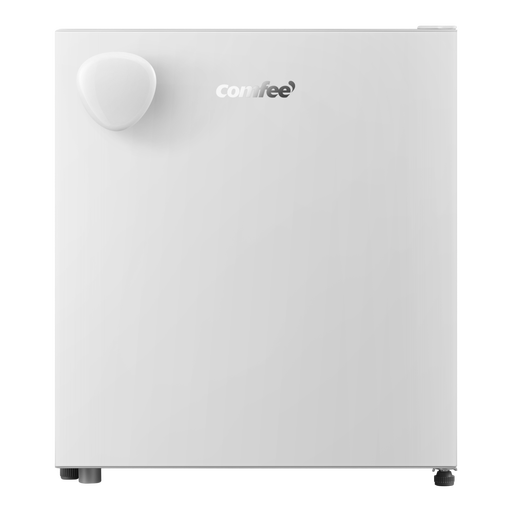
Why this product suits this profile: This narrow tabletop fridge is designed for single-person households, students and small spaces. It offers 43 litres of usable capacity, a width of 44.5 cm and three temperature settings.
The adjustable shelves and door compartments make better use of the interior than a drinks-only cooler. The stated annual consumption is 110 kWh.
Narrow design, height-adjustable shelves, salad drawer and energy efficiency class E.
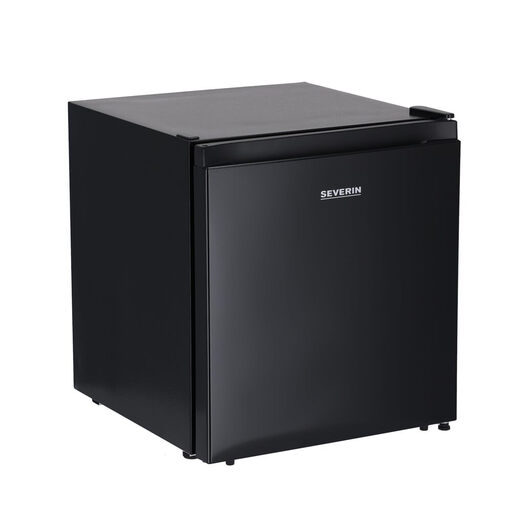
Why this product suits this profile: This 45-litre fridge combines compressor cooling with a 5-litre freezer compartment, making it suitable for a kitchen, bedroom or office.
This appliance is not designed solely as a drinks cooler: compressor cooling, a thermostat and a separate freezer compartment are documented for everyday household use.
45 litres of total capacity, 5-litre freezer compartment, 39 dB, reversible door and annual consumption of 80 kWh.

Why this product suits this profile: This portable fridge is designed for camping, motorhomes, boats, cars and longer journeys. Its two temperature zones can be used separately as cooling or freezing compartments.
Unlike basic cooler boxes, this model uses a compressor, offers defined temperature ranges and supports several power options. However, its weight of 23.2 kg should be taken into account for mobile use.
45 litres of usable capacity, dual-zone function, AC, solar and vehicle operation, plus a stated noise level of 38 dB.

Why this product suits this profile: This convertible chest freezer offers 95 litres of interior space and can be used as either a fridge or freezer, depending on your needs.
The seven-stage temperature setting and removable basket make it easier to adapt the appliance to your needs. Before buying, check whether the top-opening design is practical for the intended location.
95 litres of capacity, 4-star freezer classification, 38 dB, energy efficiency class E and convertible operating modes.
We have put together a complete, regularly updated list of products that fully meet these strict selection criteria and the safety regulations applicable in the EU.
Place the appliance on a stable, level surface and maintain the clearances specified in the instructions. Ventilation openings must not be covered. After transporting a compressor model, allow it to rest for the period specified by the manufacturer before switching it on.
Hot food should be allowed to cool before being placed inside. Opening the door frequently increases energy consumption and can cause the interior temperature to fluctuate. With a thermoelectric model, also bear in mind that it needs electricity to cool actively and does not work like an insulated passive cooler box.
Consumption depends on the design, capacity, temperature, surroundings and usage. Specific examples include 110 kWh/year for the Comfee model, 80 kWh/year for the Severin KB 8879 and 165 kWh/year for the AUCMA 95L Convertible Chest Freezer. For a realistic cost estimate, multiply the relevant figure by your electricity tariff.
It may be suitable if it has a low noise level and sufficient ventilation. Figures between 35 and 40 dB provide a useful guide. You should also consider compressor start-up, vibrations and where the appliance is positioned on the furniture. An appliance with a warming function may also produce noise from its fan.
There is no fixed lifespan that applies to every appliance. It is influenced by factors including ventilation, ambient temperature, care, transportation and operating time. Clean the seals and interior regularly, keep ventilation openings clear and follow the manufacturer’s maintenance and disposal instructions.