
Lieferung heute & morgen

Qualitätsgarantie

Willkommens-Angebote freischalten: KOSTENLOSE Lieferung | Bis zu 80 % RABATT | Kostenlose 30-Tage-JoyPlus-Testphase
App herunterladen
A mini ice maker can be a practical addition to your home, barbecue or motorhome. Instead of storing bags of ice cubes, an electric ice maker produces small batches directly on your worktop. Before buying, however, it is worth taking a close look at the technical specifications. A short production time alone says little about how practical the appliance will be in everyday use.
Statements such as “ice cubes in 6 minutes” usually refer to a single production cycle. This does not mean that a large quantity of ice will be available in six minutes. What matters is how many ice cubes are produced per cycle, the size of the water tank and the stated daily output.
When choosing a model, you should therefore consider these three figures together:
The actual production speed may also depend on the room temperature, water temperature and the appliance’s ventilation.
A quiet ice maker is particularly useful in open-plan kitchens, offices or when camping. However, the term “low noise” is difficult to assess without a measurement. You should therefore look for a specific rating in dB. Compressor or fan noise may also be noticeable while the appliance is cooling.
When using the appliance in a motorhome, you should also check that there is sufficient clearance from the walls and that the power supply is suitable for the electric ice maker.
A self-cleaning ice maker can reduce the cleaning required, but it does not replace all manual maintenance. Any remaining water should be removed through the drain opening. The ice container, scoop and accessible surfaces need to be cleaned and dried regularly.
The self-cleaning function should therefore be seen as an added convenience, not as permission to leave water standing in the appliance indefinitely.
For everyday drinks, a compact appliance with a relatively small water tank is often sufficient. If you are catering for several guests or hosting longer events, a higher daily output makes sense. A tank holding around 1.5 litres gives an indication of the available water volume, but does not automatically show how much ice can be produced without refilling.
Indicators for low water and a full ice container are useful features. They prevent the machine from continuing to run without water or finished ice cubes from blocking the outlet.
An ice maker with two ice cube sizes gives you more choice for different drinks. Smaller cubes can cool drinks more quickly, while larger versions may stay solid for longer, depending on the glass and drink. For cocktails, coffee, beer or cooling food, the shape and size should suit the container being used.
Bullet ice cubes are moulded pieces of ice that are usually rounded. They should not be confused with traditional cubes made in a freezer tray.
A compact ice maker should not only fit the width of your kitchen worktop. Also check its depth, height, cable routing and the space required for heat to escape. For mobile use, weight and ease of carrying are important.
A portable ice maker is particularly suitable for camping and motorhomes if it can be stored easily, positioned securely and connected to a suitable power source. During operation, the appliance should stand on a level, stable surface.
The following selection matches the available model to different everyday situations. As the product data only includes one specific mini ice maker, the same model is assessed according to different use profiles rather than including unsuitable kitchen appliances.
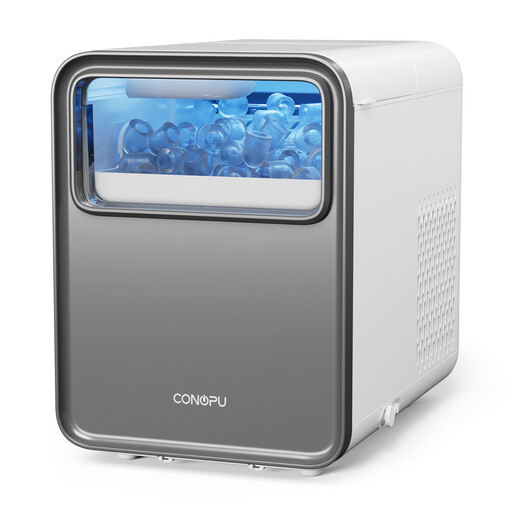
Why this product suits the profile: Operation is limited to choosing between small and large ice cubes, along with the automatic cleaning function. This is easy to understand for households that want to get started without complicated settings.
The product details provide specific figures rather than vague promises: 6–8 minutes per cycle, 9 ice cubes, plus a water-level indicator and full-ice indicator.
1.5-litre water tank, two ice cube sizes and a stated daily output of up to 12 kg.
Why this product suits the profile: For users who prioritise ease of operation and clearly documented appliance features, the transparent front, indicators and specified cleaning cycle are important selection criteria.
The self-cleaning function is described as a 30-minute cycle. A side drain opening also makes it easier to remove any remaining water.
Stated operating noise below 50 dB, transparent front and two selectable ice cube sizes.
Why this product suits the profile: Measuring 35 × 23 × 30 cm and weighing a stated 6.9 kg, the appliance is relatively easy to move for barbecues, outdoor activities or use in a motorhome.
The dimensions and weight are clearly stated. Before using it away from home, you should still check the available surface, ventilation and power supply at the intended location.
Up to 12 kg of ice per day according to the product details, full-ice indicator, water-level indicator, plus a supplied basket and ice scoop.
We have put together a complete, regularly updated list of products that fully meet these strict selection criteria and the safety regulations applicable in the EU.
The running costs of a mini ice maker depend mainly on electricity consumption, operating time and water requirements. You should check the exact power consumption in the relevant product datasheet. An appliance that is switched on only when needed will generally be used differently from an ice maker that operates continuously.
Simple routines can help extend its service life:
This depends on the model and operating conditions. According to the product details, the CONOPU Countertop Ice Maker takes around 6 to 8 minutes for 9 ice cubes. The first batch may vary depending on the ambient temperature and water temperature.
Many appliances are designed for repeated production cycles, but not necessarily for uninterrupted continuous operation. The water level, ice container and heat dissipation should be checked regularly. Finished ice cubes should be removed promptly, and the appliance should be cleaned after use.
A portable ice maker may be suitable if its dimensions, weight, power supply and placement area are compatible with the vehicle or campsite. You should check the technical connection specifications before buying. Adequate ventilation is also important in a motorhome so that the heat generated can escape.