People short on worktop space
If you’re baking just a few rolls, weigh up the appliance’s external dimensions and required clearance against its usable baking area. Severin and Steba list the exact dimensions of their respective models.


In a small kitchen, your choice depends mainly on whether you want to bake a few rolls or fit several on a tray with space between them. A compact countertop oven may be enough for small batches, while the usable tray area is key for larger portions. An air fryer is another option, but its basket does not automatically offer the same space as a baking tray. For its specific recipe, Dr. Oetker recommends a preheated oven at around 200 °C using top and bottom heat, or 180 °C with fan assistance. Don’t assume these settings will work in other appliances without checking first.
If you’re baking just a few rolls, weigh up the appliance’s external dimensions and required clearance against its usable baking area. Severin and Steba list the exact dimensions of their respective models.
If you want to bake several rolls on the tray at once, the tray’s actual dimensions are more useful than the oven’s capacity in litres. Rommelsbacher lists a tray measuring 32,5 × 28,5 cm for the BG 1550 and BGE 1580/E.
If you’d like to cook other small dishes as well as sausages wrapped in pastry, the available heating modes may matter. Steba lists top and bottom heat, plus optional fan assistance, for the KB M19. Check the functions of the exact model you’re considering.
A good fit if: You have limited worktop space and tend to bake small batches at a time.
The trade-off: A smaller appliance may have less usable baking space. Check the tray dimensions and clearance guidance.
A good fit if: You often want to bake several rolls on a tray with space between them.
The trade-off: A larger tray may require more worktop space. Compare the appliance dimensions and the clearance specified in the instructions.
A good fit if: You mainly cook small batches and the basket is big enough for your portion.
The trade-off: Check how many rolls will fit in the basket with space between them, and follow the appliance’s baking guidance.
A good fit if: You already have a suitable oven or want to bake a large batch of rolls at once.
The trade-off: To compare electricity use, look at the consumption of each specific appliance when cooking a similar portion in similar conditions.
| What matters when buying | What to check | Who it matters most to |
|---|---|---|
| Worktop space and positioning | Compare the appliance’s dimensions with the space available, and take account of the model-specific clearance in the instructions. | If you need to find a permanent spot for the oven in a small kitchen, every centimetre counts. Around 33 % of consumers focus primarily on the space needed and where the appliance can be positioned. |
| Usable tray area | Compare the tray dimensions with the number of rolls you plan to bake, and check whether a baking tray is included with the exact model. | If you want to fit several rolls on the tray in one batch, its usable area is crucial. Around 25 % of consumers prioritise portion size and tray area. |
| Heating modes and baking control | Match the appliance’s available heating mode and settings to the recipe instructions. | If you also make other small baked dishes, you’ll want to choose a heating mode that suits the recipe. Around 25 % of consumers pay particular attention to suitable heating modes and control over the baking process. |
| Energy use and cleaning | Compare energy consumption only for similar portions and cooking methods, and check whether the crumb tray and accessories can be removed. | If you use the oven regularly, running costs and easy cleaning may matter more than the rated power alone. Around 17 % of consumers give these factors top priority. |
Oven capacity, usable tray dimensions and external dimensions describe different things. A capacity in litres doesn’t tell you directly how many rolls will fit side by side.
Measure the space where you plan to put the appliance, then check the tray dimensions and the clearance guidance for the exact model.
A tray that’s too small may mean baking in extra batches, while an appliance that’s too large may not fit in the space you have.
Dr. Oetker’s recipe gives different settings for top and bottom heat and fan-assisted cooking, and calls for the oven to be preheated.
First choose a heating mode that your appliance has, then use the corresponding recipe setting as a starting point. Keep an eye on the rolls as they bake.
If you’re using raw sausage, the meat must be cooked through as well. The colour of the pastry alone won’t tell you whether it is.
The German Federal Institute for Risk Assessment recommends cooking meat dishes to at least 70 °C for two minutes at the centre, and checking with a meat thermometer if in doubt. Follow good kitchen hygiene, too. For pre-cooked sausages, follow the pack instructions.
An appliance’s rated power is not the same as its actual energy consumption per baking session.
Compare consumption in kWh only for similar portions and baking conditions. The consumer advice centre points to the actual consumption of each appliance.
The range includes a very compact 9-l countertop oven and a larger countertop oven with fan assistance.
According to the manufacturer, the KB M19 combines a 19-l capacity with top and bottom heat and optional fan assistance.
According to the manufacturer, the BG 1550 and BGE 1580/E are 30-l countertop ovens with a tray measuring 32,5 × 28,5 cm.
The options below include countertop ovens and a pizza oven. Compare their design, heating modes and baking accessories with the space you have and the portion you need to cook.
 No image available
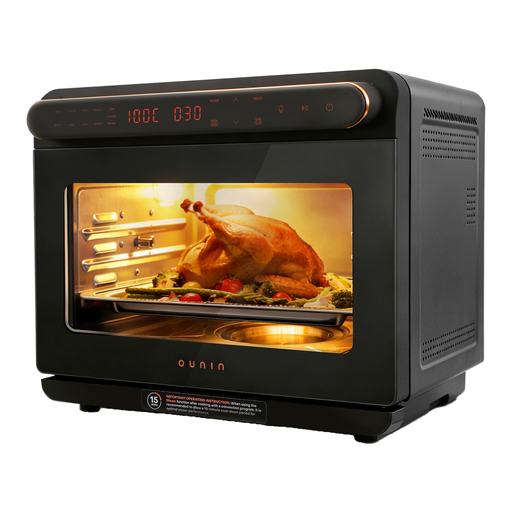
Could be worth considering if you’d like to use the steam functions mentioned in the product name as well as bake.
24 l; the product name mentions Steam Bake and Steam Roast. The product description lists a 1-l water tank, a baking pan and a 304 stainless steel interior.
 No image available
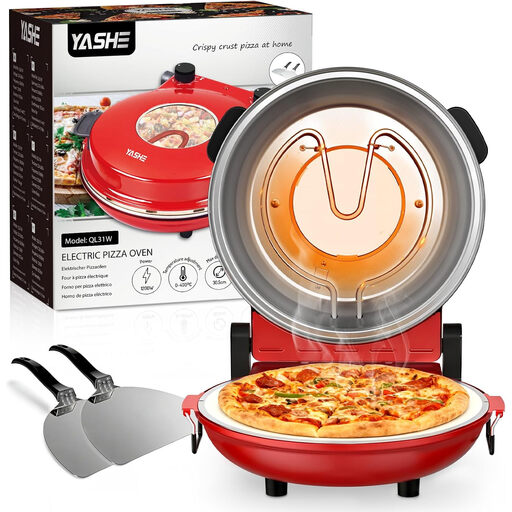
Its dimensions may make it worth considering if you have limited space. Check first that the baking surface is suitable for the number of rolls you want to make.
The product description lists external dimensions of 32,5 × 35 × 16,5 cm, top and bottom heat, a built-in timer and a viewing window. The product name specifies a 30-cm ceramic stone.
 No image available
The listed dimensions may be useful if space is limited. Compare them with the space you have and check the size of the included tray.
10 l; 37 × 26,5 × 21 cm according to the product description. Features listed include top and bottom heat, a baking tray, a wire rack and a temperature range of 100 to 230 °C.
 No image available
Could suit you if you’re looking for a mini oven described as having fan assistance. Measure the space available and check the settings of the exact model.
28 l; the product description lists top heat, bottom heat or combined heat, a baking tray, temperature control and a timer.
 No image available
If you want to use a larger baking tray, check its dimensions and whether the appliance, including the required clearance, will fit in your kitchen.
32 l and 1600 W; the product description lists external dimensions of 52,3 × 36 × 32,2 cm, a baking tray and a wire rack. The product name also mentions a timer, a crumb tray and a temperature range of 100 to 250 °C.
For its specific recipe, Dr. Oetker recommends a preheated oven at around 200 °C using top and bottom heat, or around 180 °C with fan assistance, and a baking time of 20 to 25 minutes. These settings aren’t guaranteed to work for every type of pastry, sausage or countertop appliance, so keep an eye on the rolls as they bake.
If you’re using raw sausage, the meat must be cooked through as well as the pastry being browned. The German Federal Institute for Risk Assessment recommends cooking meat dishes to at least 70 °C for two minutes at the centre, and checking with a meat thermometer if in doubt. This safety advice applies to rolls containing raw meat.
As well as the appliance’s dimensions, allow for the clearance specified in the instructions for that model. The external dimensions alone don’t show how much space you’ll need altogether. Also check that the usable tray area is large enough for your portion.
No. Size or wattage alone won’t tell you how much energy an appliance uses per baking session. Compare the actual electricity consumption in kWh for the same portion and similar baking conditions. The consumer advice centre says the appliance’s actual consumption is what matters.
Electrical appliances covered by the EU Low Voltage Directive, including those with a rated voltage of 50 to 1.000 V AC, must carry CE marking. This is the manufacturer’s declaration of conformity, not an independent quality mark. Check the marking and documentation for the specific appliance.