Bakers short on space
If worktop space is limited, remember to check the model-specific ventilation clearances as well as the external dimensions. This will help you work out whether your chosen spot is actually suitable.


First, choose a spot where the specific oven can be safely positioned in line with the manufacturer's instructions. Then compare the usable baking tray area with the amount of dough you usually make. A smaller oven cavity saves space, but may mean baking in more batches. Extra heating functions also take up space and are only useful if you plan to use them. Recipe temperatures are a starting point, not a guarantee of identical results in every mini oven.
If worktop space is limited, remember to check the model-specific ventilation clearances as well as the external dimensions. This will help you work out whether your chosen spot is actually suitable.
If you bake a range of recipes, check whether the oven has top and bottom heat, and fan-assisted cooking if required. Recipe temperatures are a guide and need to suit both the specific appliance and the bake.
If you want to bake in as few batches as possible, compare the usable baking tray area with the size of your usual batch. A larger oven cavity may take up more space.
| What to consider | What to check | Who it matters most to |
|---|---|---|
| A safe place to position it | Check the external dimensions and the side and top ventilation clearances in the instructions for the specific model. | If I have limited worktop space, the oven needs to fit with the required clearance around it; around 33% of consumers put having a suitable space for safe use first. |
| The right heating functions | Check for top and bottom heat and whether fan-assisted cooking can be switched on; monitor how your recipe and bake turn out in your own oven. | If I bake different recipes, I want to be able to choose the heating functions they call for; around 27% of consumers prioritise the right heating functions. |
| Tray area and batch size | Compare the usable tray dimensions with the amount of dough you usually make, rather than looking only at the oven cavity capacity. | If I want to bake a larger batch in as few rounds as possible, the actual tray area is key; around 20% of consumers prioritise batch size. |
| Ease of use and cleaning | Check what’s included, the cleaning instructions and whether suitable replacement parts are available. | If easy cleaning and replacing damaged accessories matter to me, I check these details before buying; around 20% of consumers put ease of use and potential follow-on costs first. |
The required ventilation clearances can make a significant difference to the space you need. For the Rommelsbacher BG 1055/E, the manufacturer specifies 4 cm at the sides and 1 m above it. These requirements do not automatically apply to other models.
Check the installation instructions for your chosen appliance and measure the full clearance required before buying.
If your chosen spot isn’t suitable, you may need to find somewhere else for the oven or choose a different model.
Capacity alone doesn’t show how many biscuits will fit on the supplied tray. Manufacturer specifications for the interior or tray dimensions may be more useful for comparing models.
Compare the tray area with your usual batch size, and allow for extra baking rounds if the tray is smaller than you expected.
A smaller tray may mean baking in more batches.
Dr. Oetker’s recipe for delicate almond biscuits gives different settings for top and bottom heat and fan-assisted cooking. The product specifications for the Tristar OV-3620 and Severin TO 2052 state that they do not have a convection or fan-assisted function.
Before buying, check that the exact model explicitly lists the heating function your recipe calls for.
The BG 1055/E is an 18 l mini oven with top and bottom heat and selectable fan-assisted cooking.
The KB M19 has a 19 l capacity, switchable fan-assisted cooking and separately selectable top and bottom heat.
The TO 2052 is a 9 l model without a fan-assisted function; the TO 2068 has a 20 l capacity, fan-assisted cooking and top and bottom heat.
The OV-3620 is a 19 l baking and toast oven with top and bottom heat.
The TO 20 offers top and bottom heat, fan-assisted cooking and an additional rotisserie spit.
This selection includes mini ovens and ovens with a range of cavity sizes and features. Compare the external dimensions, heating functions and usable area for your batch with the requirements of your space and recipe.
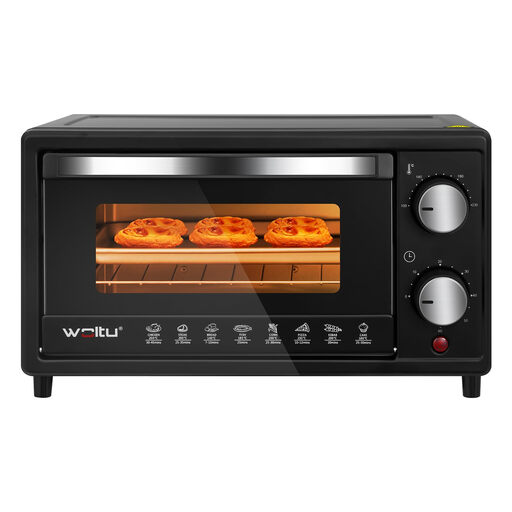 No image available
Could suit a smaller batch of dough; check first that the usable baking area is right for the amount you plan to make.
10 l; 100–230 °C; 0–60-minute timer; top and bottom heat; pizza function.
 No image available
If you’re looking for a larger baking area, carefully compare the appliance dimensions with the space you have available.
32 l; 1600 W; 100–250 °C; 60-minute timer; crumb tray.
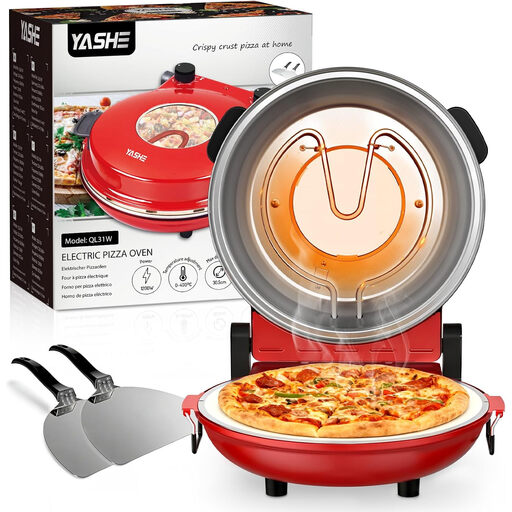 No image available
Check that the listed features and available space suit what you plan to bake.
30 cm ceramic stone; top and bottom heat; built-in timer; viewing window.
 No image available
The separate cooking zones may be worth considering; check whether you need this feature for what you plan to bake.
23 l total capacity; two cooking zones; 15 programmes.
For its ‘Delicate almond biscuits’ recipe, Dr. Oetker suggests baking on the middle shelf for around 15 minutes after preheating, at about 180 °C using top and bottom heat or about 160 °C with fan-assisted cooking. These settings are for this particular dough and aren’t guaranteed to work for every recipe or mini oven.
Don’t decide based on the external dimensions alone. Check the installation instructions for the specific model. Rommelsbacher says the BG 1055/E must not be built in and specifies 4 cm of ventilation clearance at the sides and 1 m above it. Other models have their own manufacturer requirements.
Check the cleaning instructions, what’s included and whether suitable replacement parts are available for the specific model. For example, a removable crumb tray is listed for the BG 1055/E and KB M19.
No. According to the Verbraucherzentrale, your statutory rights are set out in law and apply against the seller. A guarantee is an additional voluntary promise with its own terms and conditions. If something is faulty, check what rights you have against the seller.
No. The German Federal Ministry for the Environment advises that old electrical appliances should be disposed of separately and properly, as putting them in household rubbish can pose environmental risks. Find out about suitable local collection or return options.