What should you look for when buying?
First compare the tray area and heating mode with your recipe; then check that the appliance will fit safely in the space you have in mind.
| What matters |
What to check when buying |
Who will find this most important? |
| Tray area and batch size |
Check the usable tray dimensions and which trays are included; don’t use the oven cavity capacity to estimate how many crescents will fit. |
When we’re baking together, I want to gauge the tray area and plan how many batches we’ll need. Around 36% of consumers say batch size matters most to them. |
| Heating mode and baking time |
Compare conventional top and bottom heat with fan-assisted heat, as well as the temperature you need. For the recipe cited, Dr. Oetker recommends about 180 °C or 160 °C respectively, and 10–11 minutes on the middle shelf. |
If I want to follow the recipe’s heating mode closely and keep an eye on the short baking time, the right settings matter more than extra features. Around 29% of consumers put heating mode and temperature first. |
| Worktop space and clearance |
Check the appliance’s dimensions against the space you plan to use and leave the clearances specified in its instructions; don’t treat a countertop oven as a built-in appliance. |
If I have limited worktop space, I want to plan where the oven will go and allow for the necessary clearance in advance, even if that means baking more batches. Around 21% of consumers are most concerned about space. |
| Safe, practical use |
Read the guidance on hot surfaces, ventilation and supervision; if you’re buying a new appliance, also check that it has the required CE marking. |
When several people are around the oven during a group baking session, safe handling and easy cleaning matter more to me than baking the largest possible batch. Around 14% of consumers say this is their main concern. |
According to the European Union, the CE marking is the manufacturer’s declaration that a product complies with the relevant requirements; it is not an independent quality mark. Check the marking and safety information for the specific appliance.
Mini ovens at Joybuy
This selection includes mini ovens and compact oven or air fryer combinations. Before deciding, check the usable tray area and the CE marking on the specific appliance; you can’t determine either from the product name alone.
 No image available
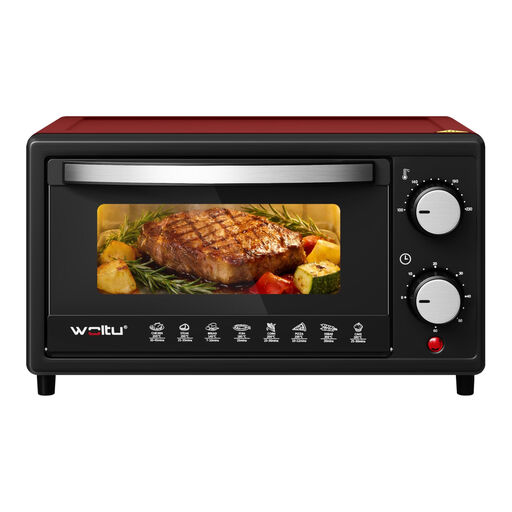
WOLTU mini oven, 32 l, 1.600 W
For a group baking session, compare the temperature settings with your recipe; the capacity in litres won’t tell you the usable tray area.
Listed in the product name: 32 l, 1.600 W, timer, crumb tray and a temperature range of 100 °C to 250 °C.
View at Joybuy
 No image available
WOLTU mini oven with pizza function, 10 l
The compact size may suit smaller batches; check in advance that the tray is big enough for the number of crescents you plan to bake.
Listed in the product name: 10 l, pizza function and a temperature range of 100 °C to 230 °C.
View at Joybuy
 No image available
WOLTU mini convection oven, 28 l
If you’re comparing a larger oven cavity with temperature control, also check the usable tray area and whether you can select the heating mode you need.
Listed in the product name: 28 l, pizza function, temperature control and timer.
View at Joybuy
 No image available
ROUNY air fryer oven, 6,5 l
The product description lists baking as one of its functions. If you want to keep an eye on your bake, the viewing window and interior light are useful features.
Listed in the product name: 6,5 l, stainless steel basket, inner pot and rack, plus Classic Knob Control. Don’t block the air inlet or outlet while the appliance is in use; avoid hot surfaces and only allow children to use it under supervision.
View at Joybuy
 No image available
OIMIS smart air fryer toaster oven, 30 l, 21 presets
If you’re comparing several cooking methods in one appliance, check which features you’ll actually need for your baking session and which accessories are included.
Listed in the product name: 30 l, 21 presets, 1.800 W and suitable for a 13-inch pizza. Keep it away from flammable materials while in use.
View at Joybuy
Frequently asked questions
What temperature and baking time should I use for almond crescents?
The Dr. Oetker vanilla crescent recipe with ground almonds cited here recommends about 180 °C with conventional top and bottom heat, or about 160 °C with fan-assisted heat, and 10–11 minutes on the middle shelf. These are recipe guidelines, not settings tested on every mini oven.
How can I tell whether enough crescents will fit on a tray?
Compare the usable dimensions of the specific tray and allow space between the dough pieces as directed by your recipe. The oven cavity capacity in litres doesn’t tell you how many pieces will fit on a tray or guarantee even baking on several trays at once.
Can I put a mini oven in a cramped cupboard?
Don’t judge this by the appliance’s outer dimensions alone. The Steba KB M19 instructions explicitly state that it isn’t a built-in oven and require, among other things, a 10 cm gap from the rear wall. Follow the manufacturer’s instructions for other models.
Is the CE marking an independent safety test?
No. Electrical appliances covered by relevant EU rules must meet the applicable conformity requirements and carry the required CE marking. According to the European Union, the manufacturer uses the marking to declare conformity; it isn’t an independent quality mark.
Does a mini oven need an EU energy label?
Not necessarily. Rommelsbacher says that EU energy labels aren’t required for its mini ovens weighing under 18 kg. The absence of a label therefore doesn’t provide an efficiency comparison for these appliances; nor does the power rating in watts, on its own, tell you how much energy each batch will use.


