Hosts catering for a crowd
If you’re serving warm apple slices to several guests, start by checking that your tin and tray will fit inside the oven. A Würzmoment recipe suggests arranging the slices evenly in a single layer in a baking dish.


For warm, soft apple slices, first consider whether your tin will fit and how much usable tray space there is, then check the oven capacity and heating functions. If you want to make dried apple rings instead, you’ll need a suitably low temperature and a method of releasing moisture that’s permitted by the appliance instructions. The term ‘mini oven’ alone doesn’t tell you whether it’s suitable.
If you’re serving warm apple slices to several guests, start by checking that your tin and tray will fit inside the oven. A Würzmoment recipe suggests arranging the slices evenly in a single layer in a baking dish.
If you’re planning a dry snack rather than a warm dessert, check the temperature range and drying method. The Federal Centre for Nutrition recommends using a low temperature and leaving a gap in the oven door to let moisture escape when drying food in an oven. Always follow the instructions for your specific appliance.
If you’re happy to cook batches one after another, a smaller appliance could be an option. As well as checking the external dimensions, read the model’s setup instructions. For example, the instructions for the Severin TO 2056 say to unplug the appliance and let it cool before cleaning.
First decide whether you want to serve the apple slices warm and soft or as dried apple rings. Then check that your tin fits, look at the usable tray space and measure the space available for the appliance. The capacity in litres alone won’t tell you how many portions you can make or whether food will cook evenly on several levels.
| Priority | What to check when buying | Who is this most important for? |
|---|---|---|
| Usable space and batch size | Check that your tin will fit inside the oven and on the usable tray area; also check the external dimensions against the space available. | If you want to fit as many slices as possible on the tray at once for several guests, usable space is what matters. Around 36 % of consumers therefore prioritise making a few large batches. |
| The texture you want | Decide in advance whether you want warm, baked slices or dried rings. The Federal Centre for Nutrition gives a temperature range of 40–50 °C for drying food in an oven; check the temperature and operating method against the appliance instructions. | If you want to serve a warm dessert rather than a dry snack, you’ll need a suitable cooking method. Around 29 % of consumers prioritise the texture they want. |
| Space and safe operation | Check the external dimensions, required clearances and connection requirements in the instructions for the specific model. | If you have limited worktop space, make sure you can position the oven with the required clearances. Around 21 % of consumers prioritise space and safe operation. |
| Energy use over several batches | Compare the energy use in kWh for a similar cooking task; the Consumer Advice Centre stresses the importance of the appliance’s actual energy use. | If you’re planning several or longer cooking sessions, you’ll want to estimate the energy used for the actual cooking task. Around 14 % of consumers prioritise running costs. |
A larger oven capacity doesn’t guarantee that your dish will fit or that there’ll be room to arrange enough slices side by side on the tray.
Before buying, compare the dimensions of your dish with the internal dimensions and tray of the specific model.
If the usable space is limited, you may need to cook extra batches for a family gathering.
Warm, soft apple slices and dried apple rings need different cooking methods. A function name alone doesn’t tell you whether the temperature and operating method will suit your recipe.
Decide what texture you want, then check that the recipe and temperature range are compatible with the instructions for the exact model.
If the appliance or usable space isn’t right for your chosen method, you may need to cook extra batches.
The rated power in watts doesn’t measure the energy used for a specific cooking task. The Consumer Advice Centre points out that the appliance’s actual energy use is what matters when making a comparison.
Where possible, compare the kWh figures for a similar task and take the planned cooking time into account.
The TO 2058 may be worth considering if you’re checking whether larger dishes will fit. Severin lists a 42-litre capacity, a fan setting and external dimensions of 51,5 × 42 × 36,5 cm (W × D × H).
According to Rommelsbacher, the BGE 1580/E combines a 30-litre capacity with an optional fan setting and a temperature range of 80 to 230 °C.
Gastroback describes the Design Ofen Air Fry & Pizza 42815 as a combination appliance with baking and drying functions; it has a stated capacity of 22 litres and a temperature range of 55 to 220 °C.
The KB M19 could be an option if you’re short on space and smaller batches will do. Steba lists a 19-litre capacity, a fan setting and internal dimensions of 31 × 25,5 cm (W × D).
This selection includes mini and combination ovens with a baking function, from smaller models for cooking in batches to options with a larger capacity. Check that the usable space will fit your dish; a drying function doesn’t remove the need to check that the temperature and operating method are suitable.
 No image available
Described as a 32-litre mini oven with a baking function. Check that the included tray will fit the dish you plan to use.
 No image available
Described as a mini fan oven for baking. Check whether your dish will fit on one of the stated shelves.
 No image available
This combination appliance is described as having baking and drying functions. Check the temperature range and the method you plan to use against the instructions.
The product information advises keeping flammable materials away during use and cleaning the interior after every use.
 No image available
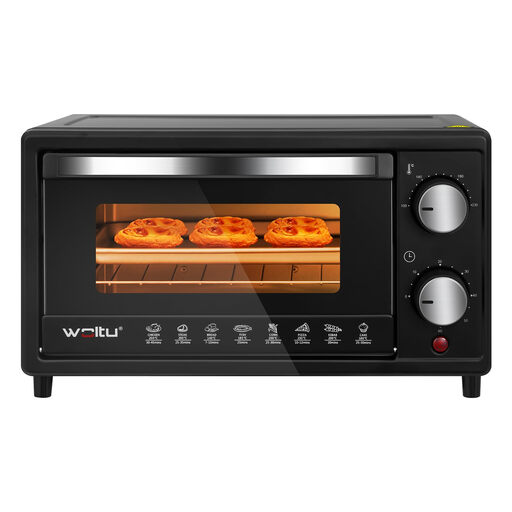
The description recommends this 10-litre appliance for 1–2 people, so it’s more suited to cooking in batches for a family gathering.
No, the methods are designed to achieve different results. A recipe for warm, soft apple slices describes baking them in a dish; the Federal Centre for Nutrition’s advice on apple rings is about drying them. Decide which result you want to serve before choosing an appliance.
Only if the instructions for your specific appliance allow it. The Federal Centre for Nutrition recommends leaving a gap in the oven door to let moisture escape when drying food in an oven. This doesn’t mean that every electric tabletop oven can be used this way.
Compare the external dimensions of your dish with the internal dimensions of the specific appliance, and check that the dish will fit on the tray. If you want to cook several slices side by side, usable space matters more than the capacity in litres alone.
An electric mini oven must meet the EU requirements that apply to it and carry the appropriate CE marking. According to the European Union, the manufacturer is responsible for conformity. The marking is a declaration by the manufacturer, not proof of an independent inspection of each individual product.
Follow the instructions for your model. The manufacturer’s instructions for the Severin TO 2056 say to unplug the appliance and let it cool before cleaning. This model-specific instruction doesn’t automatically apply to other models.