Rolls for one or two people
If you want to prepare aubergine slices and a small dish, the usable interior dimensions matter more than having the highest possible capacity in litres. GialloZafferano’s recipe uses an ovenproof dish for the rolls.


First, choose an ovenproof dish that suits the portion you want to make, then compare its external dimensions with the mini oven’s usable interior space. The capacity in litres alone won’t tell you whether it will fit. For recipes that call for pre-baking aubergine slices before baking the filled rolls in a dish, the right heating modes and the specific model’s placement requirements are key. Extra programmes don’t replace these checks.
If you want to prepare aubergine slices and a small dish, the usable interior dimensions matter more than having the highest possible capacity in litres. GialloZafferano’s recipe uses an ovenproof dish for the rolls.
As well as checking the appliance’s external dimensions, read the placement instructions in the manual for the specific model. For example, the Steba KB M19 manual specifies a clearance from the wall and unobstructed ventilation slots.
If you want to bake more rolls at once, you’ll need to check the dish size, oven cavity and space required together. A larger capacity in litres alone doesn’t confirm that your dish will fit.
First, compare your dish with the interior space and shelf positions. Then check which heating modes you need for each step of the recipe, and whether the appliance will fit in your kitchen with the required clearance.
| Consideration | What to look for | Who should pay particular attention? |
|---|---|---|
| Dish and portion size | Compare the dish’s external dimensions, including handles, with the usable interior space, shelf positions and door clearance. | If I want to prepare rolls for one or two people in a dish, fit is what matters most; around 36% of consumers put dish and portion size first. |
| A safe place to position it | Check the appliance dimensions, model-specific clearance requirements and ventilation instructions. | If I have limited worktop space, I also need to allow for the required clearances and ventilation; that’s why around 29% of consumers prioritise a safe place to position their oven. |
| Heating modes | Check the specifications for the specific model to see whether it has top and bottom heat and, if needed, a fan-assisted setting. | If I want to fan-bake aubergine slices before baking the rolls in a dish, I compare the heating modes needed for both steps; around 21% of consumers focus primarily on suitable heating modes. |
| Cleaning and running costs | Look for an accessible interior and removable accessories; compare energy consumption only for equivalent baking cycles. | If easy cleaning and clear running costs matter to me, I check the accessories and specific energy consumption figures; around 14% of consumers put these factors first. |
The rolls sit side by side in a dish. Handles, the shelf and the door all need room too, even if the stated oven capacity sounds sufficient.
Measure the dish, including all its handles, and compare its external dimensions with the interior and shelf positions of the specific oven.
If the dish doesn’t fit, you may need to bake in several batches or use a different ovenproof dish.
The appliance’s dimensions alone don’t take account of the clearances or ventilation required in the manual. Requirements vary by model.
Before choosing where to put it, check the manual for the exact oven you’re planning to buy and allow for the specified clearances.
You may need to rearrange your kitchen if the chosen position isn’t suitable.
Rated power isn’t the same as the electricity used for a complete baking cycle. It doesn’t, on its own, tell you how much you’ll save per dish.
Compare energy consumption figures only for the same baking cycle, and factor in your electricity tariff.
A pizza or rotisserie programme doesn’t mean the appliance has the heating mode required for a particular recipe. According to the manufacturer, the Severin TO 2067 doesn’t have a fan-assisted function.
Check the specifications for the specific model for top and bottom heat and fan-assisted cooking. Only choose extra functions if you’ll actually use them.
The BG 1055/E is an 18-l model with top and bottom heat and an optional fan-assisted setting; the BGE 1580/E has a 30-l capacity. These details apply to these models, not the entire range.
The KB M19 is a 19-l model with an optional fan-assisted setting. Its published interior and external dimensions can help you check whether your dish and chosen position are suitable.
The TO 2067 is a 20-l countertop oven with top and bottom heat, suited to buyers who don’t need a fan-assisted function.
The MBG 3727 is a 25-l model with top and bottom heat and a fan-assisted setting, for buyers considering a larger dish.
According to Gastroback, the Design Ofen Air Fry & Pizza 42815 combines a 22-l oven cavity with several functions.
This selection of Joybuy products includes countertop ovens for baking, with a range of oven capacities. Compare the stated dimensions and features with your dish, recipe and chosen position.
 No image available
This could be worth considering if you’re looking for a countertop oven for baking and grilling; check the external dimensions against the space available.
32 l; 1.600 W; temperature range 100 to 250 °C; timer; removable crumb tray. External dimensions: 52,3 × 36 × 32,2 cm.
 No image available
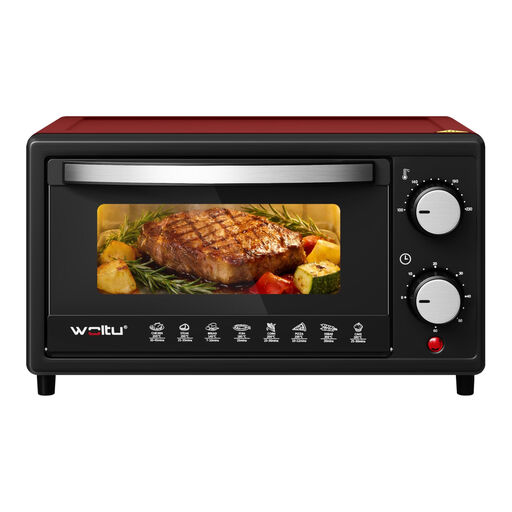
Its more compact external dimensions could be useful if you’re short on space; still, check whether your dish will fit.
10 l; temperature range 100 to 230 °C; 60-minute timer; pizza function. The description lists a baking tray and wire rack. External dimensions: 37 × 26,5 × 21 cm.
 No image available
The stated heating modes could be useful if you want to choose between top heat, bottom heat and combined top and bottom heat.
28 l; three heating modes; temperature range 100 to 230 °C. The description states that it can fit a 26 cm pizza; this doesn’t confirm that an oven dish will fit.
 No image available
This could suit you if you want a larger oven cavity and extra cooking functions; make sure to allow for the external dimensions and the required safety clearance.
30 l; 1.800 W; temperature range 30 to 230 °C; 21 pre-set functions. External dimensions: 456 × 430 × 365 mm. Keep away from flammable materials such as curtains and wooden tables while in use.
Compare the dish’s external dimensions, including the handles, with the usable oven cavity and shelf positions. A capacity in litres or suitability for a round tin doesn’t automatically mean that a rectangular oven dish will fit.
Not for every recipe, but GialloZafferano’s method uses a fan setting to pre-bake the slices, then bakes the rolls in the dish using conventional heat. If you want to follow this method, check that the oven has both heating modes. If it doesn’t have a fan setting, you’ll need to adapt the first step and keep an eye on how the food is cooking.
There’s no single answer. Follow the clearance and ventilation requirements, and guidance on hot surfaces, in the manual for the specific model. For example, the Steba KB M19 manual requires unobstructed ventilation slots and a 10 cm gap between the back of the appliance and the kitchen wall. This isn’t a general approval to place it beneath a wall cupboard.
For electrical equipment covered by the EU Low Voltage Directive, including appliances operating at 50 to 1.000 V AC, the manufacturer must apply the CE marking after following the required conformity assessment procedure. The European Union explains that CE indicates the manufacturer’s declaration that the product meets the relevant requirements; it isn’t an independent quality mark. Check the details for the specific product you’re buying.
No. Rated power alone doesn’t tell you how much electricity a complete baking cycle uses. To compare costs, you’ll need energy consumption figures for the same cycle and your electricity tariff. The Verbraucherzentrale recommends checking actual energy consumption.