Batch-cookers with a large casserole dish
You want to prepare several portions in one go, so you need to check that the dish’s footprint, handles and height all fit inside the oven.


For batch-cooking lentil and potato bake, a mini oven is a good fit if your filled dish, including its handles, fits inside the usable cooking space; capacity in litres alone is not enough to tell you. For one large batch, the usable space for your dish matters most, while with smaller batches, the available worktop space and the model’s ventilation clearances become more important. Compare heating functions and cleaning options only once you know the dish and where the oven will go.
You want to prepare several portions in one go, so you need to check that the dish’s footprint, handles and height all fit inside the oven.
You can bake smaller batches, but you still need a safe spot for the appliance with enough clearance for ventilation.
Once you’ve confirmed your dish fits, you compare heating functions and cleaning options because you plan to use the oven regularly for bakes.
A good fit if: you need to fit a larger dish for several portions in one go. Rommelsbacher gives the BG 1805/E a capacity of 42 l and says it can take round dishes up to 31.5 cm in diameter, but this does not guarantee a fit for any rectangular dish.
Trade-off: the appliance takes up more worktop space; certain Rommelsbacher models also require the manufacturer’s specified clearances.
A good fit if: a smaller dish or multiple oven batches will do. Caso Design gives the TO 26 SilverStyle a capacity of 26 l and internal dimensions of 350 × 200 × 300 mm (width × height × depth).
Trade-off: smaller batches may mean extra oven runs; the rated power alone does not tell you whether you’ll save on electricity.
A good fit if: your dish already fits safely in your existing oven and you don’t need an additional mini oven.
Trade-off: a general energy comparison is unreliable unless you measure consumption for the same baking task.
| What matters to you | What to look for when buying | Who should prioritise it |
|---|---|---|
| One large batch | Measure the dish with its handles and check the usable width, depth and height, as well as the shelf position. | If I want to bake several portions at once, my filled dish needs to fit, handles and all. Around 42% of consumers put one large batch first. |
| Space for the appliance | Check the specific model’s external dimensions and installation instructions against the space available around the appliance. | If worktop space is limited, I’d rather make a smaller batch if that means I can position the appliance safely. Around 25% of consumers prioritise available space. |
| Heating function | Check the heating functions and controls for the exact model, and keep an eye on the bake as it cooks. | If the finish matters to me, I want to set the heating function accordingly while still checking that the bake is heated through. Around 17% of consumers prioritise adjustable heating functions. |
| Cleaning and running costs | Check which parts can be removed and whether spare parts are available; compare costs only for similar baking tasks and measured energy use. | If I bake often, I look for easy-to-reach parts for cleaning and clear costs per use. Around 16% of consumers put cleaning and ongoing running costs first. |
The oven’s capacity or the dimensions of a baking tray won’t tell you for certain whether your casserole dish will fit with its handles and filled height.
Measure the dish you actually use and compare its dimensions with the inside of the specific model and the shelf position you’ll need.
Depending on the fit, you may need a different dish or another oven run.
Certain Rommelsbacher models need additional clearance beyond their external dimensions. These requirements do not automatically apply to other brands.
Before buying, check the available space against the installation instructions for the exact model.
You may need to find a different spot for the appliance.
The Verbraucherzentrale notes that consumption depends on the specific appliance. A smaller dish may also mean you need to bake in several batches.
If needed, compare measured energy use for the same baking task and planned batch size.
A Joybuy listing for a WOLTU mini oven includes conflicting-looking specifications, including 120 volts. This does not confirm that it is suitable for use in Germany.
For this specific listing, check the rating plate, instructions and electrical specifications. Don’t treat it as a suitable replacement until these details have been clarified.
The BG 1805/E and BGE 1580/E differ in several ways, including their stated oven capacities and controls.
The TO 2058 is a 42-litre mini oven and toaster oven; you’ll need to check separately whether your specific casserole dish fits.
The TO 26 SilverStyle is a more compact 26-l option.
The KB 27 U.2 is a smaller design for dishes of a correspondingly compact size.
The Joybuy products below cover different appliance sizes and batch-cooking scenarios. Check whether your casserole dish fits the specific model you’re considering.
 Image unavailable
Could be worth considering for a larger batch; check that your dish, including its handles and filled height, fits inside the usable cooking space.
The product name specifies 32 l, 1.600 W, a timer, a removable crumb tray and a temperature range of 100 to 250 °C.
 Image unavailable
Could be suitable for batch-cooking several portions; check your dish’s dimensions against the specific oven interior.
The product name specifies 28 l, a temperature control and a timer.
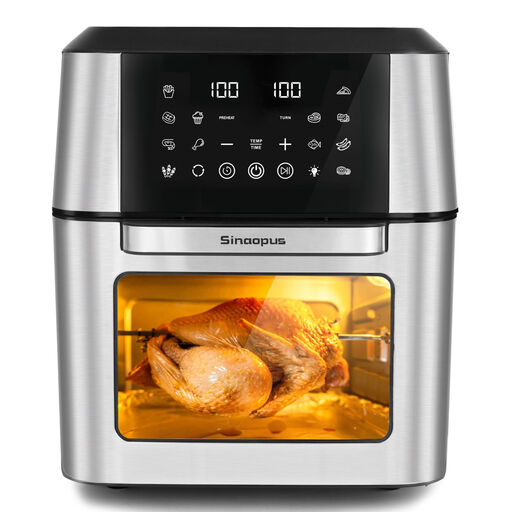 Image unavailable
Could suit you if you’re looking for a 2-in-1 appliance for baking and different portion sizes; check first that your dish fits inside the usable cooking space.
The product name specifies 1.800 W, a touchscreen, a timer and 12 programmes.
 Image unavailable
The description recommends this appliance for one or two people, so it’s less suitable for larger batch-cooking quantities.
The product name specifies 10 l and a temperature range of 100 to 230 °C.
No. Measure your dish, handles and filled height, then check the internal dimensions and the suitable shelf position. Rommelsbacher says the BG 1805/E can take round dishes up to 31.5 cm in diameter; that doesn’t automatically confirm that a rectangular casserole dish will fit.
Only if the instructions for your chosen model allow it with the available clearance. For certain Rommelsbacher models specifically named by the manufacturer, Rommelsbacher Support specifies at least 4 cm of clearance at the back and sides, with 100 cm of clear space above. Other appliances have their own requirements.
The German Federal Institute for Risk Assessment recommends dividing larger quantities between several shallow dishes so they cool quickly, chilling them to below 7 °C within a few hours, storing them in the fridge and eating them within two to three days. Plan how you’ll chill the portions separately from your choice of oven.
For appliances covered by the relevant harmonised EU rules, the manufacturer uses the CE mark to declare conformity. As the European Commission explains, it is not an independent quality mark. The German Federal Network Agency lists CE marking and German-language instructions among the checks used for market surveillance. The German Environment Agency notes that local collection points generally accept old electrical appliances free of charge.
Your statutory rights relating to faulty goods are against the seller; any additional guarantee is voluntary and subject to its own terms. The Verbraucherzentrale explains that, if a product is faulty, you can initially seek a remedy through repair or replacement.