Batch cooks with a large casserole dish
If you want to bake several portions in one go, measure your dish and check that the appliance will fit on your worktop too. Rommelsbacher Support lists a usable internal area of 34 × 28 cm for the BG 1805/E.


Choose a mini oven based first on the usable space for your casserole dish and how much you want to cook in each batch, rather than on its capacity in litres alone. A larger appliance may fit a bigger dish, but it will take up more worktop space; a compact model may be a better fit if you’re happy to use smaller dishes and, if necessary, cook in several batches. For storing food, the German Federal Institute for Risk Assessment recommends dividing larger quantities into several shallow containers to cool.
If you want to bake several portions in one go, measure your dish and check that the appliance will fit on your worktop too. Rommelsbacher Support lists a usable internal area of 34 × 28 cm for the BG 1805/E.
If you’re happy to bake smaller portions one after another, you can focus more on how much worktop space you have when choosing an appliance. Compare the external dimensions of the specific model with the space you have available.
If you’d like to cook other small dishes as well as casseroles, additional heating settings or functions may be useful. Even so, check first that your casserole dish will actually fit inside.
| What matters to you | What to look for | Who it matters most to |
|---|---|---|
| Casserole dish and batch size | Measure the outside of your dish, including the handles and height. Compare the dimensions with the usable space and the model’s shelf guidance; Rommelsbacher Support lists 34 × 28 cm of usable internal space for the BG 1805/E. | If I want to bake as many portions as possible at once, finding a dish that fits matters more than the capacity in litres. Around 36% of consumers put dish size and batch quantity first. |
| Heating settings for casseroles | Check whether you can select top and bottom heat and fan-assisted heat separately or together. The available heating settings alone don’t guarantee a particular result or mean that several dishes will fit at once. | If I want to choose the right setting for my casserole, I check the functions of the exact model. Around 29% of consumers rank the available heating settings as their most important buying consideration. |
| Worktop space | Measure the space you have available and take account of the appliance’s full dimensions, as well as its positioning and ventilation guidance. According to Rommelsbacher Support, the BG 1805/E is 55 cm wide including its feet. | If my worktop space is limited, the oven needs to fit there safely, even if that means planning to cook smaller batches. Around 21% of consumers prioritise the space available for the appliance. |
| Cleaning and running costs | Check the cleaning instructions and which parts can be removed. To compare electricity costs, consumption figures for a full cooking cycle are more useful than a single power rating. | If I use the oven often, I consider running costs as well as cleaning. Around 14% of consumers make maintenance and running costs their top buying consideration. |
The oven’s internal capacity and the usable space for a casserole dish are two different measurements. The dimensions of a baking tray don’t automatically tell you which dishes will fit on the rack either.
Measure the outside of your dish, including the handles, and compare it with the stated usable space, the rack and the shelf height.
The number of shelf levels alone doesn’t confirm that two tall, filled dishes will have enough room between them or are suitable for the appliance.
Before planning to use several levels, check the dish height, the distance from the heating elements and the instructions for the specific model.
The surface doesn’t show whether the casserole has heated through sufficiently. The German Federal Institute for Risk Assessment recommends heating food to at least 70 °C for two minutes throughout.
When reheating food later, remember to check the temperature inside the portion too.
A single power rating doesn’t tell you how much electricity a complete cooking cycle uses. The German consumer advice centre recommends looking at actual electricity consumption.
Only compare consumption figures measured on the same basis, and use your own electricity tariff to work out the cost.
The range includes different sizes for larger dishes and smaller batches.
The TO 2058 offers several heating settings and shelf levels for different types of cooking.
The KB M19 is a more compact option if you’re considering smaller dishes and cooking in several batches.
The Design Ofen Air Fry & Pizza 42815 is worth considering if you want additional functions alongside a mini oven.
The following Joybuy models are compact mini ovens in a range of sizes. Before buying, compare the dimensions of your dish with the details for the appliance, and consider cooking in several batches if you choose a smaller model.
 No image available
A compact option if you’re looking for a mini oven for baking and grilling; check the dimensions of your casserole dish first.
32 l; 1600 W; timer; temperature range 100–250 °C; crumb tray and accessories.
 No image available
The stated heating modes give you several settings to choose from. Check the dimensions of your casserole dish against the appliance specifications to make sure it will fit.
28 l; three heating modes: top heat, bottom heat or combined; 1600 W; 60-minute timer.
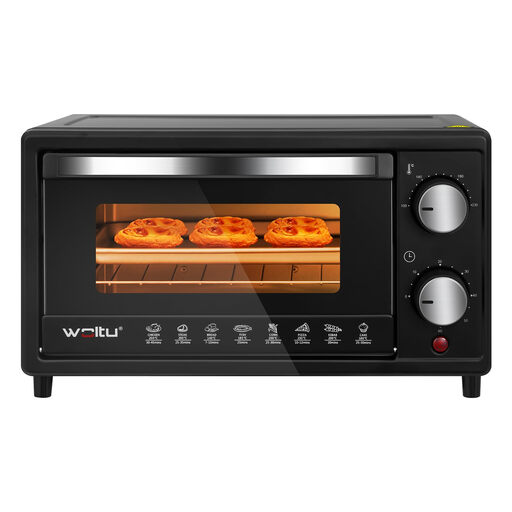 No image available
The product description recommends this model for smaller quantities for one or two people. You may need to cook in several batches if you’re making portions to freeze.
10 l; top and bottom heat; temperature range 100–230 °C; timer; pizza function.
No, the capacity in litres alone isn’t enough. Measure the outside of your dish, including the handles, and compare it with the usable space, the rack and the shelf height. For example, Rommelsbacher Support lists 34 × 28 cm of usable space for the BG 1805/E and recommends using a slightly smaller dish.
The German Federal Institute for Risk Assessment recommends dividing larger quantities of food into several shallow containers to cool, then chilling them to below 7 °C within a few hours.
The German Federal Institute for Risk Assessment recommends heating food to at least 70 °C for two minutes throughout. For a thick portion, check the temperature in the centre too; a browned surface alone won’t tell you reliably whether it has heated through.
It depends on the requirements for the specific model. Check the positioning and ventilation guidance in the instructions, and measure the space available. According to Rommelsbacher Support, the worktop for the BG 1805/E must be at least as wide as the appliance itself: 55 cm including its feet.
When you buy from a business seller in the EU, you’re generally entitled to a minimum two-year legal guarantee from the date you receive the goods. The seller is responsible for this. Any additional manufacturer’s guarantee is separate.