Home cooks short on worktop space
If worktop space is limited, you’ll need to consider not only the appliance’s external dimensions but also the clearances required for your chosen model.


Choose a mini oven based on whether the tray is big enough for your portion of beetroot and whether you can position the appliance safely, leaving the clearances specified by the manufacturer – not simply on its capacity in litres. For larger portions, usable tray area and suitable heating modes matter more than lots of extra features. A smaller appliance may be a better fit when space is tight, but you may need to cook in several batches.
If worktop space is limited, you’ll need to consider not only the appliance’s external dimensions but also the clearances required for your chosen model.
If you want to cook more beetroot wedges at once, compare the tray and usable internal dimensions rather than relying on the capacity in litres alone.
If you use it regularly, suitable heating modes, a timer and removable parts that are easy to clean may be important. The wattage alone doesn’t tell you how much electricity a cooking session uses.
When choosing a mini oven for beetroot wedges in a small kitchen, the main considerations are where you’ll put it, portion size, control over cooking and ease of cleaning.
| Consideration | What to check before buying | Who will value this? |
|---|---|---|
| A safe place to put it | Check the external dimensions and the model-specific clearances from walls and overhead units in the instructions. | If worktop space is tight, I’ll measure the appliance and allow for the clearances in the instructions too. Around 36% of consumers may put having a safe place for it first. |
| Tray space and portion size | Compare the tray and internal dimensions with the amount you want to cook. Steba gives the KB M19’s internal dimensions as 23.5 × 31 × 25.5 cm (H × W × D); the manufacturer’s stated maximum dish diameter isn’t a substitute for tray dimensions. | If I want to spread the wedges out on one tray, I’ll compare its usable area with my portion size. Around 29% of consumers may focus mainly on portion size and tray area. |
| Heating mode and timer | Check the specific model’s top and bottom heat, temperature settings and timer. An NDR recipe for quartered beetroot gives 200 °C using top and bottom heat and a cooking time of around 30–45 minutes; this isn’t a set cooking time for every mini oven. | If I want to control how my food cooks, I’ll check that the heating mode and timer suit my recipe. Around 21% of consumers may give the greatest weight to the available controls. |
| Cleaning and running costs | Compare what’s included, which parts are removable and the cleaning instructions. For comparing electricity costs, kWh figures for similar cooking sessions are more useful than wattage alone; the Verbraucherzentrale recommends taking actual consumption into account. | If I use the oven often, I want to be able to clear away crumbs and splashes easily and get a realistic idea of its energy use. Around 14% of consumers may prioritise cleaning and running costs. |
For the Rommelsbacher BG 1055/E, the manufacturer specifies not only an appliance width of 44 cm, but also 4 cm of clearance at the sides and 1 m above for ventilation. These positioning requirements apply to this model and don’t automatically apply to other ovens.
Before choosing a model, check the instructions for your chosen appliance against the space you actually have.
Oven capacity, internal dimensions and the maximum dish diameter are different things. A capacity in litres alone won’t tell you how many wedges will fit on a tray.
Compare the tray and internal dimensions with your portion. Don’t mistake a stated dish diameter for the tray dimensions, and allow for several batches if needed.
The rated power doesn’t directly show how much electricity it takes to cook the same amount of beetroot.
To compare costs, you’ll need consumption figures in kWh for similar cooking sessions and your own electricity tariff.
The BG 1055/E is a mini oven with an 18 l capacity and selectable fan-assisted cooking. According to the manufacturer, the BGE 1580/E offers 30 l, making it a different option for those with different space and portion requirements.
According to the manufacturer, the KB M19 offers 19 l, optional fan-assisted cooking and published internal dimensions that you can compare with your chosen dish or tray.
According to the manufacturer, the TO 20 SilverStyle is a freestanding oven with a capacity of around 20 l, fan-assisted cooking, and top and bottom heat.
The TO 2052 is a 9 l option without fan-assisted cooking; according to the manufacturer, the TO 2068 offers 20 l and fan-assisted cooking.
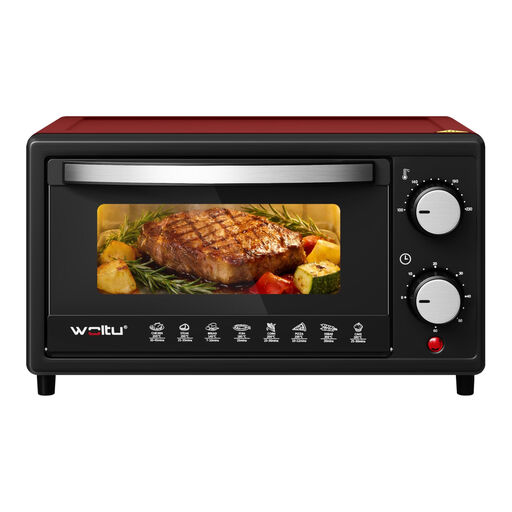
The following Joybuy options include mini ovens with baking functions, in a range of capacities and with different features. For each appliance, compare the external dimensions and positioning requirements with the space you have available.
 No product image available
An option if you want to set the temperature and cooking time, then clear away crumbs after use.
Capacity: 32 l; temperature range: 100–250 °C; 60-minute timer; removable crumb tray. Stated external dimensions: 52.3 × 36 × 32.2 cm.
 No product image available
The smaller capacity may suit small portions. Before buying, check that the appliance and the required clearances will fit on your worktop.
Capacity: 10 l; stated external dimensions: 37 × 26.5 × 21 cm; top and bottom heat; temperature range: 100–230 °C; timer up to 60 minutes; baking tray.
 No product image available
An option if you want to choose between top heat, bottom heat and a combination of both.
Capacity: 28 l; temperature range: 100–230 °C; three heating modes; 60-minute timer. Before buying, check the specific appliance’s external dimensions and positioning requirements.
An NDR recipe for quartered beetroot suggests 200 °C using top and bottom heat, for around 30–45 minutes, turning the pieces halfway through. Check that the wedges are tender in your mini oven, as the recipe’s cooking time isn’t a set requirement for every appliance.
Only if you can meet the positioning requirements for the specific model. Rommelsbacher requires 4 cm of clearance at the sides and 1 m above the BG 1055/E for ventilation; other appliances have their own manufacturer’s requirements.
Compare the energy use in kWh for cooking sessions that are as similar as possible, and calculate the cost using your price per kWh. The wattage alone doesn’t tell you how much electricity a mini oven uses to cook a particular portion of beetroot.
Electrical appliances covered by the Low Voltage Directive must meet the relevant EU requirements. The manufacturer is responsible for applying the CE marking, which isn’t an independent quality mark. According to the Bundesnetzagentur, traders must check the marking and any required German-language documentation.
Your statutory rights against the seller are separate from any voluntary manufacturer’s guarantee. According to the Verbraucherzentrale, if a product is faulty, consumers can initially request that the seller puts things right, for example by repairing or replacing it.