If you’re baking with a clafoutis dish you already own
If you want to use your dish to make several lunch portions, check that its diameter, handles and height will fit in the oven cavity.


First, measure your baking dish, including its handles and height. For the recipe we researched, which uses a dish about 22 cm in diameter, you’ll need an oven cavity that can actually fit it; with a smaller appliance, you’ll need to adjust the dish size and recipe quantity. The recipe calls for conventional top and bottom heat, but the oven setting alone doesn’t prove that the egg mixture has been heated sufficiently throughout. Also check the required clearance around the appliance and plan how you’ll keep your lunch portion chilled afterwards.
If you want to use your dish to make several lunch portions, check that its diameter, handles and height will fit in the oven cavity.
For smaller baking projects, consider not only the appliance dimensions but also the clearance specified in the instructions for the model you’re considering.
If you’re baking something to eat later, your plan should include heating it thoroughly, cooling it promptly and keeping it chilled while you’re out – whatever oven you choose.
The recipe from Tanja’s gluten-free cookbook uses a dish about 22 cm in diameter and specifies conventional top and bottom heat at 180 °C for approximately 45 minutes. These details apply to the recipe and are not a confirmed cooking time for every mini oven model.
| What you need | What to check before buying | Who should pay particular attention? |
|---|---|---|
| Dish size and portion quantity | Compare the dish’s external dimensions, including handles and height, with the oven’s internal dimensions and the maximum dish size specified for that model. ROMMELSBACHER specifies up to 25 cm for the BG 1055/E and up to 20 cm for the BG 950; CASO Design specifies up to 27 cm for the TO 20 SilverStyle. | If I want to use a dish I already own to make several lunch portions, it needs to fit with its handles and height. Around 33% of consumers say that dish and portion size are their main consideration. |
| Heating method and cooking time | Check for conventional top and bottom heat, temperature control and a timer. The recipe specifies around 45 minutes; a shorter timer may mean you need to reset it. Check whether the centre is cooked independently of the oven setting. | If I’m baking an egg mixture from a recipe, I want to be able to control the heating method and cooking time without mistaking the recipe’s timings for a guaranteed cooking time. Around 27% of consumers say baking controls are their main consideration. |
| A safe place to put it | Take account of the appliance’s external dimensions, the space needed to open the door and the clearance specified in the instructions for that model. The BG 950 instructions specify at least 4 cm on all sides and 1 m above; the Steba KB M19 instructions require 10 cm between the back of the appliance and the wall and state that it must not be built in. | If I have little free worktop space, I need a spot where the appliance can sit with the required clearance around it. Around 20% of consumers say a safe place to put the appliance is their main consideration. |
| Storing lunch | Heat the clafoutis thoroughly after baking, cool it promptly if it will be stored for longer, and plan how to keep it chilled in transit. The German Federal Institute for Risk Assessment (BfR) recommends heating food to at least 70 °C for 2 minutes throughout and keeping perishable food chilled at between 2 °C and no more than 7 °C. | If I’m eating the bake later, I need to plan for cooling and keeping it chilled while I’m out, as well as baking it. Around 20% of consumers say storing lunch is their main consideration. |
The oven’s capacity alone won’t tell you whether a dish will fit with its handles and enough room for its height. The recipe uses a dish about 22 cm in diameter; the manufacturer specifies a maximum of 20 cm for the ROMMELSBACHER BG 950.
Measure your oven-safe dish, including its handles and height, and compare those measurements with the specifications for the exact model.
If the dish doesn’t fit, you may need a smaller one or to bake smaller batches.
The instructions for your chosen model may specify additional clearance for ventilation. According to its instructions, the Steba KB M19 must not be used as a built-in oven.
Before buying, compare the available space with the appliance dimensions and the positioning requirements in the instructions.
A recess that doesn’t meet these requirements may not be suitable for the appliance.
The selected temperature and cooking time don’t prove that egg-based clafoutis has been heated sufficiently throughout. The BfR recommends heating food to at least 70 °C for 2 minutes throughout.
Check whether it is cooked through. If you’ll be storing it for longer, cool it promptly to below 7 °C and keep it chilled continuously until you eat it, as recommended by the BfR.
The models considered here accommodate different dish sizes: according to the manufacturer, the BG 950 is suitable for dishes up to 20 cm, the BG 1055/E for dishes up to 25 cm and the BGE 1580/E for dishes up to 29 cm.
The TO 20 SilverStyle is a freestanding model with an oven capacity of around 20 litres. The manufacturer specifies dishes up to 27 cm.
According to the manufacturer, the KB M19 combines a 19-litre oven capacity with independently selectable top and bottom heat, plus optional fan-assisted cooking.
According to the manufacturer, the TO 2068 is an oven and toaster with a capacity of around 20 litres and a fan-assisted setting.
This selection includes compact ovens and an air fryer with a mini oven function. For every model, check separately that your dish will fit with its handles and height; the stated temperature range alone doesn’t confirm that the dish will fit or guarantee the baking result.
 No image available
A compact option for smaller baking projects, provided your chosen dish fits in the oven cavity.
10 L; top and bottom heat; 100–230 °C; 60-minute timer; external dimensions 37 × 26,5 × 21 cm.
 No image available
Useful for baking projects where several shelf positions come in handy; make sure you measure your dish first.
28 L; three heating modes and three shelf positions; top heat, bottom heat and combined heating; 100–230 °C; 60-minute timer.
 No image available
An option for baking projects where a larger oven cavity may be useful; check that your dish fits and that you have a safe place for the appliance before buying.
32 L; 1.600 W; 100–250 °C; 60-minute timer; removable crumb tray.
 No image available
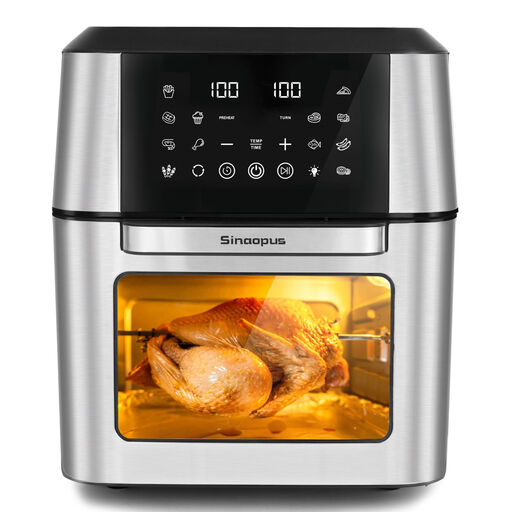
A combination appliance for baking, if the mini oven function suits your needs and your dish fits inside.
12 L; 1.800 W; 80–200 °C; 12 programmes; touchscreen; timer function.
Measure the widest part of your oven-safe dish, including the handles, as well as its height. The recipe from Tanja’s gluten-free cookbook uses a dish around 22 cm in diameter; the manufacturer specifies dishes up to 20 cm for the ROMMELSBACHER BG 950, up to 25 cm for the BG 1055/E and up to 27 cm for the CASO TO 20 SilverStyle.
The recipe gives these settings for a preheated oven using conventional top and bottom heat; they are not a confirmed cooking time for any particular mini oven model. Pay particular attention to the centre of the egg-based bake: the BfR recommends heating food to at least 70 °C for 2 minutes throughout.
Follow the instructions for your specific appliance. For the ROMMELSBACHER BG 950, they specify at least 4 cm of clearance on all sides and 1 m above; for the Steba KB M19, they specify 10 cm between the back of the appliance and the wall and state that it must not be built in. Let the appliance cool before cleaning and follow the care instructions; the ROMMELSBACHER BG 1055/E is listed as having a removable crumb tray.
If you’re storing it for longer, the BfR recommends cooling hot food promptly to below 7 °C. Perishable food should be stored at between 2 °C and no more than 7 °C, and kept chilled while you’re out. These are food hygiene recommendations, not a cooling function of the oven.
Electrical appliances must not go in household waste; they need to be collected separately. The German Environment Agency lists local recycling centres as one option for disposal. If you’re returning an appliance to a retailer, check the retailer’s individual acceptance conditions.