For smaller portions and kitchens without a suitable built-in space, a mini oven with a fan is an obvious option. For larger dishes or several portions, a built-in oven may be more suitable, provided it fits the available housing space. The key things to check are the usable internal dimensions, the dish and its handles, and the right place to position or install the oven. The Federal Institute for Risk Assessment recommends heating food to 70 °C for at least two minutes throughout, and checking the temperature with a food thermometer if in doubt.
Which type of oven is right for you?
For cooks making smaller portions
If you usually cook one or two portions after your weekly shop, compare your existing dish with the mini oven’s internal dimensions. The manufacturers’ specifications for the Steba KB M19 and Rommelsbacher BGE 1580/E show why usable dimensions – or a stated dish size – matter.
For cooks making larger family portions
For larger oven dishes, check the capacity of the oven and the dimensions of the housing space for the specific built-in model. Bosch lists a usable capacity of 71 l for the HBA514BB3, but that alone doesn’t confirm that every dish will fit.
For buyers focused on safety and cleaning
If you’re using raw sausage, make sure it’s heated all the way through: a browned surface doesn’t prove that every part has reached a high enough temperature. Cleaning aids and removable parts also vary by model.
What to look for when buying
Freestanding mini oven with a fan
A good fit if: you’re cooking smaller portions or don’t have a suitable built-in space. Steba lists a 19 l interior for the KB M19; Rommelsbacher says the BGE 1580/E can accommodate dishes up to 29 cm in diameter.
The trade-off: The oven’s capacity limits the size of dish and portions you can cook. The capacity in litres alone doesn’t prove that a particular dish will fit.
Built-in fan oven
A good fit if: you have a suitable built-in space and regularly cook larger dishes or several portions. Bosch lists a 71 l usable capacity and fan cooking for the HBA514BB3.
The trade-off: The appliance must fit the housing space. Also compare the heating functions available on the specific model.
The Federal Institute for Risk Assessment recommends heating food to at least 70 °C for two minutes throughout when cooking or reheating it. If you’re unsure, a food thermometer can help you check the temperature.
| Buying criterion |
What to check before buying |
Who it matters most to |
| Smaller portions |
Measure the dish, including its handles, and compare it with the usable internal dimensions and shelf position of the exact model. |
If I usually cook just one or two portions, I don’t want to choose an oven whose usable capacity won’t fit my dish. Around 28% of consumers prioritise smaller portions. |
| Larger oven dish |
Compare the dish, including its handles, with the oven cavity and shelf; for built-in ovens, also check the appliance and housing dimensions. |
If I’m cooking for several people, I need room for a larger dish without packing it too tightly. Around 22% of consumers prioritise larger portions. |
| Cooking raw sausage through |
Check the model’s heating functions and temperature controls; if in doubt, use a food thermometer to check that the food is cooked through. |
When cooking raw sausage, I want to make sure the pieces in the middle are heated sufficiently too; a browned surface isn’t enough to confirm this. Around 22% of consumers prioritise being able to check that food is cooked through. |
| Position or installation location |
For a worktop oven, check its external dimensions and positioning guidance; for a built-in model, compare the housing dimensions and connection requirements with the model documentation. |
If worktop or built-in space is limited, the oven needs to fit in the intended spot. Around 17% of consumers consider the available kitchen space first. |
| Energy use and cleaning |
For ovens with the relevant energy label, compare consumption per standard cycle and oven capacity; check the cleaning system and removable parts for the specific model. |
If the oven will be used often, I want to take energy use and cleaning effort into account when choosing. Around 11% of consumers prioritise ongoing running and maintenance costs. |
Common buying and usage mistakes
-
Confusing oven capacity with dish fit
The capacity in litres describes the oven cavity, not the usable width at the shelf level you want to use.
Measure the dish, including its handles and height, then compare its dimensions with the specifications for the exact model.
You may need to buy another dish that fits.
-
Comparing energy labels for built-in and worktop ovens without checking
The Federal Environment Agency describes standardised capacity and energy consumption per cycle figures for ovens covered by the scheme. Rommelsbacher says its mini ovens weighing less than 18 kg don’t carry this EU energy label.
Only compare energy figures when they’re based on the same measurements, and consider the stated consumption if you’ll use the oven frequently.
-
Assuming a browned top means the food is cooked through
A browned surface doesn’t show whether raw sausage has been heated sufficiently throughout.
The Federal Institute for Risk Assessment recommends heating food to at least 70 °C for two minutes throughout. If in doubt, check the temperature with a food thermometer.
Brands to consider
Steba
Worktop ovens for smaller portions; Steba lists a 19 l interior and optional fan cooking for the KB M19.
- Steba lists top and bottom heat, a timer and removable accessories for the KB M19.
- The internal dimensions of 23,5 × 31 × 25,5 cm are more useful for checking whether a dish will fit than capacity alone; a larger dish may be too big.
Rommelsbacher
Worktop ovens in a range of sizes; Rommelsbacher lists a 30 l capacity and dishes up to 29 cm in diameter for the BGE 1580/E.
- For this model, the manufacturer lists several heating functions, a removable crumb tray and a dismantlable door.
- The dish specification applies to the stated diameter and doesn’t confirm that every rectangular dish will fit.
Severin
Mini ovens for compact kitchens; Severin lists a capacity of around 20 l and fan cooking for the TO 2068.
- For the TO 2068, the manufacturer lists an interior light, plus top and bottom heat and fan cooking, which can be switched on separately or together.
- These specifications apply to the model named; check whether your dish will fit using its usable dimensions.
Bosch
Built-in ovens for kitchens with a suitable housing space; Bosch lists a 71 l usable capacity, fan cooking and a full-width grill for the HBA514BB3.
- For this model, Bosch lists a hydrolytic cleaning aid for light soiling, as well as specific appliance and housing dimensions.
- The cleaning aid isn’t presented as a substitute for all manual cleaning.
AEG
Built-in ovens with different cleaning options; AEG lists fan cooking, a 72 l capacity and pyrolytic cleaning for the OU5PB40WSM.
- For this model, AEG specifies a connected load of 3490 W and installation dimensions of 590 × 560 × 550 mm.
- These specifications apply to the OU5PB40WSM and not to all AEG ovens.
Joybuy products
The Joybuy products below include built-in ovens and freestanding worktop ovens. Compare the dimensions of your dish, the available space and the heating function of each model with your needs.
 No image available
Bosch HBA571BB4 Series 2 built-in oven
This model may be suitable as a built-in oven if you have a suitable housing space and want fan cooking.
The product name lists a 71 l capacity, 3D hot air, pyrolytic self-cleaning, AutoPilot 10 and LED touch controls. Plan the installation and connection using the product documentation.
Joybuy
 No image available
WOLTU BF12sz Mini Oven
This worktop oven is an option if you’re looking for a freestanding appliance for baking and grilling.
The product name lists a 32 l capacity, 1600 W, a temperature range of 100 to 250 °C, a timer and a crumb tray.
Joybuy
 No image available
WOLTU Mini Convection Oven, 28 litres
This freestanding mini fan oven may suit you if you’re looking for a worktop model rather than a built-in appliance.
The product name lists a 28 l capacity, temperature control and a timer. Before buying, check that your dish will fit in the usable oven space.
Joybuy
 No image available
HAUSWIRT C40 Smart Convection Oven
This worktop oven is an option if you’re considering fan cooking and an integrated thermometer.
The product name lists a 35 l capacity, a four-level baking rack and an LED display. Check that the appliance dimensions and usable shelf height suit your dish.
Joybuy
 No image available
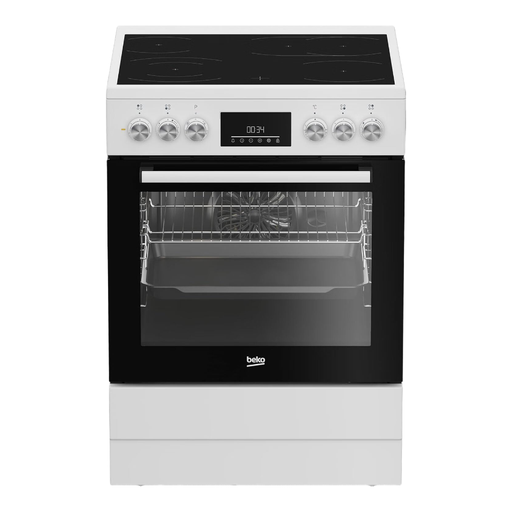
Beko FBM67320WS freestanding oven
This model may suit you if you’re looking for a freestanding appliance with a larger oven cavity and fan cooking.
The product name lists 60 cm, a 72 l capacity, SteamShine steam cleaning, eight cooking functions and energy class A. According to the product information, installation and electrical connection must be carried out by a qualified professional.
Joybuy
Frequently asked questions
How can I tell if my oven dish will fit in a mini oven?
Compare the dish, including its handles and height, with the usable internal dimensions and shelf positions of the exact model. The 30 l capacity Rommelsbacher lists for the BGE 1580/E, or the 19 l capacity Steba lists for the KB M19, doesn’t by itself confirm that a rectangular dish will fit.
Is a browned crust enough if the bake contains raw sausage?
No. The Federal Institute for Risk Assessment recommends heating food to 70 °C for at least two minutes throughout when cooking it. If in doubt, check the temperature with a food thermometer.
Does every mini oven need the same EU energy label as a built-in oven?
No. The Federal Environment Agency describes the energy label for ovens covered by the scheme, with details of oven capacity and energy consumption per cycle. Rommelsbacher says its mini ovens weighing less than 18 kg don’t carry this EU energy label, so the absence of an energy rating doesn’t provide a specific measure of energy use.
What should I do if an oven is faulty or old?
The Consumer Advice Centre distinguishes between your statutory rights against the seller and a voluntary guarantee. Old electrical appliances shouldn’t go in household rubbish; local collection points accept them free of charge.


