For cannelloni, a mini oven is suitable if your baking dish, including its handles, fits on the usable rack, through the opening and within the available height. Capacity in litres alone isn’t enough to tell you. A compact oven may be sufficient for smaller dishes, while larger portions need more usable space and a suitably safe place to put the oven. The heating mode needs to match the recipe; a higher wattage doesn’t prove that an oven will bake better or cost less to run.
Which mini oven is right for you?
If you already have a baking dish
If you want to keep using your cannelloni dish, compare its external dimensions, including the handles and height, with the usable oven space. Rommelsbacher Support gives the BG 1805/E a usable interior area of 34 × 28 cm and recommends using a slightly smaller baking dish.
If you’re cooking several portions
If you want to cook a larger quantity at once, the right dish and the oven’s actual usable space are what matter. Rommelsbacher offers the 30-litre BG 1550 and the 42-litre BG 1805/E; the larger model needs more worktop space.
If worktop space is limited
If your worktop is short on space, check the door opening and safe positioning requirements as well as the appliance dimensions. Rommelsbacher Support gives the BG 1805/E an overall width of 55 cm, including its feet.
What should you look for when buying?
For cannelloni, the key things to consider are whether your dish fits, how much you need to cook, whether you have a safe place for the oven, the right heating mode, and how it operates and is cleaned.
Compact ovens around 20 litres
A good choice if: You have a small dish that you’ve measured to make sure it fits, and want to save worktop space.
Things to note: The manufacturer says the Severin TO 2067 doesn’t have a fan-assisted setting; the Steba KB 27 U.2 has continuous fan-assisted operation.
Ovens with a capacity of 26 to 30 litres
A good choice if: You want to choose between conventional heat and fan-assisted cooking, and your dish fits in the specific oven.
Things to note: CASO gives the TO 26 SilverStyle’s interior dimensions as 350 × 200 × 300 mm (W × H × D). The Rommelsbacher BG 1550’s baking tray dimensions don’t prove that a baking dish of the same size will fit.
Larger 42-litre ovens
A good choice if: You regularly bake more cannelloni in a suitable dish and have enough room for a larger appliance.
Things to note: Rommelsbacher gives the BG 1805/E’s external dimensions as 54,5 × 43 × 36 cm (W × D × H); refer to the manual for the clearances needed when positioning it.
| What matters |
What to check before buying |
Who is it important to? |
| Whether your baking dish fits |
Measure the external dimensions, including the handles and height; compare them with the rack space, oven opening and clearance from the heating elements. |
If I want to keep using my existing dish, I’ll check its dimensions first instead of looking only at the capacity in litres. Around 31% of consumers put a good fit for their dish first. |
| Portion size |
Decide how much you need to cook and what size dish you need; don’t assume the oven’s tray dimensions mean a baking dish of the same size is guaranteed to fit. |
For several portions, I want to know whether my dish will hold the amount I need, without choosing an oven with more space than necessary. Around 25% of consumers prioritise the amount they need to cook. |
| A safe place for the oven |
Check the appliance and feet dimensions, the door’s swing area and the ventilation requirements for the specific model. |
If my worktop space is limited, I need to check in advance that the oven can sit there safely and that the door can open. Around 19% of consumers need to make sure they have a suitable place for the oven before anything else. |
| A heating mode that suits the recipe |
Check that the heating mode specified in the recipe is available on the model you’re considering. |
For my cannelloni recipes, I want to be able to select the recommended heating mode rather than automatically applying the same temperatures across different modes. Around 13% of consumers put the recipe’s heating mode first. |
| Running and cleaning |
For cost comparisons, use comparable kWh readings per baking session; check which parts can be removed and read the care instructions. |
If I bake regularly, I look for clear consumption figures and want to know how easy it is to clean the interior if sauce spills over. Around 12% of consumers prioritise running costs and cleaning. |
Common buying mistakes
-
Choosing by capacity in litres or pizza diameter alone
A rectangular dish might not fit, even if the oven has a large interior or lists a maximum size for round baking tins. The handles and height can matter too.
Compare your fully measured dish with the rack space, oven opening and interior height of the specific model.
-
Assuming the appliance dimensions are all the space you’ll need
A freestanding oven needs the clearances specified in its manual as well as space for its base. Rommelsbacher Support gives the BG 1805/E an overall width of 55 cm, including its feet.
Check your worktop, cupboards, door opening and the positioning requirements for the specific model together.
-
Using wattage or the absence of an energy label to compare running costs
The rated power doesn’t tell you how much energy a complete cannelloni baking session will use. The European Commission excludes small and portable ovens from the scope of the EU oven energy label considered here.
Compare only kWh readings for the same baking session, and factor in your own electricity tariff.
Brands to consider
Rommelsbacher
Freestanding ovens in a range of sizes, including 30- and 42-litre models.
- The manufacturer says the BG 1550 and BG 1805/E offer conventional heat and fan-assisted settings.
- Rommelsbacher Support gives the BG 1805/E a usable baking area of 34 × 28 cm and recommends a slightly smaller dish. The larger appliance takes up more space. Manufacturer claims aren’t independent baking tests.
CASO Design
The TO 26 SilverStyle is a 26-litre freestanding option with published interior dimensions.
- CASO gives the interior dimensions as 350 × 200 × 300 mm (W × H × D), and lists fan-assisted and conventional heating.
- The manufacturer’s claim that it fits round baking tins up to 30 cm in diameter doesn’t prove that every rectangular baking dish will fit.
Severin
The TO 2067 is a compact 20-litre oven for baking and toasting.
- The manufacturer says the top and bottom heating elements can be switched on separately or together; a 60-minute timer is also listed.
- The TO 2067 isn’t listed as having a fan-assisted function. Its suitability for round tins doesn’t mean your own rectangular baking dish will fit, so measure it first.
Steba
The KB 27 U.2 is a 20-litre model with documented interior dimensions.
- Steba gives the interior dimensions as 22 × 30 × 31 cm (H × W × D) and lists continuous fan-assisted operation.
- Before choosing this model, compare the interior dimensions with the external dimensions and height of your own dish.
Joybuy products
The following Joybuy picks are mini ovens with capacities of 10, 28 and 32 litres. Whether your cannelloni dish fits will also depend on the usable space, oven opening and interior height.
 No image available
Woltu BF12sz mini oven, 32 litres, black and red
An option if you’re looking for a mini oven for baking and your dish fits in the usable interior.
32 litres; 1600 W; temperature range 100 to 250 °C; 60-minute timer. The product name also mentions a removable crumb tray.
View at Joybuy
 No image available
Woltu mini oven, 28 litres, black
An option if you’re looking for a 28-litre oven with a choice of heating modes and will check that your dish fits first.
28 litres; temperature range 100 to 230 °C; top heat, bottom heat or both together. The product description says it’s designed for meals for 3–4 people.
View at Joybuy
 No image available
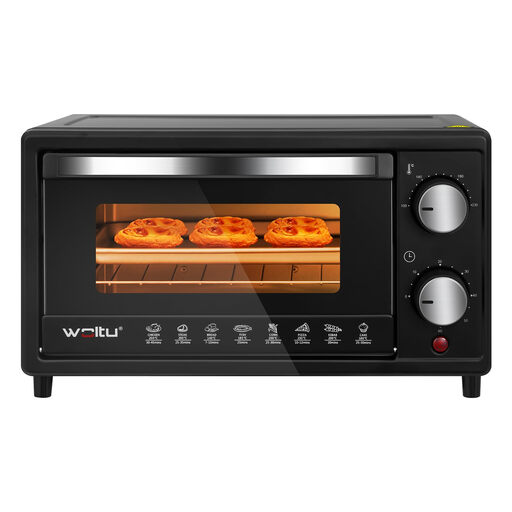
Woltu mini oven, 10 litres, black
A compact option for smaller quantities, as long as your cannelloni dish fits inside; the description says it’s designed for 1–2 people.
10 litres; temperature range 100 to 230 °C; top and bottom heat.
View at Joybuy
Frequently asked questions
Will a 25 × 20 × 5 cm cannelloni dish fit in any 20-litre oven?
No. These dimensions come from one recipe example and aren’t a general minimum size. Measure the handles and rim of your dish too, then check the usable rack space, oven opening and clearance from the heating elements in the model you’re considering.
Can I use the temperature from a fan-assisted recipe unchanged with conventional heat?
Don’t use the same temperature without checking if you change the heating mode. Follow the recipe’s instructions for the heating mode you’re actually using, and keep an eye on the dish as it bakes.
What should I bear in mind when positioning and cleaning the oven?
Follow the safety and ventilation instructions for your exact model rather than copying the clearances for another appliance. Let the oven cool before cleaning and check which parts can be removed; for example, Rommelsbacher says the BG 1550 has a removable crumb tray.
Can I work out the electricity cost per bake from the wattage or energy label?
No. To work out the cost, you’ll need the actual consumption in kWh for a comparable baking session and your electricity tariff. The European Commission excludes small and portable ovens from the scope of the EU oven energy label considered here, so the absence of a label doesn’t in itself tell you how efficient an oven is.
What are the rules in Germany if the oven breaks or needs disposing of?
The statutory warranty from the seller is different from a voluntary guarantee, as the Verbraucherzentrale explains. You mustn’t put an old electric oven in household waste; the Umweltbundesamt points to suitable collection or take-back options.


