Households eating at different times
If you won’t all be eating at the same time, plan how to keep later portions safely hot, or cool and reheat them thoroughly later.


Choose a mini oven based first on the outside dimensions of your baking dish and how much you want to cook in each batch – not just its capacity in litres. If people will be eating at different times, you’ll need either a reliable way to check that food is being kept hot or a plan to cool it quickly and reheat it thoroughly later. A keep-warm setting alone doesn’t prove that the whole dish will stay safely hot.
If you won’t all be eating at the same time, plan how to keep later portions safely hot, or cool and reheat them thoroughly later.
If you’re cooking several portions in one dish, compare its outside dimensions with the usable interior space of the specific oven.
For smaller batches, consider not only the appliance’s dimensions but also the size of the dish and a suitable spot for your freestanding oven.
If meals are served at different times, consider whether your dish will fit and how many portions you need, alongside how you’ll store later portions safely.
| What matters | What to check before buying | Who is it important to? |
|---|---|---|
| Later portions | Check whether you can monitor the temperature of the food. If not, plan to cool it quickly and reheat it thoroughly later. | If I need to serve cannelloni later, I want to know how to store it safely. Around 33% of consumers put keeping later portions safe first. |
| Dish size and portion quantity | Measure the dish’s width, depth and height, including the handles, and compare them with the model’s interior dimensions and shelf positions. | If I want to bake several portions together, my dish needs to fit properly. Around 27% of consumers prioritise dish size and portion quantity. |
| Cooking and browning | Compare the specific model’s top and bottom heat, fan-assisted setting if available, temperature range and timer. The temperature you set isn’t the temperature inside the food. | If I want to control the cooking time and browning to suit the recipe, the available heating modes matter to me. Around 27% of consumers say that controlling baking and browning is their top concern. |
| Space, cleaning and running costs | Check the appliance’s outside dimensions and placement instructions, removable parts and cleaning instructions. The wattage alone doesn’t tell you how much energy a baking session will use. | If I have limited worktop space, I also want to consider how much cleaning is involved. Around 13% of consumers prioritise space and cleaning requirements. |
A programme label doesn’t prove that the centre of every cannelloni portion reaches and stays at least 60 °C. The German Federal Institute for Risk Assessment (BfR) recommends keeping food at a minimum of 60 °C throughout when holding it hot.
Only plan to keep food hot if you can reliably check its temperature. Otherwise, cool the portions quickly and reheat them thoroughly later.
The capacity, or a stated size for round dishes, doesn’t tell you the full width, depth and height of a rectangular baking dish.
Measure the dish, including its handles, and compare all its outside dimensions with the model’s stated usable interior space.
If the dish doesn’t fit, you may need another one or have to plan for several batches.
The wattage isn’t a measurement of how much electricity a particular batch of cannelloni will use.
Only compare energy use for similar cooking sessions, and take into account how many batches you’ll need.
Rommelsbacher lists a capacity of 30 l and a maximum baking dish diameter of 29 cm for both the BG 1550 and BGE 1580/E.
Steba lists the KB M19 as having a 19-litre interior, measuring 31 × 25,5 × 23,5 cm (W × D × H).
Severin lists the TO 2068 as having a 20 l capacity, fan-assisted cooking, and top and bottom heat that can be switched on separately or together.
CASO Design lists the freestanding TO 26 SilverStyle as having a 26 l capacity and interior dimensions of 350 × 200 × 300 mm (W × H × D).
The Joybuy products below are mini ovens for planned baking sessions, in a range of appliance sizes. Before buying, compare the outside dimensions of your baking dish with the specific model’s interior. The capacity in litres alone doesn’t confirm that it will fit.
 No image available
For a planned baking session, this model offers an adjustable temperature and a timer. Check separately that your dish will fit.
32 l; 1600 W; 100–250 °C; 60-minute timer; crumb tray; listed for baking and grilling.
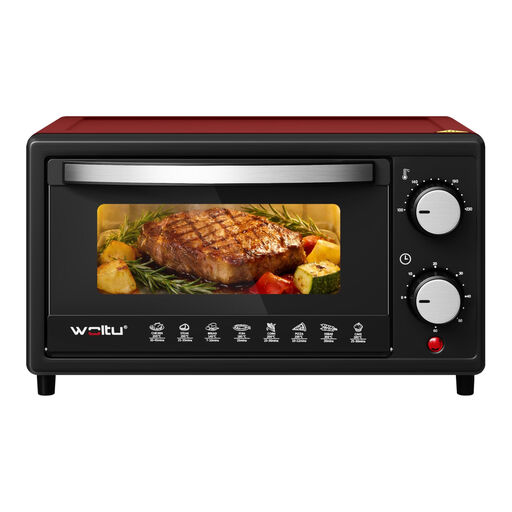 No image available
Its compact design is useful for smaller batches. Measure your baking dish, including the handles, before choosing this model.
10 l; 100–230 °C; pizza function; described as suitable for 1–2 people and equipped with a 60-minute timer.
 No image available
If you want to choose the heating mode for a particular baking session, the product description lists separate or combined heating options. You’ll need to check separately whether your dish will fit.
28 l; temperature control; top heat, bottom heat or both together; mechanical 60-minute timer with audible signal.
Only if the food stays at a minimum of 60 °C throughout. The German Federal Institute for Risk Assessment (BfR) recommends this temperature for keeping food hot; a keep-warm setting doesn’t guarantee it. For longer storage, the BfR recommends cooling hot food quickly to below 7 °C and keeping perishable food refrigerated.
According to the BfR, heat it to at least 70 °C throughout for at least two minutes. Check the food itself, as the oven’s set temperature isn’t the same as the temperature inside the food.
Not necessarily. Compare the width, depth and height of your dish, including its handles, with the usable interior dimensions and shelf positions. Rommelsbacher’s stated maximum baking dish diameter of 29 cm for the BG 1550 and BGE 1580/E doesn’t describe a rectangular base that will fit every dish.
Read the instructions for your specific appliance, including the guidance on positioning, the socket and cleaning. The instructions for the Steba KB 28 ECO specifically prohibit using it as a built-in oven and require an earthed, easily accessible socket. These model-specific requirements don’t automatically apply to other models. Let the oven cool before cleaning and follow the care instructions.
No. To compare costs, you need energy consumption figures in kWh for comparable baking sessions, as well as your own electricity rate. Wattage or capacity alone doesn’t prove that one option will cost less.