A freestanding mini oven may be sufficient for a single chocolate tart, provided the tin fits, including its rim, the oven offers the heating method specified in the recipe, and it can be positioned and connected safely. A larger oven may be more practical if you bake regularly or want to cook other dishes too. However, the capacity in litres alone won’t tell you whether your tin will fit, or whether you can bake with several tins at once.
Which oven is right for you?
Tart bakers with a tin already to hand
If you want to bake a single tart in your holiday cottage and use your own tin, start by checking its external dimensions against the oven specifications. LECKER’s chocolate tart recipe calls for a tin measuring 24 cm across the top.
Bakers short on worktop space
If you’re looking for a freestanding appliance, check the installation instructions and connection requirements for your holiday cottage kitchen, as well as the space available. Severin’s instructions for the TO 2058 include model-specific requirements for the socket and mains voltage.
Bakers catering for several guests
If you regularly want to cook other dishes or larger quantities alongside a tart, compare the capacity of larger appliances with the space available. For example, Severin lists a 42 l capacity for the TO 2058.
What should you look for when buying?
First, check that your tin fits inside the usable cooking space, then make sure you have a safe place to position and connect the oven. The heating method and any extra space you need will help you choose the right appliance for your baking plans.
| What matters |
What to look for when buying |
Who it matters most to |
| Will the tart tin fit? |
Measure the diameter and height, including the rim and handles. LECKER’s recipe calls for a tin measuring 24 cm across the top; check how your tin compares with the specifications for the oven you’re considering. |
If I want to keep using my existing tin, its actual size is what matters. Around 36% of consumers put finding a suitable tart tin first. |
| Is the position and connection suitable? |
Check the external dimensions, model-specific installation instructions, socket and mains voltage. Severin’s instructions for the TO 2058 require a correctly installed earthed socket and a mains voltage that matches the rating plate. |
In a holiday cottage kitchen, I need to make sure there’s space for the oven and a safe way to connect it. Around 29% of consumers prioritise position and connection. |
| Which heating method does the recipe need? |
Check the heating method and temperature in the recipe against the oven’s settings. For the tart case, LECKER specifies 200 °C for a conventional oven or 175 °C for a fan oven. |
If I’m following this recipe, I want to be able to choose the right heating method and temperature. Around 21% of consumers focus on the heating method specified in the recipe. |
| Do you need extra cooking space? |
Compare the usable dimensions for tins and baking trays, as well as the external dimensions. If you want to bake with several tins at once, don’t rely on the capacity in litres or the number of shelf positions alone. |
If I’m planning to cook other dishes or larger quantities alongside the tart, I need more usable space. Around 14% of consumers prioritise extra baking capacity. |
Avoid common misconceptions
-
The capacity in litres tells you whether your tart tin will fit
The cooking capacity doesn’t tell you the maximum diameter of tin the oven can take. LECKER’s recipe tin measures 24 cm across the top; Rommelsbacher specifies tins up to 20 cm for the BG 950.
Measure the widest external diameter and the height of your tin, then compare both with the specifications for the exact oven model.
-
The oven’s width is all you need to check the space available
External dimensions don’t necessarily cover every requirement for safe positioning. Severin’s instructions for the TO 2058 also include advice on connections and hot surfaces.
Compare the available worktop space and connection with the full installation and safety instructions for the exact model.
-
The wattage tells you how much electricity one tart will use
The power rating isn’t a measured figure for the energy used during a particular baking session. The Verbraucherzentrale recommends checking actual consumption figures.
Only compare consumption figures on a like-for-like basis, and don’t estimate costs from the rated power alone.
Brands and models to consider
Rommelsbacher
Rommelsbacher offers compact countertop ovens with a range of cooking capacities and specifications for tin sizes.
- The manufacturer says the BGE 1580/E has a 30 l capacity and takes baking tins up to 29 cm in diameter. It offers top and bottom heat, with optional fan assistance.
- According to the manufacturer, the BG 950 is designed for tins up to 20 cm in diameter. Check whether your particular tart tin will fit.
Severin
Severin offers countertop ovens in a range of capacities and configurations.
- The manufacturer lists a 42 l capacity, top and bottom heat, and convection heating for the TO 2058. The published external dimensions can help you check whether you have room for it.
- The TO 2068 is listed with a 20 l capacity and a 29 cm pizza stone. The size of the pizza stone doesn’t prove that a tart tin of the same size will fit.
CASO Design
According to the manufacturer, the freestanding TO 26 SilverStyle is a 26-l oven.
- The manufacturer specifies tins up to 30 cm in diameter and internal dimensions of 350 × 200 × 300 mm (W × H × D). These details can help you check whether your tin will fit and whether there’s room to position the oven.
- The tin size is a manufacturer’s specification, not the result of an independent baking test with a chocolate tart.
Clatronic
The MB 3746 is an especially compact mini oven.
- According to the manufacturer, the model has an 8 l capacity, top and bottom heat, and a temperature range of 100 to 230 °C.
- There’s no confirmed tin size for the 24 cm tin used in the recipe. Before buying, compare the actual internal dimensions with your tin.
Ovens to suit your needs at Joybuy
This selection at Joybuy includes compact mini ovens for baking in a holiday cottage.
 Image unavailable
Woltu BF12sz mini oven, 32 l
Described as a mini oven for baking; check the dimensions of your tart tin against the cooking space of the specific model.
- 32 l
- 1.600 W
- Temperature range: 100–250 °C
- Timer and crumb tray
- Black and red
View at Joybuy
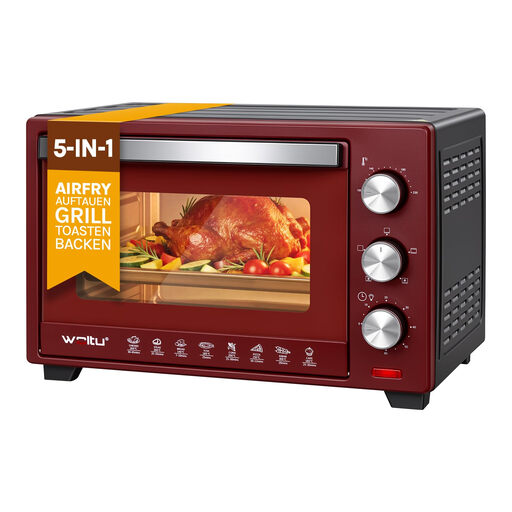 Image unavailable
Woltu mini convection oven, 28 l
The product title describes this appliance as a mini convection oven for pizza. For a tart, check the tin dimensions and recipe requirements against the specific model.
- 28 l
- Temperature control and timer
- Red and black
View at Joybuy
Frequently asked questions
Should I use top and bottom heat or a fan setting for the tart case?
Follow the recipe you’re using. For blind-baking the case in a preheated oven, LECKER specifies 200 °C for a conventional oven or 175 °C for a fan oven. The filled tart is then chilled for at least four hours. These instructions apply to the recipe described, not necessarily to every chocolate tart.
What should I check before using a countertop oven for the first time in a holiday cottage?
Read the instructions for the exact model and check where you’ll position it, how it connects and what the rating plate says. Severin’s instructions for the TO 2058 require a correctly installed earthed socket and a mains voltage that matches the rating plate. They also warn that surfaces can get hot. These instructions apply to the model mentioned and aren’t general clearance measurements for other appliances.
How should I clean the countertop oven after baking?
Follow the instructions for your model. For the TO 2058, Severin says to unplug the appliance and let it cool before cleaning. The appliance must not be immersed in liquid.
What should I look for to make sure an electric oven is safe?
Check the labelling, the manufacturer’s information and the safety details supplied with the appliance. The Bundesnetzagentur lists CE marking and German-language instructions with the required warnings among the things it checks during market surveillance. The EU Low Voltage Directive also covers household appliances within its specified voltage range. CE marking is not an independent baking or quality test.
How should I dispose of an old electric oven?
Don’t put it in general waste. The German Federal Government lists local recycling centres as an option for proper disposal and describes retailer take-back points. The updated rules outlined have been in force since 1 January 2026.


