Small batches and limited space
If you’re happy to bake small batches one after another, the right tray and a suitable spot in your holiday home are what matter. The Steba KB M19 manual sets out specific placement and connection requirements.


Choose your oven first by the usable tray area you need for the number of macaroons you plan to bake, then by the space where it can be positioned safely in your holiday home. A compact fan-assisted mini oven may suit smaller batches baked in several rounds; larger batches benefit from more tray space, but need more room. Choose the heating function and temperature to suit your specific recipe, and follow the placement and connection requirements for your chosen model.
If you’re happy to bake small batches one after another, the right tray and a suitable spot in your holiday home are what matter. The Steba KB M19 manual sets out specific placement and connection requirements.
If you want to bake as few batches as possible, compare the usable tray area and the appliance’s dimensions. The capacity in litres alone won’t tell you how many macaroons will fit on a tray with enough space between them.
If your recipes call for different heating functions or temperatures, check whether the specific model offers the setting you need. Extra programmes are no substitute for following the requirements of each recipe.
First, compare the tray with the quantity you plan to bake. Then check whether the oven can be positioned and connected at the intended spot in accordance with its manual. For appliances in Germany, the Federal Network Agency recommends checking, among other things, for correct CE marking, identifiable manufacturer details and safety information in German. The CE mark alone is not an independent quality certification.
| What to consider | What to check before buying | Who is this especially important for? |
|---|---|---|
| Heating function and recipe | Check that the exact model offers the heating function your recipe calls for and the temperature setting you need. | When I bake different recipes, I want to be able to set the heating function and temperature specified for each one. Around 36% of consumers put this ability to follow recipes first. |
| Placement and connection | Measure the intended space, including clearance and room to open the door; read the placement and connection requirements for the specific model. | In a holiday home, I want to be sure the oven will fit and can be connected as intended. Around 29% of consumers prioritise placement and connection. |
| Tray area and number of batches | Compare the usable tray dimensions with the size and spacing of your macaroons; don’t assume the cooking compartment size tells you how much tray space there is. | If I’m planning a larger batch, I want to know how many macaroons will fit on the tray and whether I’ll need to bake them in several rounds. Around 21% of consumers look first at batch size and tray area. |
| Cleaning and ongoing costs | Check the cleaning instructions and which parts are accessible; compare energy use only for batches of the same size and measured on the same basis. | If I use the oven regularly, easy cleaning, servicing and clear information about running costs matter to me. Around 14% of consumers put these points first. |
The capacity in litres doesn’t tell you how many coconut macaroons will fit on the supplied tray with enough space between them.
Compare the actual tray area with the size and spacing of your macaroons, and plan separate batches if needed.
Having several shelf positions doesn’t, by itself, mean that two trays are suitable for baking at the same time. A Rommelsbacher support response refers to “BG 1580/E”, while the model is named “BGE 1580/E”.
Ask for confirmation that using multiple trays is suitable for the full model name and the trays intended. Otherwise, plan to bake in separate batches.
As well as room for the appliance itself, you’ll need to allow for the clearance specified in the manual and enough space to open the door. For the KB M19, Steba specifies, among other things, a 10 cm gap between the back of the appliance and the kitchen wall, as well as a properly earthed, easily accessible socket.
Check the manual for the model you choose and the conditions in your holiday home, rather than applying the requirements for a different oven.
The rated power isn’t a measurement of the electricity used to bake a batch of macaroons. Rommelsbacher says its table-top and mini ovens weighing under 18 kg do not carry an EU energy label; this manufacturer statement isn’t an energy-use figure for a specific recipe.
Where figures are available, compare measured kilowatt hours for batches of the same size under similar conditions. Don’t assume that a higher or lower wattage alone means energy savings.
According to Rommelsbacher, the BGE 1580/E is a 30-l model with optional fan assistance and electronic temperature control.
According to Steba, the KB M19 is a compact 19-l oven with optional fan assistance.
According to the manufacturer, Severin offers fan-assisted mini ovens for baking and toasting in different sizes, including the approximately 20-l TO 2068 and the 42-l TO 2058.
According to Caso Design, the TO 26 SilverStyle is a freestanding 26-l oven with fan assistance and top and bottom heat.
According to Clatronic, the MBG 3727 is a 25-l oven with top and bottom heat and fan assistance.
The following Joybuy listings are mini ovens whose product details say they can be used for baking. For each model, check that the heating function suits your recipe, and review the usable tray area and placement requirements.
 No product image available
The product details list baking as a use; before buying, check that the model’s heating function suits your recipe.
32 l; 1.600 W; temperature range 100–250 °C; 60-minute timer.
Includes a baking tray and crumb tray; stated external dimensions: 52,3 × 36 × 32,2 cm.
 No product image available
The product details list baking as a use; check that the required heating function matches your recipe and that the tray is large enough for the batch you’re planning.
10 l; temperature setting from 100–230 °C; programmable 60-minute timer.
Includes a baking tray and wire rack; stated external dimensions: 37 × 26,5 × 21 cm.
 No product image available
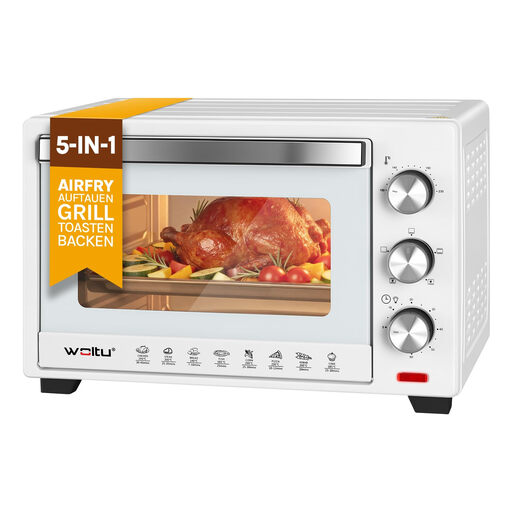
The product description lists fan assistance and top and bottom heat; before choosing, check that the settings suit your recipe and that the oven will fit in the space available.
28 l; temperature range 100–230 °C; described as including one baking tray and three adjustable shelf positions.
The description says that several trays can be used at the same time; before baking, check the model-specific manual to find out which trays are suitable.
No. The temperature and baking time depend on the specific recipe. For example, one recipe with quark calls for 150 °C fan for about 15 minutes, while another specifies 175 °C top and bottom heat for about 15–20 minutes. Follow your recipe first and keep an eye on the first batch.
There’s no general yes or no: follow the placement and connection requirements in the manual for the specific model, and check the conditions in your holiday home. For the KB M19, Steba specifies a properly earthed, easily accessible socket and a 10 cm gap between the back of the appliance and the kitchen wall. These requirements don’t automatically apply to other models.
Follow the manual for the specific model and let the appliance cool down before cleaning it. Steba lists a crumb tray for the KB M19; the manual also warns against immersing the appliance in water.
Don’t assume so based on the term “mini oven” alone. Rommelsbacher says its table-top and mini ovens weighing under 18 kg don’t carry an EU energy label; this is a manufacturer statement about those appliances, not a claim about every model. The absence of a label doesn’t, by itself, tell you how much electricity a specific batch of macaroons will use.
For a purchase from a retailer in Germany, the consumer advice centre states that statutory rights relating to defects generally apply for two years from delivery. For electrical appliances, the Federal Network Agency recommends checking, among other things, the CE mark, manufacturer details and any required safety information in German. The CE mark alone isn’t an independent quality mark.