Families with a baking dish already in mind
If you want to make a fish pie in one dish for everyone, compare its external dimensions, including the handles, with the usable oven cavity and shelf height.


First, choose a mini oven that can accommodate your filled baking dish, including its handles, on the usable shelf space. The capacity in litres alone won’t tell you whether it will fit. Adjustable top and bottom heat is a good basic setting for a pie, while fan-assisted cooking gives you another option. A larger oven cavity takes up more space on your worktop, too. Check the setup instructions for the specific model, and don’t rely on a browned surface alone to tell you when your fish pie is cooked.
If you want to make a fish pie in one dish for everyone, compare its external dimensions, including the handles, with the usable oven cavity and shelf height.
When worktop space is limited, consider the oven’s external dimensions as well as its internal capacity, and check the setup instructions for the specific model.
If you want to cook other oven dishes as well as fish pie, you can compare the heating options and controls – while keeping the size of your dish and the space the oven needs in mind.
A good fit if: Your family-sized dish fits in the oven cavity after you’ve checked the measurements, and you’re happy to go without fan-assisted cooking. Severin says the TO 2067 accommodates dishes up to 30 cm in diameter and does not have a fan-assisted function.
The trade-off: A stated diameter doesn’t confirm that a rectangular or deep dish will fit.
A good fit if: Your dish fits and you’d like to choose between top and bottom heat and fan-assisted cooking. Rommelsbacher lists both options for the BG 1550, while Gastroback lists them for the 42814 oven.
The trade-off: The capacity in litres or the diameter of a pizza stone won’t confirm that your baking dish will fit.
A good fit if: You want to use a larger family-sized dish and have enough space for the oven and ventilation. Rommelsbacher lists a 42-litre capacity for the BG 1805/E and says it accommodates round dishes up to 31,5 cm in diameter.
The trade-off: According to the manufacturer, the BG 1805/E measures 54,5 × 43 × 36 cm (W × D × H); the setup requirements in the manual also apply.
| What matters when buying | What to check | Who should pay particular attention? |
|---|---|---|
| Fit and portion size | Measure the outside of the dish, including the handles; check the usable internal dimensions and shelf height for the specific model. | If I want to bake a pie in one dish for the whole family, it needs to fit, handles included. For around 36 % of consumers, finding a suitable dish and portion size is the main priority. |
| Heating options and cooking control | Compare top and bottom heat, fan-assisted cooking, temperature control and timer for the exact model. | If I want a suitable setting for the filling and topping, I’ll check the heating options and keep an eye on how the pie is cooking. Around 29 % of consumers put heating options and cooking control first. |
| Worktop space and setup | Measure your worktop and the space around it; follow the safety and setup instructions in the manual for the specific model. | If I have limited worktop space, the oven needs to fit there safely with the required clearances. For around 21 % of consumers, available space is the main consideration. |
| Cleaning and operation | Check the cleaning instructions and whether accessories can be removed; compare energy use only using like-for-like figures. | If I want to keep cleaning to a minimum after making a pie, I’ll check the recommended cleaning methods and how the oven operates. Around 14 % of consumers prioritise ease of care and operating costs. |
A rectangular dish with handles or a deep filling needs different dimensions from a round pizza. A stated dish diameter or an included pizza stone doesn’t confirm that your baking dish will fit.
Measure the outside of your dish and check the usable width, depth and height at the shelf position you plan to use.
If the dish doesn’t fit, you may need to use a different one or bake the pie in several batches.
Heating options vary from model to model. According to its technical specifications, the Severin TO 2067 has no fan-assisted function, although top and bottom heat are listed.
Compare the heating options using the full model name before you decide.
As well as the external dimensions, you’ll need to follow the setup instructions for the specific model. For example, Steba specifies a 10 cm gap between the KB 28 ECO and the kitchen wall behind it. This figure doesn’t automatically apply to other models.
Before you buy, check the manual for the oven you’ve chosen and measure the space available, allowing for the clearances it specifies.
Rated power isn’t the same as the energy used for a particular baking session. The Verbraucherzentrale recommends checking the appliance’s actual energy consumption.
Compare consumption figures only when they’re based on the same method of measurement. You’ll also need your own electricity tariff to work out the cost.
The BG 1550 and BG 1805/E offer two different oven cavity sizes to compare when considering different dishes and available space.
The KB M19 is a compact option to consider if your dish fits inside the oven cavity.
The TO 2067 is worth considering if you want top and bottom heat and don’t need fan-assisted cooking.
The Design Bistro Ofen Bake & Grill, item 42814, adds a 26-litre model to the selection.
This selection includes tabletop and mini ovens for baking and family meals. For each model, check the dimensions of your dish and make sure the heating options you need are included.
 No image available
The product details list baking and grilling among its uses. Before buying, check that your dish will fit in the usable oven cavity.
32 litres; 1.600 W; temperature range 100–250 °C; 60-minute timer; crumb tray.
 No image available
The product description lists families of 3–4 as a target audience. You’ll still need to check the dimensions separately to see whether your pie dish will fit.
Three heating modes: top heat, bottom heat and combined heat; temperature range 100–230 °C.
 No image available
If you’d like to monitor the temperature inside your food as it cooks, the product description lists an integrated thermometer. Also check that your dish and shelf position are suitable for your fish pie.
35 litres; convection heating; integrated thermometer; four-level rack.
 No image available
The product description lists meals for 6–8 people among its uses. The stated capacity doesn’t replace checking the dimensions of your baking dish.
21 presets; functions can be combined; 1.800 W.
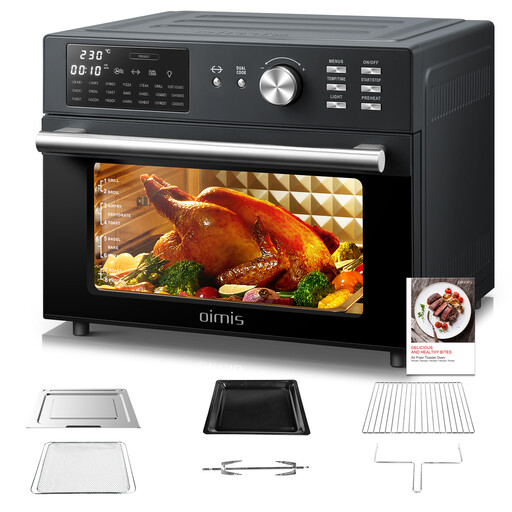 No image available
If you’d like to use the listed extra functions as well as cook oven dishes, the product description includes a rotisserie and dehydrator function. For your pie, check the dimensions of the dish and the shelf position you plan to use.
21 presets; 1.800 W; rotisserie and dehydrator function.
Not necessarily. What matters is the external size of your dish, including the handles, and the usable space inside the oven. Compare the measurements with the shelf position you plan to use. The size of a baking tray doesn’t automatically tell you how much room there is for a baking dish.
Top and bottom heat is a good basic setting for a pie. Fan-assisted cooking can be a useful extra if you’d like it for other dishes, too. Check the heating options against the full model name, as not every appliance offers fan-assisted cooking.
Follow the instructions for the specific model, as the required clearances aren’t necessarily the same for every oven. For example, Steba specifies a 10 cm gap between the KB 28 ECO and the kitchen wall behind it, and warns that surfaces can get hot. This isn’t a general rule for all models.
Don’t rely on a browned surface alone. Check the filling as it cooks. The German Federal Institute for Risk Assessment highlights the potential hygiene risks associated with raw fish and cross-contamination. Keep raw ingredients and used kitchen utensils separate from ready-to-eat food.
No. Rated power isn’t a measurement of the energy used for your baking session. To make a meaningful cost comparison, you’ll need consumption figures based on the same measurement method and your own electricity tariff. The Verbraucherzentrale recommends checking the appliance’s actual energy consumption.