Baking one dish to share
You want to bake a fruit cobbler for several people in a single dish. The Good Food recipe serves six, so the dish dimensions and usable oven space will determine whether a suitable dish will fit.


First, choose a mini oven based on whether your cobbler dish will fit and whether you can position the oven safely where you plan to use it – capacity in litres alone isn’t enough. Adjustable top and bottom heat and, where available, fan-assisted cooking can help you adapt a recipe’s settings to your oven. A larger cavity gives you more room for a dish to share, but takes up more space.
You want to bake a fruit cobbler for several people in a single dish. The Good Food recipe serves six, so the dish dimensions and usable oven space will determine whether a suitable dish will fit.
You want to adjust the heating method and cooking time to suit the recipe and the level of browning you’re after. It’s worth checking the heating options and temperature range of the specific appliance.
You’re planning to use a smaller dish and need to allow for the clearances in the appliance manual, as well as the oven’s external dimensions. For example, the manual for the Steba KB M19 specifies a 10 cm gap between the appliance and the kitchen wall for this model.
Good Food’s plum cobbler recipe specifies 200 °C using top and bottom heat, or 180 °C with fan-assisted cooking. These settings are a useful starting point, but they won’t guarantee the same results in every mini oven.
| What matters | What to look for when buying | Who should pay particular attention? |
|---|---|---|
| Will the dish fit for a portion to share? | Measure the dish across its widest points, including the handles, then compare the measurements with the oven’s internal width, depth and available height. | If you want to bake a cobbler for several people in one dish, it needs to fit inside with its handles. Around 36% of consumers say dish size is their main concern. |
| Can you bake the fruit and topping just right? | Check the heating options, temperature range and timer on the specific model; keep an eye on browning and doneness as it cooks. | If you want to control how brown the topping gets in line with the recipe, look for suitable heating options and a timer that meets your needs. Around 29% of consumers say control over baking is their main concern. |
| Can you position the oven safely where you’ll bake? | Check the external dimensions, make sure you have a stable, heat-resistant surface, and follow the clearance and ventilation instructions in the manual. | If worktop space is limited, allow for the model’s required standing area and clearances as well as its external dimensions. Around 21% of consumers say space and safe use are their main concerns. |
| How much effort does it take to clean and use? | Check the cleaning instructions and whether the crumb tray can be removed; wattage alone doesn’t tell you how much energy one bake will use. | If you’ll use the oven regularly, you’ll want to get an idea of the cleaning involved and the ongoing costs. Around 14% of consumers say cleaning and running costs are their main concerns. |
Capacity alone won’t tell you whether a dish will fit in the oven cavity, including its handles and height.
Measure the outside of the dish and compare it with the stated internal dimensions and the types of oven dish permitted for the specific model.
If the dish doesn’t fit, you may need a smaller one or to bake in another batch.
Clearance and ventilation requirements may mean you need extra space. Surfaces can also get hot during use.
Read the manual for the model you’re considering. The Steba KB M19 requires a 10 cm gap between the back of the appliance and the kitchen wall; this doesn’t automatically apply to other appliances.
The rated power in watts doesn’t show how much electricity is used to bake a cobbler. The European Commission excludes small and portable ovens from the energy-labelling rules for domestic ovens.
To compare costs, you’ll need energy consumption in kWh under comparable conditions, as well as your own electricity tariff.
According to the manufacturer, the BG 1550 and BGE 1580/E are 30-litre appliances that fit round baking tins up to 29 cm in diameter.
The TO 26 SilverStyle is a 26-litre option with published internal dimensions.
The KB M19 is a 19-litre option for a smaller dish and limited space.
The TO 2068 is a 20-litre option with fan-assisted cooking and switchable top and bottom heat.
According to the manufacturer, the Design Bistro Ofen Bake & Grill, article 42814, has a 26-litre oven cavity.
The Joybuy products below range from compact mini ovens to combination appliances. Before buying, check that your cobbler dish fits in the usable oven space, and follow the instructions and safety information for the model you choose.
 No image available
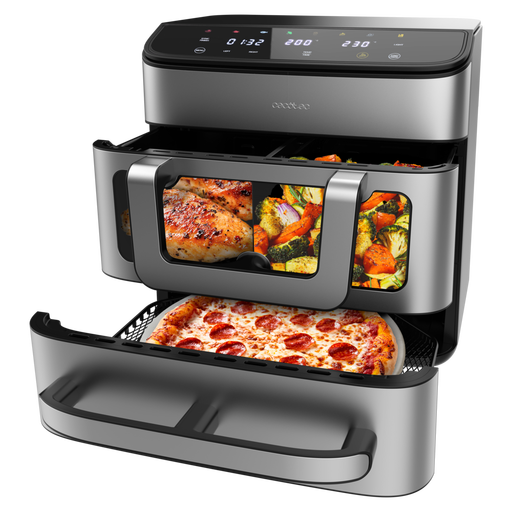
This combination appliance has a pizza oven compartment and an air fryer compartment. It may suit you if your dish and cooking method fit the relevant compartment.
The product title lists a 30-cm oven compartment, a 9-litre compartment, 2700 W and a maximum temperature of 230 °C.
 No image available
If you’re looking for a mini oven for baking and grilling, this model could be an option. Check that your dish fits inside.
The product title lists a 32-litre capacity, 1600 W, a 60-minute timer and a temperature range of 100 to 250 °C. A removable crumb tray is also specified.
 No image available
This 28-litre mini convection oven could be an option if your cobbler dish fits inside and you want to use the specified heating method.
The product title lists a temperature control and a timer.
 No image available
This combination appliance could be an option if your cobbler dish fits in the oven cavity. The pizza size listed in the title doesn’t replace measuring your dish.
The product title lists a 30-litre capacity, 21 presets, suitability for 13-inch pizzas and 1800 W. According to the product information, keep the appliance away from flammable materials and clean the interior after each use.
 No image available
A 10-litre appliance could suit smaller baking jobs. If you’re baking a portion to share, check particularly carefully that your dish will fit.
The product title lists a temperature range of 100 to 230 °C.
Not if you want to guarantee the result. Good Food’s plum cobbler recipe specifies 200 °C using top and bottom heat, or 180 °C with fan-assisted cooking, with separate cooking stages for the fruit and topping. Follow your oven’s instructions and check the browning and doneness as it cooks.
Measure the outside of the dish, including the handles, and compare its width, depth and height with the internal dimensions of the specific appliance. A manufacturer’s statement about round baking tins won’t tell you whether a rectangular dish will fit.
Place it on a suitable, stable surface and follow the clearance instructions for the specific model. The Steba KB M19 manual specifies a 10 cm gap between the back of the appliance and the kitchen wall, and warns that surfaces get hot. These instructions don’t automatically apply to other appliances.
The European Commission excludes small and portable ovens from the energy-labelling rules for domestic ovens. So a missing label alone doesn’t prove that an appliance uses little energy or that it’s illegal. For running costs, rated power in watts isn’t a substitute for comparable energy consumption figures in kWh.