Bakers short on space
Check that the oven, its open door and the required ventilation clearances will all fit in the space you have in mind.


First, choose an oven that fits safely in your intended space, with the required clearances. Then compare the usable tray area with the number of biscuits you want to bake in each batch. A very small toaster oven may suit smaller quantities, while a larger mini oven takes up more space and may offer additional heating modes. Recipe temperatures are a starting point, not a guarantee of identical results in every appliance.
Check that the oven, its open door and the required ventilation clearances will all fit in the space you have in mind.
If you want to bake larger quantities, usable tray area and the number of biscuits you want to bake per batch matter more than the oven’s capacity alone.
If you bake different kinds of jam biscuits, check which heating modes and temperature settings the specific model offers.
With limited worktop space, first make sure you have a safe place for the oven. Then compare the tray area and heating modes.
| Criterion | What to check before buying | Who should pay particular attention? |
|---|---|---|
| Safe placement | Check the space available, door clearance and the clearances specified in the manual for the exact model. Rommelsbacher requires 4 cm at the sides and 1 m above the BG 1055/E; this requirement does not automatically apply to other appliances. | If worktop space is limited, you need to be able to position the oven safely with enough room for ventilation. Around 36 % of consumers give finding a suitable place the highest priority. |
| Usable baking area | Compare the dimensions of the supplied tray with the arrangement of your cut-out biscuits. Capacity in litres or the number of shelf positions does not tell you how much tray area is usable at once. | If you want to bake as many biscuits as possible in each batch, look at the actual tray area. Around 29 % of consumers put batch size first. |
| Heating mode and temperature | Check whether you can select top/bottom heat or fan-assisted cooking, and whether the temperature range matches your recipe. Dr. Oetker recommends around 180 °C with top/bottom heat or 160 °C with fan-assisted cooking for Spitzbuben. | If you bake different jam biscuit recipes, having the right choice of heating modes is important. Around 21 % of consumers prioritise this recipe flexibility. |
| Running costs, cleaning and service | Compare energy consumption figures only when the usage conditions are comparable. Also check the cleaning instructions, accessories and the service explicitly offered for the specific model. | If you are particularly concerned about ongoing costs, maintenance or repairability, consider these points alongside the basic functions. Around 14 % of consumers put these aspects first. |
The space you need goes beyond the oven’s casing: the Rommelsbacher BG 1055/E requires 4 cm of ventilation clearance at the sides and 1 m above. The Steba KB M19 manual specifies a 10 cm gap between the back of the appliance and the kitchen wall.
Before choosing, check the manual for the exact model and allow space for the open door and the required clearances. Don’t treat a freestanding oven as a built-in appliance unless the manufacturer explicitly says you can.
The required clearance could make your planned spot unsuitable or take up additional worktop space.
The oven’s capacity and number of shelf positions don’t tell you how many biscuits will fit on the tray actually supplied.
Compare the tray dimensions and biscuit shapes with the quantity you plan to bake. Before buying, check which accessories are included with the specific version.
A smaller tray than expected could mean baking extra batches.
Rated power and the energy actually used during baking are different things. The number of batches you need to bake also affects how you use the appliance.
Compare energy consumption figures only when they are based on the same measurement and usage conditions, and take the quantity you plan to bake into account.
The details below relate to the named models and information from their manufacturers. They are not based on independent baking tests and do not apply to entire product ranges.
The TO 2052 is a very small toaster oven; the TO 2068 offers more oven space and fan-assisted cooking.
The BG 1055/E is an 18-l mini oven with selectable heating modes.
The KB M19 has a fan-assisted cooking function that can be switched on and three shelf positions.
The EO12512.WG adds a fan-assisted model, listed by the manufacturer as having a capacity of 12,5 l.
This selection includes mini ovens and air fryer ovens for the worktop. Before deciding, compare the space you have available, the heating modes and the baking accessories included.
 No image available
For a small worktop, the stated external dimensions give you a useful guide; compare them with the space available.
External dimensions: 37 × 26,5 × 21 cm. Comes with a baking tray and wire rack; top and bottom heat; temperature control from 100–230 °C.
 No image available
If you want to use different heating modes, check that the available functions suit your recipes.
Capacity: 28 l; temperature control from 100–230 °C; top heat, bottom heat and combined heat. Comes with a baking tray, wire rack and crumb tray.
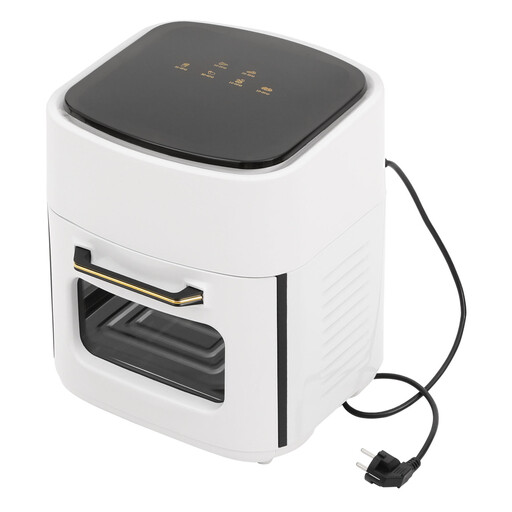 No image available
If you’re considering a compact appliance for your worktop, check its exact external dimensions and whether the accessories are suitable for your biscuits.
Capacity: 15 l; power: 1400 W; 360° fan-assisted heating; touchscreen time and temperature controls; viewing window and dishwasher-safe basket.
 No image available
If two cooking zones are important to you, check the layout of the compartments and trays for the specific appliance.
Capacity: 23 l; two cooking zones with a removable divider. The product description lists several trays and wire racks.
 No image available
If space is limited, compare the stated external dimensions with your available space before choosing a larger-capacity oven.
External dimensions: 52,3 × 36 × 32,2 cm; capacity: 32 l; power: 1600 W; temperature control from 100–250 °C. Comes with a baking tray, wire rack with handle and crumb tray.
Follow the recipe you’re using. For Spitzbuben, which are sandwiched together with jelly after baking, Dr. Oetker recommends around 180 °C with top/bottom heat or 160 °C with fan-assisted cooking, and a baking time of around 9 minutes. For a recipe with jam baked in, the supplier recommends around 200 °C or 180 °C and around 10 minutes. These are recipe recommendations, not settings tested for every mini oven.
Let the appliance cool down and follow its manual. The Severin TO 2052 manual says to unplug the appliance and let it cool before cleaning. A crumb tray is listed for some of the models mentioned; check the manual for cleaning instructions for your particular appliance.
In Germany, consumers who buy new faulty goods can generally make a warranty claim against the seller within two years of delivery. The Verbraucherzentrale distinguishes these statutory rights from a voluntary manufacturer’s guarantee.
No. According to the European Commission, small and portable ovens fall outside the scope of the relevant oven energy labelling rules. So the absence of a label does not automatically mean that an appliance is non-compliant or particularly energy-efficient. To compare energy consumption, you need figures based on comparable real-world use.
Don’t put it in your household rubbish. Take it to a separate collection point, such as a recycling centre. The Umweltbundesamt says you can drop it off there free of charge; whether you can return it to a retailer depends on the applicable legal requirements.