Holiday cooks with a dish already in mind
If you want to use the same lasagne dish in your holiday home, compare its external dimensions with the usable rack area. Check its height and the shelf position too.


First, measure your lasagne dish, including its handles and height, and compare it with the usable rack area and the oven’s internal height: the capacity in litres alone won’t confirm that your dish will fit. Then check whether you can position and connect the appliance safely, allowing for the clearances specified in the instructions. A larger cavity may give you more room for a dish, but it will also take up more worktop space.
If you want to use the same lasagne dish in your holiday home, compare its external dimensions with the usable rack area. Check its height and the shelf position too.
If your kitchen has limited space, consider not just the appliance’s body but also its feet and the clearances specified in the instructions when working out how much room you’ll need.
If you want to cook more than just lasagne, check the heating functions and, if important to you, the cleaning and spare-parts options for the specific model.
Measure your dish and the space first, then compare the heating functions, controls and after-sales service with the way you plan to use the oven.
When choosing a mini oven for vegetable lasagne in a holiday home, the main considerations vary: whether your dish will fit, where the oven will go, its cooking functions, or ongoing costs and after-sales service.
| What matters to you | What to look for when buying | Who is it especially relevant to? |
|---|---|---|
| Will your lasagne dish fit? | Compare its external dimensions, including handles, with the rack area, internal height, shelf position and door clearance. Rommelsbacher gives the BG 1805/E a usable internal area of 34 × 28 cm and recommends using a slightly smaller dish. | If I want to keep using the dish I already own, it needs to fit on the rack and slide into the oven. Around 36% of consumers put fit first. |
| Positioning and connection | Check the appliance’s width, including its feet, as well as the clearances and connection requirements for the specific model in the instructions. The Steba instructions require a 10 cm gap between the back of the KB M19 and the wall. | If worktop space in the holiday home is limited, I’ll also need to allow for ventilation gaps and check where the socket is. Around 29% of consumers prioritise a safe position for the appliance. |
| Heating functions and controls | Compare the heating functions, temperature control and shelf options you need for the way you’ll use the specific model. CASO lists top heat, bottom heat and fan-assisted cooking for the TO 26 SilverStyle. | If I want to use the oven for other dishes too, the right heating functions matter more to me than the capacity in litres alone. Around 21% of consumers put cooking functions first. |
| Ongoing costs and after-sales service | Rated power alone doesn’t give a reliable indication of electricity costs. To compare models, you’ll need the energy consumption in kWh for a comparable cooking cycle. Also check what spare parts and repair services are available. | If I plan to use the appliance regularly, I’ll consider not just running costs but also the support available after purchase. Around 14% of consumers prioritise ongoing costs and after-sales service. |
The oven’s capacity doesn’t tell you whether a rectangular dish will fit on the rack. Rommelsbacher gives the BG 1805/E a usable internal area of 34 × 28 cm and recommends using a slightly smaller dish.
Measure your dish, including its handles, and compare its dimensions with the usable area, shelf height and door clearance of the specific oven.
Worth considering if you want to check a larger baking dish against specific appliance dimensions or look at an oven with a stated cavity capacity.
Worth considering if you want to compare published internal dimensions and the heating functions of a specific model.
Worth considering if you’re planning to use a smaller lasagne dish and have limited space for the appliance.
Worth considering if you want to look at a model with a larger stated capacity and repair services on offer.
This selection includes mini ovens and a combination oven for lasagne and other oven dishes. Before buying, check your dish dimensions and the space available against the details for the specific model.
 No image available
Described as a mini oven for baking and grilling; check that your dish will fit on the usable rack area.
32 l; 100–250 °C; 1600 W; timer; removable crumb tray.
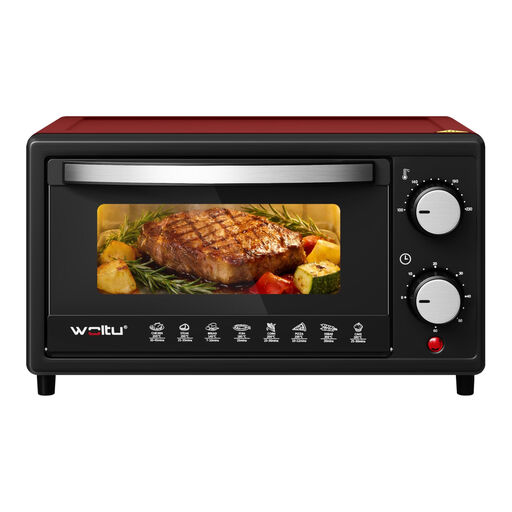 No image available
The product name mentions a pizza function; check in advance that your lasagne dish will fit inside the oven.
10 l; 100–230 °C.
 No image available
Described as a mini convection oven; check the dimensions and height of your dish against the details for the specific appliance.
28 l; temperature control and timer.
 No image available
The product name lists baking as one of the combination appliance’s functions; check that your dish will fit the specific model.
30 l; 30–230 °C; 21 presets; 1800 W.
No. Compare the external dimensions of your dish, including its handles, with the usable rack area, and check its height and shelf position. For example, Rommelsbacher gives the 42 l BG 1805/E a usable internal area of 34 × 28 cm and recommends using a slightly smaller dish.
Check the instructions for the specific model. The Steba KB M19 requires a 10 cm gap between the back of the appliance and the kitchen wall. The instructions also require a properly earthed, easily accessible socket. Don’t assume the same requirements apply to other ovens without checking.
When keeping food hot, the German Federal Institute for Risk Assessment recommends a temperature of at least 60 °C throughout. When reheating, it recommends at least 70 °C throughout for two minutes. A keep-warm setting alone doesn’t confirm the temperature of the lasagne.
If you buy new goods that are faulty, you can claim your statutory consumer rights against the seller within two years of receiving them. The German consumer advice centre distinguishes these legal rights from a manufacturer’s guarantee, which is voluntary and subject to its own terms.
No. New mains-powered appliances covered by the Low Voltage Directive must carry the CE mark before being made available. The manufacturer uses it to declare that the product complies with the relevant requirements; it is not, in itself, an independent test result.