Small batches for lunchboxes
If you only bake a few biscuits at a time and have limited worktop space, compare the usable tray area with the size of your biscuits. A small appliance takes up less room, but limits how many you can bake in one go.


A compact mini oven can be a good choice for baking a small batch of lemon biscuits for a lunchbox, provided its baking tray is large enough. For bigger batches, look for a larger usable tray and make sure you have enough space for the oven. The heating options, temperature controls and timer can also make it easier to plan several batches in a row.
If you only bake a few biscuits at a time and have limited worktop space, compare the usable tray area with the size of your biscuits. A small appliance takes up less room, but limits how many you can bake in one go.
If you prepare biscuits for several weekdays or people, consider the tray area, shelf positions and available heating options as well as the oven capacity.
If you plan to keep the oven on a worktop, make sure its external dimensions and the clearances specified in the instructions are suitable for the space.
First, compare the baking tray area with the number of biscuits you want to make. Then check that the oven, along with the required safety clearances, will fit in your chosen spot.
| Criteria | What to look for | Who should pay particular attention |
|---|---|---|
| Usable tray area | Compare the tray and internal dimensions, the baking tray supplied, and the size of your biscuits and spacing between them. | If I’m baking just a small batch for a lunchbox, I want enough room to space the biscuits out on the tray without needing more worktop space than necessary. Around 36% of consumers put tray area and batch size first. |
| Heating options and control | Check the temperature range, top and bottom heat, fan-assisted settings where available, and timer for the specific model. | If I regularly bake short batches, I want to set the heating mode and baking time to suit and keep an eye on how brown the biscuits are getting. Around 29% of consumers prioritise baking controls. |
| Space and safe use | Allow for the external dimensions and the clearances specified in the model’s instructions; check the markings on the specific appliance being offered. | If I want to keep the oven on a small worktop, I need space for the appliance and its required clearances. Around 21% of consumers focus mainly on space and safe use. |
| Cleaning and effort | Check the cleaning instructions and whether there’s a removable crumb tray; only compare electricity use on a like-for-like basis. | If I bake often, I want to clear away crumbs easily after each batch and keep the day-to-day effort manageable. Around 14% of consumers focus on cleaning and ongoing effort. |
Oven capacity alone doesn’t tell you how much usable space there is on the baking tray. Manufacturer information for models such as the Steba KB A9 and CASO TO 26 SilverStyle lists the oven capacity separately from the internal dimensions.
Compare the internal and tray dimensions with the size of your biscuits and the spacing you want to leave between them.
If the tray is small, you may need to bake a larger batch in several rounds.
As well as the external dimensions, the instructions may specify clearances for that particular model. For example, the Steba KB A9 instructions require a 10 cm gap between the back of the appliance and the kitchen wall, and warn that surfaces can get hot.
Check the instructions for the specific model against your chosen location, rather than assuming the clearances for another oven will apply.
The rated power isn’t a measure of the electricity used to bake a particular batch of biscuits. The Verbraucherzentrale recommends taking the appliance’s actual electricity consumption into account.
Don’t assume you’ll save money based on wattage alone. To compare consumption, measure it for a complete batch and take into account how often you use the oven and your own electricity tariff.
The manufacturer’s range includes both a compact 10-l oven and a 42-l model.
According to the manufacturer, the KB A9 is a 9-l tabletop oven designed for small portions.
The TO 2068 is a 20-l baking and toasting oven with several heating options.
The TO 26 SilverStyle is a 26-l option with documented internal dimensions.
The Vintage 0979/05 is an 18-l oven with conventional heating options.
The range includes a 10-l mini oven for small batches and 28- and 32-l models for bigger baking plans. For each model, check the usable tray area and the space it needs.
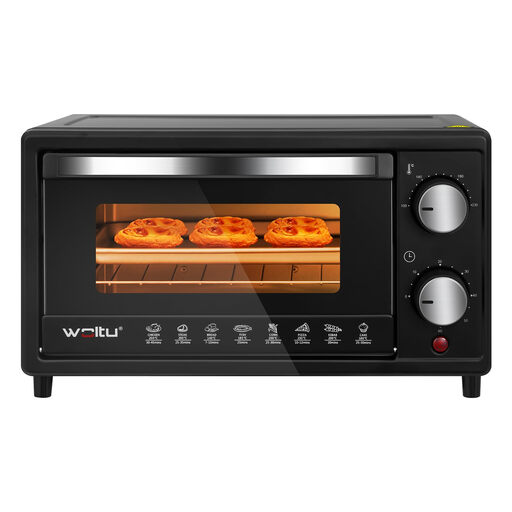 No image available
A compact option for small batches, with top and bottom heat and a baking tray included.
10 l; temperature range 100–230 °C; timer 0–60 minutes; top and bottom heat.
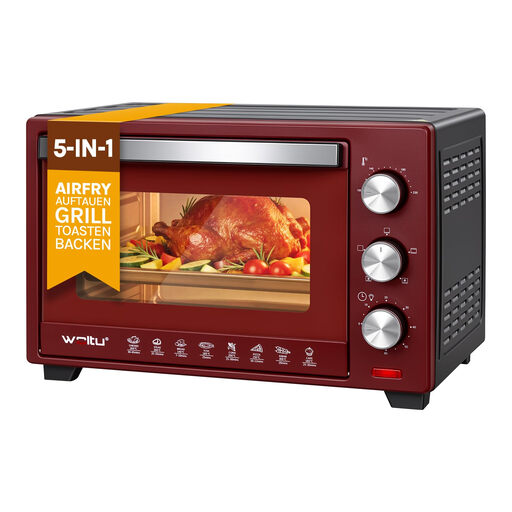 No image available
A larger-capacity option for baking projects where three adjustable shelf positions come in handy.
28 l; three heating modes; temperature range 100–230 °C; 60-minute timer; baking tray and wire rack.
 No image available
A 32-l option for larger baking projects, with a baking tray, wire rack and removable crumb tray.
Temperature range 100–250 °C; 60-minute timer; 1600 W.
A 9- or 10-l model may suit small batches, provided the usable baking tray area is right for the size of your biscuits and the spacing between them. The litre capacity alone doesn’t tell you how many biscuits will fit on the tray.
Rommelsbacher recommends preheating the BG 950, as food may burn from direct heat during the initial heating phase. For other models, follow the instructions and the recipe you’re using.
Switch off the oven, unplug it and let it cool before cleaning. The instructions for the specific model explain whether the crumb tray, door or baking tray can be removed and how to clean them.
No. If a product is faulty, your statutory rights are against the seller. A warranty is an additional voluntary promise with its own terms and conditions. The Verbraucherzentrale points out that these are two separate entitlements.
CE marking is required if the specific appliance falls under harmonised EU rules that require it. The European Commission notes that CE marking isn’t mandatory for every product, so check the marking on the specific appliance being offered. It’s the manufacturer’s declaration of conformity, not an independent quality mark for baking results.