Celebration bakers with lots of dough
You want to bake the biscuits you need in as few batches as possible, so your first step is to compare suitable baking trays.


Start by choosing a mini oven based on the usable baking tray area and how many biscuits you want to bake at a time – not just its capacity. A larger tray can be handy when you’re baking a lot of biscuits, but it takes up more worktop space. If space is limited, smaller trays and baking in several batches are an alternative. Also check that you can select the heating mode your recipe calls for, and check the clearances specified in the instructions for where to position the oven.
You want to bake the biscuits you need in as few batches as possible, so your first step is to compare suitable baking trays.
You want to be able to select the heating mode specified in your recipe. Models differ in whether fan-assisted cooking is selectable, permanent or not available.
You can plan to bake smaller batches, but you’ll need to consider the oven’s casing, door opening and the positioning instructions for the specific model.
| What matters | What to check before buying | Who it matters most to |
|---|---|---|
| Tray area and number of batches | Compare the dimensions of the tray you can actually use, the accessories included and the space required by the specific oven. | For a family celebration, I want to bake as many biscuits as possible in each batch and plan the amount of dough accordingly. Around 36% of consumers prioritise tray area. |
| Heating mode and recipe suitability | Check the heating modes available on the complete model against your recipe; look for selectable or permanent fan-assisted cooking. | If my recipe calls for a particular heating mode, I want to be able to select it. Around 29% of consumers say heating mode is their main consideration. |
| Positioning and space | Allow for the casing dimensions, door opening, power connection and the clearances specified in the instructions for the specific model. | Before buying, I want to know whether the oven and its door will fit in the space available, with the required clearances. Around 21% of consumers pay particular attention to where the oven will go. |
| Cleaning and running costs | Check the cleaning instructions, whether there’s a removable crumb tray and whether consumption figures can be compared like for like. | After several batches, I want to be able to remove crumbs easily and estimate running costs using comparable figures. Around 14% of consumers prioritise cleaning and running costs. |
Capacity doesn’t tell you how large the usable tray is or how many biscuits will fit on it. Rommelsbacher publishes different original tray dimensions for its models.
Compare the tray dimensions for the specific model and plan how much dough you’ll bake in each batch.
Severin’s product specifications don’t list a fan-assisted function for the TO 2067, while Steba describes the KB 27 U.2 as having permanent fan-assisted cooking.
Compare the heating modes on the full model name with your recipe, rather than relying on the general description ‘oven’.
The required clearances are set out in the instructions for the specific oven and need to be added to the space taken up by its casing.
Before buying, check the available space, the door opening and the positioning instructions for the specific model.
The Verbraucherzentrale points out that actual electricity consumption is what matters. The power rating alone doesn’t show how much energy it takes to bake a full batch of biscuits, including all the batches required.
Only compare consumption figures measured under comparable conditions, and consider how many batches you’re likely to need.
Rommelsbacher lists a 42 l capacity and an original tray measuring 38.5 × 31.5 cm for the BG 1805/E; the BGE 1580/E has a 30 l capacity and a 32.5 × 28.5 cm tray. The manufacturer’s figures help you compare tray areas.
According to the manufacturer, the Severin TO 2067 is a 20-l baking and toasting oven for smaller batches.
Steba lists a 20 l capacity for the KB 27 U.2, along with its internal and external dimensions.
According to the manufacturer, the CASO TO 26 SilverStyle is a 26-l oven with published internal dimensions of 350 × 200 × 300 mm (W × H × D).
This selection of mini ovens from Joybuy includes models for baking that may suit smaller batches or baking spread across several batches.
 No image available
The description lists baking and an included baking tray, making it a useful option to compare for smaller batches of biscuits.
32 l; 1,600 W; temperature range 100–250 °C; 60-minute timer. A crumb tray is also listed.
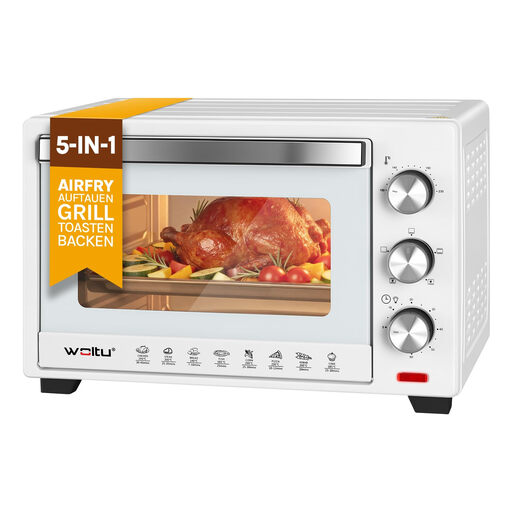 No image available
The description lists baking as one of its uses. Check the heating modes if you want to match them to your lemon biscuit recipe.
28 l; three heating modes; temperature control from 100–230 °C; 60-minute timer. Several baking trays and three shelf positions are listed, but this doesn’t confirm that two loaded trays can be used at the same time.
 No image available
If worktop space is limited and you only need to bake small quantities, this compact model could be an option; the product description recommends it for 1–2 people.
10 l; top and bottom heat; 100–230 °C; 60-minute timer; dimensions 37 × 26.5 × 21 cm. If you’re baking for a larger celebration, consider whether the small capacity means you’ll need several batches.
No. The number of shelf positions alone doesn’t confirm that you can use two loaded trays at once. Check the instructions or the manufacturer’s information for the full model name. Until then, bake the biscuits in separate batches.
Compare the dimensions of the usable tray rather than relying only on the capacity in litres. Rommelsbacher lists an original tray measuring 38.5 × 31.5 cm for the BG 1805/E and one measuring 32.5 × 28.5 cm for the BGE 1580/E. You can’t use these figures to determine an exact number of biscuits.
It depends on the settings your recipe calls for. Compare top and bottom heat, and fan-assisted cooking if required, with the functions of the exact model: fan-assisted cooking can be switched on for the BGE 1580/E; the Severin TO 2067’s product specifications don’t list a fan-assisted function; and fan-assisted cooking is permanent on the Steba KB 27 U.2.
For its mini ovens, Rommelsbacher recommends heating the appliance for 15 minutes at the maximum temperature, using top and bottom heat and fan-assisted cooking, before first use. Ventilate the room well and wipe the oven with a damp cloth once it has cooled. For other brands, follow the instructions provided with the appliance.
For its mini ovens, Rommelsbacher recommends washing accessories in warm water with a little washing-up liquid and wiping the door and oven interior with a damp cloth after use. For other appliances, follow the cleaning instructions provided.