Family cake bakers
If you’re baking a lemon cake in a loaf tin for several guests, you’ll need to make sure the tin, oven shelf and usable oven cavity are a good fit. Dr. Oetker’s recipe specifies a 25 × 11 cm loaf tin.


The key is whether your loaf tin, with enough room for the cake to rise, will fit inside the usable oven cavity – the capacity in litres alone won’t tell you that. Dr. Oetker’s lemon cake recipe calls for around 170 °C using conventional heat or 150 °C with a fan oven, and a baking time of about 60 minutes. So, having the right heating modes and enough cooking time matters just as much as considering how much worktop space a larger oven may take up.
If you’re baking a lemon cake in a loaf tin for several guests, you’ll need to make sure the tin, oven shelf and usable oven cavity are a good fit. Dr. Oetker’s recipe specifies a 25 × 11 cm loaf tin.
If worktop space is limited, remember to check not only the appliance dimensions but also the model-specific clearances needed for safe positioning.
If you plan to use the oven regularly for other dishes after your family gathering, compare the oven cavity size and available heating modes with the food you actually want to cook.
Dr. Oetker’s lemon cake recipe calls for around 170 °C using conventional heat or 150 °C with a fan oven, and a baking time of about 60 minutes. As well as checking that your tin will fit, consider the oven controls, where you’ll position it and how you plan to use it after the gathering.
| What matters | What to check when buying | Who is this important to? |
|---|---|---|
| Tin and oven cavity | Compare the usable internal width, depth and height, shelf position, the external dimensions of your tin and the clearance from the heating elements. | If I want to use the 25 × 11 cm loaf tin specified in Dr. Oetker’s recipe, there also needs to be enough room above the rising cake. Around 40% of consumers put finding a suitable tin and usable oven cavity first. |
| Heating mode and baking time | Check whether conventional heat or a fan oven is available, along with suitable temperature and timer settings. | If I’m baking the lemon cake according to the recipe, I want to be able to select the right heating mode and allow for the baking time of about 60 minutes. Around 31% of consumers prioritise the oven controls. |
| Safe positioning | Check the appliance’s external dimensions, clearances in the model instructions, a suitable socket and enough room to open the door. | If I have limited worktop space, the appliance needs to fit safely with the required clearances and be easy to use. Around 15% of consumers pay particular attention to where they can position it. |
| Future use | Choose only the heating modes and accessories you need; compare energy figures only where the conditions of use are comparable. | If I want to use the oven regularly after the gathering, the functions I need and its energy use in everyday cooking matter to me. Around 14% of consumers prioritise longer-term use. |
A stated diameter for round baking tins doesn’t tell you whether a loaf tin will fit or whether there’ll be enough room above the rising cake.
Compare your tin’s external dimensions with the usable internal dimensions and shelf position. Remember to allow for clearance from the heating elements, too.
The instructions for each model may specify clearances for safe positioning. Surfaces you can touch may also become hot while the oven is in use.
Measure the space you have in mind, taking account of the appliance’s external dimensions and the advice in its specific instruction manual.
A test figure for a particular duration and temperature won’t necessarily reflect the energy used for a baking session of around 60 minutes. The Verbraucherzentrale (German consumer advice centre) points out that the appliance’s actual electricity consumption is what matters.
Compare energy figures only under comparable conditions, and relate them to how you’ll actually use the oven.
The BGE 1580/E is a 30-litre mini oven with separately selectable conventional heat and optional fan-assisted cooking.
According to Severin, the TO 2058 has a 42-litre oven cavity, making it an option for buyers who want to use their oven for other dishes after a family gathering.
The Bake & Style 26 Touch is a countertop oven with published internal dimensions that you can compare with your own baking tin.
The KB M9 is a 9-litre oven for smaller dishes. For a family cake, you’ll need to check the fit of your tin and the baking time particularly carefully.
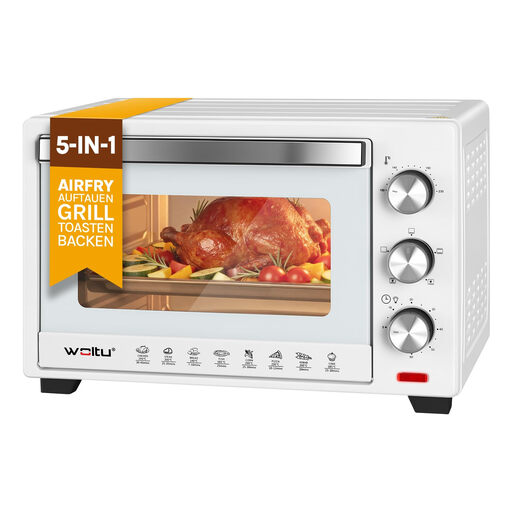
The Joybuy products below are mini ovens. For a family cake, check that your loaf tin will fit each model and that there’s enough room above the batter.
 No image available
Before baking the lemon cake, check that your loaf tin will fit, with enough room above the batter.
The product name lists a capacity of 32 litres, 1.600 W, a temperature range of 100 to 250 °C, a timer and a crumb tray.
 No image available
Before buying, compare the usable internal dimensions with your loaf tin. The capacity in litres alone doesn’t confirm that the tin will fit or that there’ll be enough headroom.
The product name lists a capacity of 10 litres, a pizza function and a temperature range of 100 to 230 °C.
 No image available
If you’re considering a mini convection oven, check which cooking modes are available and whether your loaf tin will fit with enough room above the batter.
The product name lists a capacity of 28 litres, a temperature control and a timer.
Dr. Oetker’s lemon cake recipe calls for around 170 °C using conventional heat or 150 °C with a fan oven, and a baking time of about 60 minutes in a preheated oven. Rommelsbacher says that, for the mini ovens listed by the manufacturer, you can use the recipe’s stated temperatures and times; you may need to adjust the quantities to suit the oven cavity. This guidance from the manufacturer doesn’t automatically apply to other models or recipes.
Compare the external dimensions of your tin with the usable internal dimensions and shelf position of the specific appliance. Allow extra room above the rising cake and clearance from the heating elements, too. A capacity in litres or a diameter for round tins won’t confirm that it will fit.
Follow the instructions for the specific model, as clearances and safety warnings vary by appliance. For example, the instructions for the Steba KB 28 ECO specify a 10 cm gap between the back of the appliance and the kitchen wall; this isn’t a general rule for other models. The Severin TO 2058 instructions warn that surfaces you can touch may become hot, and say to unplug the appliance and let it cool before cleaning.
No. According to the European Commission, by applying the required CE marking, the manufacturer declares that the product complies with the relevant EU rules. There is no central EU body that issues an approval or certificate for this. Check the marking and the exact identity of the appliance in the specific product listing.
If the appliance is faulty, your statutory rights against the seller are separate from any voluntary manufacturer’s warranty. The Verbraucherzentrale (German consumer advice centre) says that the statutory warranty period is generally two years. Online purchases usually come with a 14-day right to cancel. Whether and how this applies in your case depends on the relevant conditions.