Loaf tin bakers
If you want to bake a lemon cake in a loaf tin you already own, compare its external dimensions and height with the usable space inside the oven. Dr. Oetker’s recipe uses a 25 × 11 cm tin and gives a baking time of around 60 minutes.


Start by checking that your loaf tin will fit and choosing a suitable heating mode. Then consider the timer, the space available and the installation requirements for the specific model. Having your own mini oven means you don’t have to work around the shared oven’s schedule, but it does take up extra space. Neither the stated capacity in litres nor the rated power alone tells you whether your tin will fit or how much electricity one baking session will use.
If you want to bake a lemon cake in a loaf tin you already own, compare its external dimensions and height with the usable space inside the oven. Dr. Oetker’s recipe uses a 25 × 11 cm tin and gives a baking time of around 60 minutes.
If the shared oven is in use, having your own oven can give you the freedom to bake when it suits you. You’ll need a safe place to put it and a timer that fits the recipe.
If worktop space is limited, the appliance’s external dimensions and the required ventilation clearances must both fit in the space you have in mind. Installation requirements vary by model.
First check the tin and heating mode, then the timer and a safe place to put the oven. You can only make a meaningful comparison of electricity use if you have figures for similar baking sessions.
| What matters | What to check before buying | Who is it most important for? |
|---|---|---|
| Loaf tin fit | Compare the tin’s external dimensions, including its rim, and its height with the usable interior space and shelf position. Dr. Oetker’s recipe specifies a 25 × 11 cm tin. | If I want to keep using the tin I already own, I’ll first check its dimensions and the height of the filled cake. Around 36% of consumers in this situation prioritise finding a mini oven that fits their loaf tin. |
| A baking schedule you can plan around | Check for conventional top and bottom heat or a suitable fan-assisted setting, as well as the timer duration. Dr. Oetker specifies around 170 °C for conventional top and bottom heat or 150 °C for fan-assisted baking, with a baking time of about 60 minutes. These recipe settings have not been tested on every appliance. | If the shared oven is in use, I need to be able to plan my own baking time. Around 29% of consumers in this situation prioritise being able to bake independently. |
| A safe place to put the oven | Check the appliance’s external dimensions, door opening and the clearances specified in the manual for that model against the space you have in mind. The manual for the Rommelsbacher BG 1550 requires at least 4 cm of clearance all round and 1 m above; this requirement does not automatically apply to other models. | If worktop space is limited, I’ll check that the appliance, its open door and the required ventilation clearances will all fit. Around 21% of consumers prioritise having a safe place for the oven. |
| Electricity use when baking | For a meaningful comparison, look at consumption in kWh for similar baking sessions. The rated power alone does not tell you how much electricity this cake will use. The Verbraucherzentrale advises checking the appliance’s actual electricity consumption. | I want to assess energy use based on comparable baking sessions, rather than assume that one appliance rating tells me how much electricity the cake will use. Around 14% of consumers prioritise electricity consumption. |
The capacity in litres doesn’t tell you for certain whether your particular loaf tin and the cake will fit, or whether there’ll be enough clearance from the heating elements.
Measure the outside of your tin and check the usable interior height and shelf position of the specific model.
Depending on the fit, you may need a different baking tin or another appliance.
Having a clear space isn’t enough if there isn’t room for the clearances required for that model between the appliance and walls or overhead cupboards. The Rommelsbacher BG 1550 manual specifies at least 4 cm all round and 1 m above.
Compare the clearances specified in the manual for your model with the space where you plan to put it.
Dr. Oetker’s recipe gives a baking time of about 60 minutes; according to the manufacturer, the Clatronic MBG 3726 also has a 60-minute timer.
Keep an eye on the cake while it bakes and check whether you can reset the timer if needed. If you’d like more flexibility, compare the timer durations of other models.
A product page or the place where you buy an appliance doesn’t, by itself, confirm that its electrical specification is compatible with your connection. In Germany, the VDE gives 230 V at 50 Hz as the usual supply.
Before buying, compare the mains voltage and frequency specified for the appliance with the supply you intend to use.
According to Rommelsbacher, the BG 1550 and BGE 1580/E are 30-litre appliances with conventional top and bottom heat, switchable fan-assisted cooking and a 120-minute timer.
According to the manufacturer, the Clatronic MBG 3726 is a 20-litre model with conventional top and bottom heat.
According to its model specifications, the Severin TO 2068 is a 20-litre appliance with conventional top and bottom heat and fan-assisted cooking.
The following Joybuy mini ovens come in different stated sizes and can be compared if you want to bake on your own schedule. For each specific model, check that your loaf tin will fit, review the installation requirements and make sure the electrical specifications are compatible with the connection you intend to use.
 No image available
Could be worth considering if you’re looking for your own countertop oven for baking when it suits you. Check whether your loaf tin fits inside the specific model.
28 litres; timer.
Before buying, compare the mains voltage and frequency with the supply you intend to use.
 No image available
Could suit you if you want to bake on your own schedule and have room for a larger appliance. The capacity in litres doesn’t replace checking whether your loaf tin will fit.
32 litres; 1600 W; 100–250 °C; timer; crumb tray.
Before buying, compare the mains voltage and frequency with the supply you intend to use.
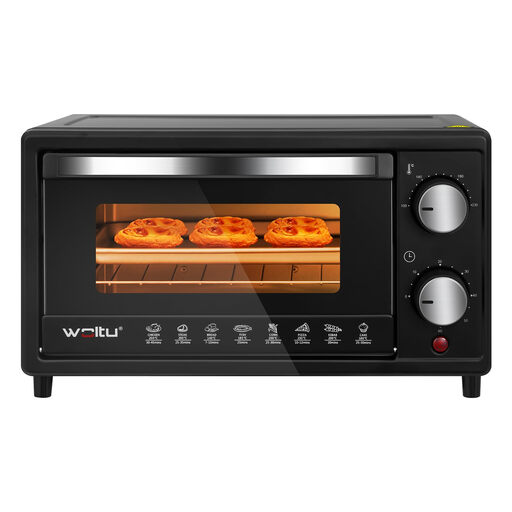 No image available
Could be an interesting compact countertop oven if space is tight. In particular, check whether your loaf tin will fit inside.
10 litres; 100–230 °C; pizza function.
Before buying, compare the mains voltage and frequency with the supply you intend to use.
Dr. Oetker’s recipe for a 25 × 11 cm loaf tin specifies around 170 °C with conventional top and bottom heat or 150 °C with fan-assisted cooking, and a baking time of about 60 minutes. Follow your appliance’s instructions and check the cake as it bakes. The recipe settings haven’t been tested on every mini oven.
Only if you can meet the installation requirements for that specific model in the space you have in mind. The Rommelsbacher BG 1550 manual requires at least 4 cm of clearance on all sides and 1 m above; these measurements do not automatically apply to all mini ovens.
Compare the mains voltage and frequency specified for the appliance with the supply you intend to use. In Germany, the VDE gives 230 V at 50 Hz as the usual supply.
No. You can’t tell from the type of appliance alone. Compare the actual consumption in kWh for similar baking sessions; the Verbraucherzentrale recommends checking the appliance’s actual electricity consumption.
Switch off the appliance, let it cool down and follow the instructions for your model. Rommelsbacher lists a removable crumb tray for the BG 1550 and BGE 1580/E; that doesn’t mean other parts are dishwasher-safe.