What should you look for when buying?
Start with the cake tin you’ll actually use, then check the heating mode, timer and safe placement requirements for the specific model you want.
| Buying priority |
What to look for |
Who is it important to? |
| Room for the tin and cake |
Measure the outside of your tin, including its rim and handles, and compare it with the usable width, depth and height of the cooking space. The 29 cm figure for the Rommelsbacher BG 1550 refers to round tins, not a specific loaf tin. |
I want to fit the 25 × 11 cm loaf tin from Dr. Oetker’s recipe, including its handles and the rising cake. Around 36% of consumers put the tin and cake size first. |
| Heating mode and baking time |
Check that you can set the required heating mode, recipe temperature and cooking time. For its example recipe, Dr. Oetker specifies 170 °C with top and bottom heat or 150 °C with fan-assisted heat, and a baking time of around 60 minutes. |
If I want to follow my recipe, the heating mode, temperature and cooking time need to match. Around 29% of consumers prioritise recipe settings. |
| Placement and safe use |
Take the external dimensions, surface and clearances in the manual for the specific model into account. For the Steba KB 28 ECO, the manual warns that surfaces get hot and specifies a 10 cm gap between the back of the appliance and the wall. This clearance does not automatically apply to other appliances. |
I need a place where the oven can stand safely with the required clearances. Around 21% of consumers put placement and safe use first. |
| Cleaning and day-to-day use |
Check the cleaning instructions, removable parts and availability of replacement accessories. For electricity costs, the Verbraucherzentrale recommends checking actual energy consumption rather than using wattage alone to estimate the cost of baking a cake. |
If I use the oven regularly, I want to keep cleaning and energy consumption in mind. Around 14% of consumers prioritise care and running costs. |
Joybuy products for cakes and baking
The Joybuy products below are mini ovens for different baking needs. Before choosing one, check that your tin will fit and that the heating mode, temperature range and placement requirements suit your recipe and kitchen.
 No image available
WOLTU BF12sz mini oven, 32 l, 1.600 W, black and red
An option if you’re looking for a mini oven with a larger cooking space and an adjustable temperature range.
Features listed in the product name: temperature range of 100–250 °C, timer, crumb tray, and suitability for baking and grilling.
Joybuy
 No image available
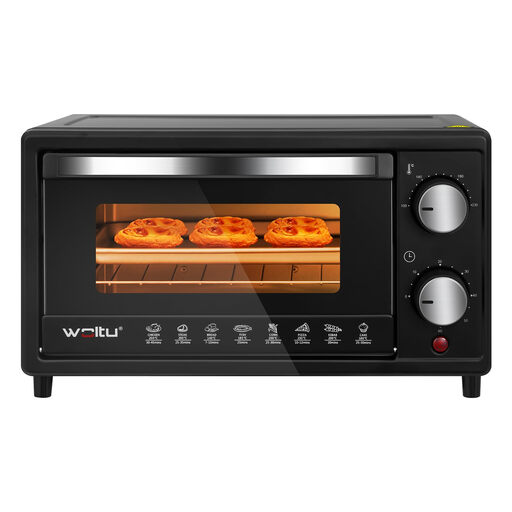
WOLTU mini oven, 10 l, black
A compact option if you’re looking for a small cooking space and adjustable temperature.
Features listed in the product name: temperature range of 100–230 °C and pizza function.
Joybuy
 No image available
WOLTU mini convection oven, 28 l, black
An option if you’re considering a mini convection oven with adjustable temperature and a timer.
Features listed in the product name: temperature control and timer. Check the usable internal dimensions to make sure your tin will fit.
Joybuy
 No image available
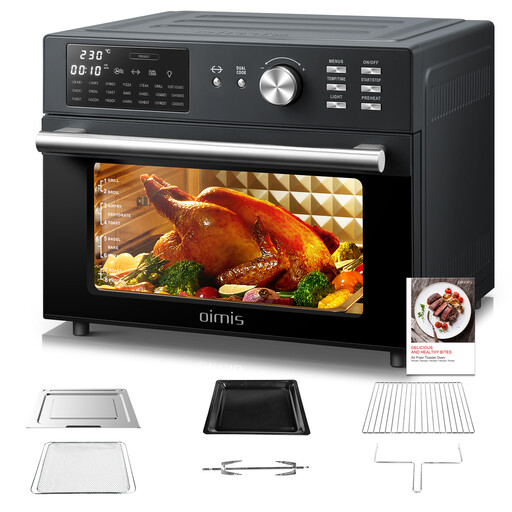
OIMIS air fryer toaster oven, 30 l, 1.800 W, grey
An option if you’d like to use cooking methods beyond baking.
Features listed in the product name: 21 preset programmes, rotisserie and dehydrator function. These features do not prove any particular advantage for baking lemon cake.
Joybuy
Frequently asked questions
Which recipe settings can I use as a starting point?
Dr. Oetker’s lemon cake recipe calls for a 25 × 11 cm loaf tin, around 170 °C with top and bottom heat or 150 °C with fan-assisted heat, and a baking time of about 60 minutes. These are recipe instructions, not a guarantee of identical results in every mini oven.
Can I put a mini oven in a kitchen cupboard?
You can’t decide based on the oven’s external dimensions alone. The Steba KB 28 ECO manual says this model is not suitable for built-in installation and warns that surfaces get hot. Always follow the instructions for the specific appliance.
How should I clean the oven after baking?
Follow the cleaning instructions for your particular model. Rommelsbacher lists a removable crumb tray for the BG 1550. Check the details for your specific appliance to see whether other models include removable parts or accessories.
What should I know about faults or returning an online purchase in Germany?
Your statutory rights if a product is faulty are different from a voluntary guarantee. For goods ordered online, you generally have 14 days from receipt to cancel your purchase. The Verbraucherzentrale highlights that exceptions may apply, so check the terms and conditions for your order.
Which electrical markings should I look for when buying?
The EU Low Voltage Directive applies to electrical equipment with a rated voltage between 50 and 1,000 V AC. For equipment covered by the directive, the relevant safety and conformity requirements, including CE marking, apply. The European Union notes that CE marking is not a quality mark awarded by a central EU body. Check the information for the specific model.


