For cooks with an oven dish already to hand
If you want to use your usual oven dish, its usable internal dimensions matter more than its stated capacity in litres. Measure the outside of the dish, including its handles.


The capacity in litres isn’t the only thing that matters. Your oven dish, including its handles, needs to fit inside the usable cooking space, and the oven must have the required clearance when positioned. A compact countertop oven may suit smaller dishes. If you’d also like to cook other meals in it, compare the heating functions of the specific model. A smaller oven doesn’t automatically mean a lower electricity bill.
If you want to use your usual oven dish, its usable internal dimensions matter more than its stated capacity in litres. Measure the outside of the dish, including its handles.
As well as the oven’s external dimensions, allow for the clearances specified in the instructions for that particular appliance.
If you’d like to cook other small dishes as well as casseroles, compare the heating functions you can actually select and how much effort each model takes to clean.
First, measure your dish, including its handles. Then check the space available for the oven against the instructions for the specific model. You can then compare the heating functions, cleaning requirements and energy use to suit the way you’ll use it.
| What matters | What to look for when buying | Who is this most important to? |
|---|---|---|
| Dish size and portion size | Measure the outside of the dish, including its handles, and compare it with the usable internal dimensions. Steba lists internal dimensions of 22 × 30 × 31 cm (H × W × D) for the KB 27 U.2; Rommelsbacher says that round baking tins up to 29 cm in diameter will fit the BGE 1580/E. | I want to use the dish I already own, rather than having to choose a smaller one because it’s too wide or deep. Around 36% of consumers are likely to prioritise a suitable dish fit and portion size. |
| A safe place to position it | Check the available space and the clearances specified in the instructions for the exact model. For the TO 2068, Severin specifies 12 cm at the sides and back, and 30 cm above. | If worktop space is limited, I need to know in advance whether the oven will fit there with the required clearance. Around 29% of consumers are likely to prioritise where they can place it. |
| Heating functions | Compare the functions of the specific model: Clatronic lists top and bottom heat for the MBG 3726; Rommelsbacher says the BGE 1580/E also has selectable fan-assisted cooking. | I want to be able to choose the right heating function for my casserole and any other dishes I might bake. Around 21% of consumers are likely to prioritise comparing heating functions. |
| Running costs and care | Check the cleaning instructions and whether any parts can be removed; Clatronic lists a removable crumb tray for the MBG 3726. To compare electricity costs, the Verbraucherzentrale recommends looking at actual energy use rather than rated power alone, and comparing like-for-like cooking quantities. | Easy cleaning and clear running costs matter more to me than extra features. Around 14% of consumers are likely to prioritise running costs and care. |
The stated capacity doesn’t tell you whether a particular dish, including its handles, will fit inside. Two ovens with the same capacity aren’t necessarily the same size inside.
Measure the outside of your dish and compare its width, depth and height with the specifications for the exact model.
You may need to allow for additional clearances, depending on the model. This means the space required could be larger than the oven’s footprint.
Before choosing an oven, check its instructions and measure the available space, including any clearances specified.
Rated power alone doesn’t tell you how much energy it takes to cook a casserole. Cooking time and the need to bake in additional batches also make a difference.
Compare energy use for the same quantity of food, taking into account any additional batches you’ll need to cook.
The BGE 1580/E is an example of a larger mini oven.
The TO 2068 is an example of a 20-l model with selectable heating functions.
The MBG 3726 is an example of a 20-l oven with top and bottom heat.
The KB 27 U.2 is an example of a 20-l model with published internal dimensions.
This selection includes mini ovens with different cooking capacities for baking. Before choosing, compare the internal dimensions with your dish, the positioning instructions with the space you have available, and the compliance information for the specific version on offer.
 No image available
Described as a 28-litre oven; check its internal dimensions against your oven dish.
The product description lists a temperature control and a timer.
 No image available
The stated capacity can help you narrow down your options, but the usable internal dimensions also determine whether your dish will fit.
Specifications include a 32 l capacity, 1.600 W, a temperature range of 100–250 °C, a timer and a removable crumb tray.
 No image available
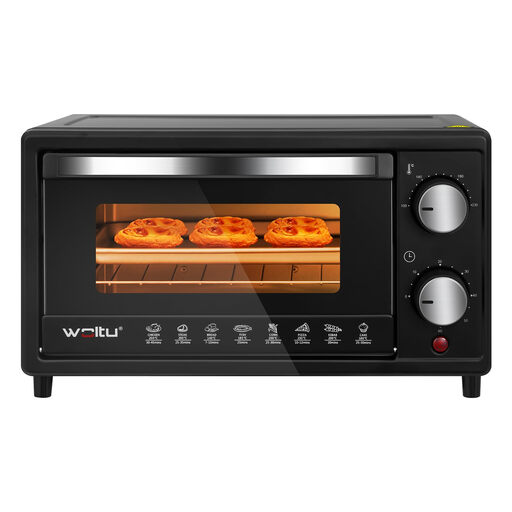
Its smaller stated capacity may suit small portions; check whether your oven dish will fit.
The product description lists a 10 l capacity and a temperature range of 100–230 °C.
Capacity alone doesn’t confirm that your dish will fit. Measure it on the outside, including the handles, and compare its width, depth and height with the usable internal dimensions. Steba publishes internal dimensions of 22 × 30 × 31 cm (H × W × D) for the KB 27 U.2.
Only if the space meets the requirements for that specific model. For the TO 2068, Severin specifies a minimum clearance of 12 cm at the sides and back, and 30 cm above. These figures aren’t a general requirement for all mini ovens.
No. A smaller cooking capacity or lower wattage alone doesn’t guarantee savings. Compare actual energy use for the same quantity of food and allow for any additional batches you may need to cook.
For the TO 2068, Severin’s instructions say to unplug the appliance and let it cool down before cleaning; it must not be immersed in liquid. Follow the instructions for any other model you use.
Electrical equipment covered by the EU Low Voltage Directive, meaning equipment rated for 50 to 1.000 V AC, must meet the relevant EU requirements. According to Your Europe, the manufacturer uses the CE marking to declare that the product meets the applicable EU rules. Check the information for the specific version on offer.