What should you look for when buying?
First, check that your dish fits and that you can set up the oven safely. Then consider the heating functions and cleaning features to find the right model for your bake.
| What matters |
What to look for |
Who is this important to? |
| Dish fit |
Measure the outside of the dish, including its handles and height. Compare the measurements with the oven cavity, shelf positions and clearance from the heating elements. |
If I want to use a dish I already own, whether it actually fits matters more than the stated capacity. That’s why around 36% of consumers put dish fit first. |
| A safe place to put it |
Compare the oven’s external dimensions with the available space and check the clearance and ventilation requirements in the instructions for that specific model. |
If there’s little worktop space in the holiday home kitchen, I want to know whether there’s room for both the oven and the required clearances. Around 29% of consumers prioritise having a safe place to use it. |
| Heating functions and shelf position |
Check whether you can select top and bottom heat, and which shelf position the instructions recommend for browning the top. |
To get a golden cheese topping, I want to be able to set the heating function and position the dish appropriately. Around 21% of consumers prioritise having a choice of heating functions. |
| Cleaning |
Check what’s included, whether the crumb tray can be removed, and the care instructions for the oven cavity and accessories. |
After cooking, I want to be able to reach the crumb tray and oven cavity easily, and follow the cleaning instructions. Around 14% of consumers focus mainly on cleaning. |
Mini ovens at Joybuy
This selection includes compact and medium-sized mini ovens with baking and/or grilling functions. For each model, check that your dish fits and that the location meets the requirements for that particular appliance.
 No image available
Woltu BF12sz mini oven, 32 l, black
With baking and grilling functions, this model is worth considering if you want to use your oven for bakes and other dishes.
32 l; 1600 W; temperature range 100 to 250 °C; timer; crumb tray.
View at Joybuy
 No image available
Woltu mini oven, 10 l, white
With top and bottom heat, this compact model is an option if your dish is small enough to fit and you have limited space.
10 l; temperature range 100 to 230 °C; external dimensions 37 × 26,5 × 21 cm.
View at Joybuy
 No image available
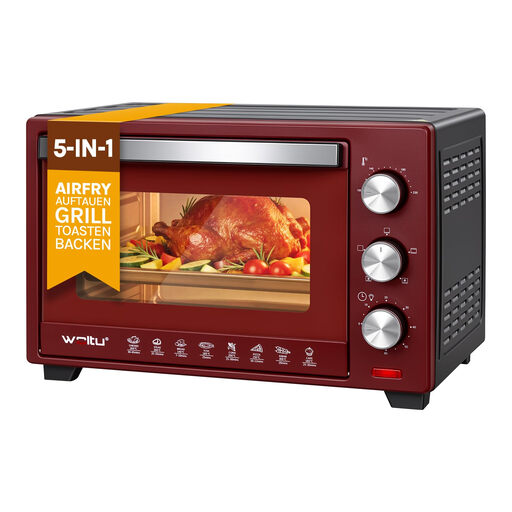
Woltu mini fan oven, 28 l, red and black
The choice of top and bottom heat, as well as the combined setting, is useful if you want to tailor the cooking to baking and browning the top.
28 l; temperature control; timer; three shelf positions; removable crumb tray.
View at Joybuy
Frequently asked questions
How can I check whether my dish will fit?
Measure the outside of the dish, including its rim and handles, as well as its height. Compare these measurements with the interior and shelf positions of the specific oven. Capacity figures or the external dimensions of a baking tray aren’t enough.
Can I put a mini oven under a wall cupboard?
There’s no single answer: follow the setup and ventilation requirements in the instructions for your specific model, and make sure there’s enough space. The instructions for the Steba KB M19 rule out built-in use and specify a 10 cm gap between the oven and the kitchen wall behind it.
What should I bear in mind when cleaning after a bake?
Let the appliance cool down and follow the cleaning instructions. Before buying, check whether the crumb tray and any trays you’ll use can be removed. Clatronic lists a removable crumb tray for the MBG 3727, while Severin says the TO 2068 has removable, dishwasher-safe parts.
Can I work out the electricity cost of a bake from the wattage?
No. The rated power alone doesn’t tell you how much electricity a baking cycle actually uses. To calculate the cost, you’ll need the consumption in kWh and your electricity price per kWh. Cooking time and how you use the oven also affect consumption.
Does a portable mini oven in Germany need an EU oven energy label?
Under the European Commission’s rules, small and portable ovens are outside the scope of the energy-labelling requirements for household ovens. So the absence of an oven energy label alone doesn’t prove that such an oven is being offered unlawfully.
What marking should I check on a new mains-powered mini oven?
If a new mains-powered appliance sold on the German market falls within the voltage range of the EU Low Voltage Directive 2014/35/EU, the manufacturer must carry out the relevant conformity assessment procedure, issue an EU Declaration of Conformity and apply the CE marking. Whether a particular product meets the requirements must be checked individually; the CE marking isn’t proof of independent product testing.


