What should you look for when buying?
For its 25 × 11 cm marble cake recipe, Dr. Oetker gives a baking time of around 55 minutes. Manufacturers publish different internal dimensions and clearance requirements for different appliances, so check that your tin will fit and that the space available suits the specific model.
| Buying consideration |
What to check |
Who it matters most to |
| Loaf tin fit |
External dimensions, including handles, and clearance above the mixture. |
If I want to keep using my tin, including for a cake as it rises, usable width, depth and height are key. Around 36% of consumers put loaf tin fit first. |
| A safe place to position it |
External dimensions, room for the door to open and model-specific clearances. |
With limited worktop space, I want to know whether the appliance and its required clearances will fit in the intended spot. Around 29% of consumers prioritise finding a suitable place for it. |
| Heating function and timer |
The heating function you need and the timer setting for a longer baking session. |
If I want to follow the recipe’s recommended heating function and baking time as closely as possible, the controls on the specific oven matter. Around 21% of consumers look first at the heating function and baking controls. |
| Running costs and cleaning |
Energy consumption figures based on the same test method, and cleaning options. |
If you use your oven regularly, you’ll want to get an idea of its energy use and how much effort it takes to clean. Around 14% of consumers prioritise running costs, cleaning and service. |
Suitable products at Joybuy
These freestanding mini ovens include both compact and more spacious designs. Check the specifications for each model against your loaf tin and the space available.
 No image available
WOLTU BF12sz mini oven
Described as a mini oven for preparing a range of dishes; the product details list baking and grilling.
Features listed include a timer and a removable crumb tray.
View at Joybuy
 No image available
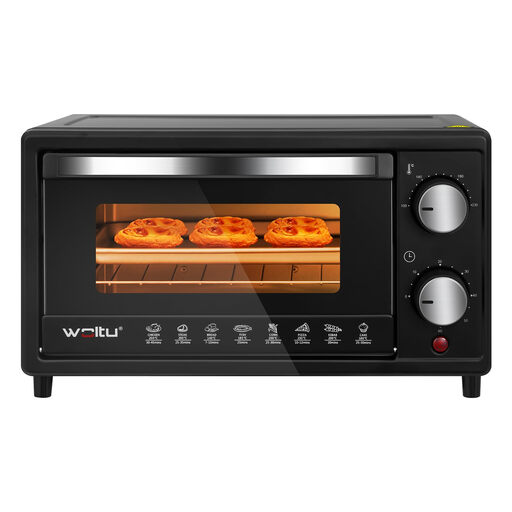
WOLTU 10 l mini oven
This compact design is an option if saving space is your priority and you’ve confirmed that your tin will fit.
Specifications include a capacity of 10 l, 800 W, a temperature range of 100–230 °C, top and bottom heat, and a programmable 60-minute timer. Dimensions are listed as 37 × 26.5 × 21 cm.
View at Joybuy
 No image available
WOLTU 28 l mini convection oven
The larger cooking space may suit you if you’re planning to prepare other dishes as well as marble cake. You’ll still need to check that there’s enough height for your tin.
Specifications include a capacity of 28 l, a temperature range of 100–230 °C, three heating modes and a mechanical 60-minute timer.
View at Joybuy
Frequently asked questions
Can I choose an oven for a 25 × 11 cm loaf tin based on its litre capacity alone?
No. The litre capacity describes the oven’s cooking volume, not whether a particular tin will fit. Measure the outside of your tin and check the usable internal dimensions, shelf position and clearance for the cake as it rises.
Can I save space by putting a freestanding mini oven in a cupboard?
It depends on the instructions for the specific appliance. Steba explicitly says the KB M19 isn’t a built-in oven and requires 10 cm between the back of the appliance and the kitchen wall. The manufacturer specifies different minimum clearances for the Rommelsbacher BG 1055/E. These instructions apply to the models mentioned, not to all mini ovens.
What temperature and baking time should I use for marble cake?
For a 25 × 11 cm loaf tin, the Dr. Oetker recipe gives a temperature of around 180 °C using top and bottom heat, or around 160 °C with convection, and a baking time of about 55 minutes. These are recipe instructions, not tested performance figures for a specific mini oven.
Will a small oven definitely use less electricity when baking a cake?
Not simply because it’s smaller or has a lower wattage. To compare appliances, you need energy consumption figures based on the same test method; the Verbraucherzentrale highlights actual appliance consumption as the key factor.
What happens if it develops a fault: a guarantee or statutory rights?
The Verbraucherzentrale distinguishes statutory consumer rights against the seller from an additional voluntary guarantee, which has its own terms and conditions. When buying, check who the seller is and what guarantee terms apply to the specific appliance.
Is the CE mark an independent award for especially good baking results?
No. According to the European Commission, the manufacturer uses the CE marking to declare that the applicable EU product requirements have been met; it isn’t an independent test comparing baking results. Mains-powered appliances covered by the EU Low Voltage Directive must meet the requirements set out for them.


