First, measure your loaf tin, including its rim, and compare it with the oven’s usable internal width, depth and height. The capacity in litres alone won’t confirm that your tin – or a risen cake – will fit. Then choose a heating setting and timer that suit your recipe, and check that the oven will fit safely in its intended spot. A smaller appliance only saves space if the tin and its position both work in practice.
Who is a mini oven suitable for?
Bakers with a loaf tin they already own
You want to use your existing tin to make a marble cake in several lunchbox-sized portions. Compare the tin’s length, width and height with the usable interior space. Dr. Oetker has a recipe that uses a 25 × 11 cm loaf tin.
Bakers short on worktop space
You need an oven that fits safely in a small kitchen, and would be happy to use a smaller tin and make a smaller cake if needed. As well as the appliance’s width, check there’s room to open the door and follow the model’s installation instructions.
Regular users of small ovens
You want to cook more than marble cake, so you’ll need to weigh up additional heating options against the appliance’s dimensions and ease of use. The specifications for the Severin TO 2068 and Rommelsbacher BGE 1580/E show some of the features available.
What should you look for when buying?
Start by checking whether your tin fits, then check where you’ll put the oven. After that, match the heating settings and timer to your recipe.
| Buying priority |
What to check |
Who it matters most to |
| Loaf tin fit |
Compare the tin, including its rim and handles, with the usable internal width and depth, and the height above the shelf. |
If I want to keep using my existing tin to make several lunchbox-sized portions, there must also be enough room above the risen cake. Around 36% of shoppers put fit first. |
| A safe place for the oven |
Allow for the appliance’s full dimensions, the space needed to open the door and the installation instructions in the manual. |
If my kitchen has little spare worktop space, I need a suitable spot where the oven can stand securely and the door can open. Around 29% of shoppers prioritise where to put it. |
| Heating settings and timer |
Match conventional top-and-bottom heat or fan-assisted cooking to the recipe, and check the timer duration and controls. |
If I want to follow a marble cake recipe, the right heating setting and easy-to-use controls for the baking time matter. Around 21% of shoppers put this first. |
| Extra features and ongoing costs |
Only pay for features you’ll actually use; don’t treat the wattage as the energy used for one baking session. |
If I want to use the oven for other dishes too, I weigh up extra features against the space it takes up and its running costs. Around 14% of shoppers prioritise versatility and ongoing costs. |
Common buying misconceptions
-
Assuming the oven’s capacity guarantees your tin will fit
A capacity in litres won’t tell you whether your loaf tin, including its rim, will fit, or whether there’ll be enough room above the cake.
Measure your tin and compare its outside dimensions with the appliance’s usable interior space and shelf height.
-
Allowing only for the oven’s external dimensions
You’ll also need to account for the appliance’s full width, the space needed to open the door and the clearances in the manual. The manufacturer lists the Rommelsbacher BG 1805/E as 55 cm wide, including its feet.
Check that your intended spot works with the appliance’s full dimensions and model-specific installation instructions.
-
Overlooking conflicting voltage information
A retailer’s listing alone can’t confirm that the specific version of an appliance is suitable for the socket you plan to use.
Before plugging it in, check the voltage on the rating plate and compare it with the manufacturer’s official documentation.
-
Assuming extra features or wattage mean better or cheaper cakes
A rotisserie or pizza stone won’t solve a fit problem. And the electrical power rating doesn’t tell you how much energy it takes to bake a whole marble cake.
Prioritise a suitable tin and heating setting. Consider other features only if you’ll use them, and compare energy figures on a like-for-like basis.
Brands and models to consider
Caso
The TO 26 SilverStyle is an example of a medium-sized countertop oven with published internal dimensions.
- According to Caso Design, it has a 26-litre capacity, internal dimensions of 350 × 200 × 300 mm (width × height × depth), top and bottom heat, fan-assisted cooking and a timer of up to 120 minutes.
- The internal dimensions alone don’t confirm how much space there’ll be above a cake tin. A rotisserie and pizza stone aren’t essential for baking marble cake.
Severin
The TO 2068 is a 20-litre option with several heating settings for cakes and other dishes.
- Severin says you can select top and bottom heat and fan-assisted cooking separately or together. The appliance also has four shelf positions and an interior light.
- Before buying, check your tin’s dimensions against the usable interior space and the height available on the shelf you plan to use.
Rommelsbacher
The BGE 1580/E and BG 1805/E are examples of larger compact ovens, offering more room and extra ways to cook.
- The manufacturer lists the BGE 1580/E as having a 30-litre capacity, four shelf positions and a timer of up to 120 minutes. The BG 1805/E is listed as 55 cm wide overall, including its feet.
- These specifications apply to the models listed, not the entire range. Extra oven space takes up more room and isn’t automatically worthwhile if you’re only baking one loaf cake.
Clatronic
The MB 3746 is a very compact oven, worth considering only if you’ve confirmed that a small cake tin will fit.
- According to Clatronic, the model has an 8-litre capacity, top and bottom heat, two shelf positions and a timer of up to 60 minutes.
- Its capacity doesn’t tell you whether a particular tin will fit or if there’ll be enough room above a risen cake.
Tristar
The OV-3615 is another example of a small oven for shoppers who want to use a small baking tin.
- Tristar lists a 10-litre capacity, top and bottom heat and a timer of up to 60 minutes.
- Before choosing it, check that your particular tin will fit, with enough room for the cake to rise.
Mini ovens at Joybuy
The WOLTU mini ovens below have capacities of 10, 28 and 32 litres, with different sizes and features. Check that your tin fits the specific model and review its individual specifications; capacity alone isn’t a substitute for measuring.
 No image available
WOLTU BF12sz mini oven, 32 litres, black and red
For marble cake, check your tin’s dimensions and shelf height against the appliance’s usable interior space.
Specifications include a 32-litre capacity, 1,600 W, a temperature range of 100–250 °C, a timer and a removable crumb tray. The external dimensions are 52.3 × 36 × 32.2 cm.
View at Joybuy
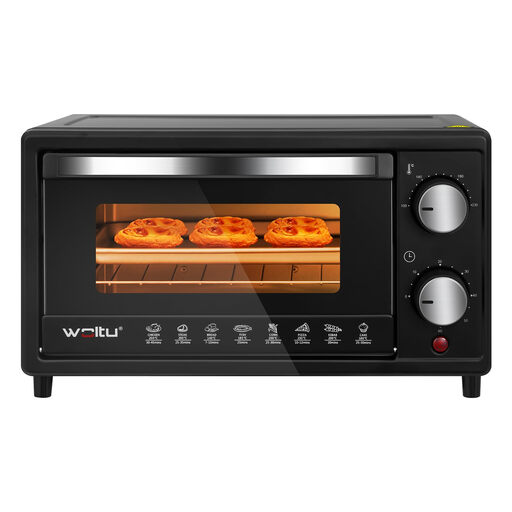 No image available
WOLTU mini oven, 10 litres, with top and bottom heat
This compact model is suitable for marble cake only if your tin fits, with enough room for the cake to rise.
Specifications include a 10-litre capacity, 800 W, top and bottom heat, a temperature range of 100–230 °C, a timer of up to 60 minutes and external dimensions of 37 × 26.5 × 21 cm.
View at Joybuy
 No image available
WOLTU mini convection oven, 28 litres
If you’d like to use the oven for other dishes too, check that your loaf tin fits on one of the shelves before considering the features.
Specifications include a 28-litre capacity, three heating settings, three shelf positions, a temperature range of 100–230 °C and a timer of up to 60 minutes.
View at Joybuy
Frequently asked questions
Can I use the temperature from a standard marble cake recipe?
Start with the recipe’s temperature for the heating setting you’ve chosen. For a recipe using a 25 × 11 cm loaf tin, Dr. Oetker recommends around 180 °C with top and bottom heat, or 160 °C with fan-assisted cooking, and a baking time of around 55 minutes. These are recipe timings, not a guarantee for every mini oven or tin, so keep an eye on the cake and follow the appliance instructions too.
What should I bear in mind when positioning and cleaning the oven?
Follow the installation and connection instructions in the manual for your specific model. Severin’s manual for the TO 2068 warns that accessible surfaces can get hot, and says to unplug the appliance and let it cool before cleaning. These instructions apply to that model.
What does the wattage tell me about the cost of baking a marble cake?
The wattage doesn’t measure the energy used for a complete baking session. To compare costs, you’ll need the energy use in kWh on a like-for-like basis, as well as your electricity tariff. The Verbraucherzentrale explains how electricity consumption per standard baking session is stated.
What markings and documents should an electric mini oven for Germany have?
For a mains-powered household appliance covered by the relevant EU product rules, check for the CE marking and the required documentation. The Bundesnetzagentur lists German-language instructions with the necessary usage and safety warnings as something to check. The CE mark is the manufacturer’s declaration of conformity, not an independent quality mark.
Does marble cake for a lunchbox need to be kept chilled?
That depends on the ingredients and toppings in the finished portion. If it contains perishable ingredients, follow their storage guidance and keep them chilled during transport. The Bundesinstitut für Risikobewertung recommends keeping perishable food as cold as possible until it is eaten or prepared.


