What should you look for when buying?
LECKER’s mushroom quiche recipe calls for a tin measuring 27/28 cm in diameter. Rommelsbacher specifies a maximum tin size of 25 cm for the BG 1055/E, while the manufacturer states that the BG 1550 can take tins up to 29 cm and CASO gives a maximum of 30 cm for the TO 26 SilverStyle. So, before choosing extra features, compare the maximum tin size for the specific model with your own tin.
| Concern |
What to check before buying |
Who it matters most to |
| Tin fit |
Compare the outside diameter of your tin with the explicitly stated maximum tin size. |
If I want to keep using my existing tart tin, it needs to fit in the oven. Around 28% of consumers cite this as their main concern. |
| Coordinating timings |
Check the timer duration, end-of-cycle alert and how easy it is to read the time and temperature settings. |
If we’re sharing the preparation and deciding when to start baking, everyone needs to be able to see the set baking time. Around 22% of consumers prioritise coordinating the baking stage. |
| Heating settings |
Check whether you can select top and bottom heat and, if needed, fan-assisted heat. |
If I want to choose the right heating setting for my recipe and check the result, this option is essential. It is a main concern for around 22% of consumers. |
| Space for the oven |
Allow for the oven’s dimensions, door clearance and the gaps specified in the manual for the particular model. |
If my worktop space is limited, I need room for the oven and the required clearances. Around 17% of consumers focus above all on finding a suitable place for it. |
| Cleaning and everyday use |
Check which parts can be removed and read the cleaning instructions; only compare energy consumption figures measured on the same basis. |
If I bake often, I want to remove any residue easily and get a clear idea of running costs. For around 11% of consumers, maintenance and ongoing costs are the main concern. |
Mini ovens at Joybuy
This Joybuy selection includes mini ovens and a pizza oven with details on baking, heating settings or timers. Check each model’s fit for your tin and suitability for the baking time you have in mind.
 No image available
WOLTU BF12sz mini oven, 32 litres, white
The 60-minute timer with automatic switch-off is designed for a timed baking stage.
Adjustable temperature: 100 to 250 °C; power: 1600 W. A crumb tray is mentioned in the product name.
View at Joybuy
 No image available
WOLTU mini oven, 10 litres, white
Top and bottom heat and a programmable timer are listed for coordinating a baking stage.
Adjustable temperature: 100 to 230 °C; timer: 60 minutes. The product name mentions a pizza function.
View at Joybuy
 No image available
WOLTU mini convection oven, 28 litres, black
The product description lists three heating settings and a 60-minute timer with an audible alert.
Adjustable temperature: 100 to 230 °C; settings listed are top heat, bottom heat and combined heat.
View at Joybuy
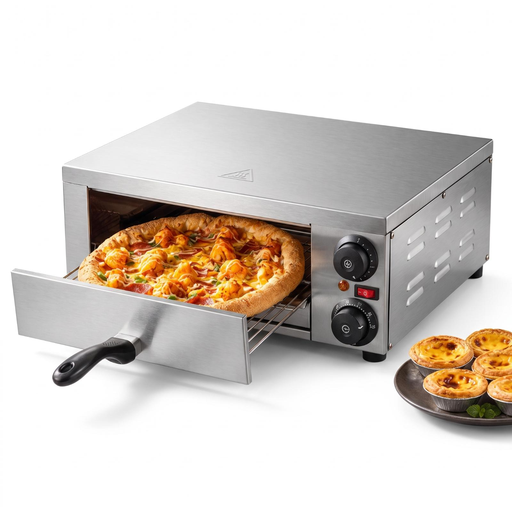 No image available
Stainless steel pizza oven, 2000 W
The description lists smaller baked goods as another possible use, alongside pizza.
Temperature control up to 350 °C; the timer with end-of-cycle alarm is limited to 15 minutes. The 45–50-minute baking time in the LECKER recipe would require you to reset it.
View at Joybuy
Frequently asked questions
Can I use the same baking time for a mushroom quiche as I would in a full-size oven?
Not as a guaranteed setting. LECKER’s recipe gives a baking time of 45–50 minutes in a preheated oven for a 27/28 cm tin, with different settings depending on the type of heat. Check the tin fit, heating setting and result in your own oven.
Can I place the mini oven right next to a wall or inside a cupboard?
Follow the instructions for the model you’ve bought. Steba requires a 10 cm gap between the back of the KB M19 and the kitchen wall, and says it must not be used as a built-in oven. This requirement doesn’t automatically apply to other models.
How should we store prepared ingredients or leftover tart if the meal is delayed?
Don’t leave ingredients that need to be kept chilled out of the fridge simply because you’re coordinating the timings. The German Federal Institute for Risk Assessment advises keeping perishable foods as cold as possible until they’re used. How you store and reheat the cooked tart will depend on the ingredients and the relevant food hygiene advice.
How can I compare the running costs of a mini oven?
Compare consumption figures only when they’re measured on the same basis, and take your electricity tariff into account. The Verbraucherzentrale recommends checking the oven’s actual energy consumption; wattage alone doesn’t tell you how much energy a single baking cycle will use.
Is CE marking relevant for an electric mini oven in Germany?
Yes, if the appliance is covered by the relevant harmonised EU legislation: the required CE marking must be affixed before the product is placed on the market. It is the manufacturer’s declaration of conformity, not an independent quality mark. Check the marking and details for the specific appliance being offered.


