Start by choosing a mini oven based on the outer dimensions of your tart tin and the space the appliance needs, including the required clearances. Then compare the heating settings and cleaning requirements. Manufacturers’ details about tin sizes and features aren’t baking tests for mushroom tart.
Which oven is right for you?
Tart makers with a tin already in mind
If you want to keep using a particular tart tin, compare its full external dimensions with the details for the specific oven. Rommelsbacher, Severin and Caso list the maximum tin diameters for individual models.
Housemates short on space
For a shared worktop, consider both the appliance’s dimensions and the installation requirements for the specific model. Rommelsbacher lists required clearances from the walls and above the appliance for certain mini ovens.
Housemates who bake different recipes
If you want to use the oven for a range of recipes, compare the heating settings, controls and removable parts for cleaning. Available features vary by model.
What should you look for when buying?
For a mushroom tart in a shared kitchen, start by deciding what matters most when choosing an oven.
| What matters |
What to check before buying |
Who should pay particular attention? |
| Tart tin fit |
Measure the external diameter and height; compare them with the model specifications and usable oven space. |
If I want to use my existing tin, it needs to fit in the oven with the rim in place. Around 29% of consumers put finding the right fit first. |
| A safe place to set it up |
Measure the worktop and available clearance; follow the instructions for the specific model. |
In a shared house, the oven needs to fit without making the shared worktop impractical to use. For around 29% of consumers, finding a suitable place for it is the top priority. |
| Heating settings for your recipe |
Compare the heating setting and temperature required by the recipe with those available on the specific model. |
If I bake different recipes, I want to be able to choose suitable heating settings. Around 24% of consumers prioritise compatibility with their recipes. |
| Sharing the oven |
Check the controls, timer and removable crumb tray or baking tray; agree on how it will be cleaned. |
If several people use the oven, it should be practical for everyone to operate and clean. Around 18% of consumers put ease of shared use first. |
Avoid common buying mistakes
-
Choosing based on capacity alone
The stated capacity doesn’t tell you whether a particular round tin will fit, including its rim and handles. Specifications can vary even between small appliances.
Measure the outside of your tin and compare it with the details for the model you’re considering.
If the tin doesn’t fit, you may need a smaller one.
-
Pushing the oven under a cupboard with little clearance
The required clearances can take up more space than the appliance itself. Certain Rommelsbacher models have their own installation requirements.
Measure the available space and check the instructions for the exact model you want to buy.
If you can’t leave the required clearance where you plan to put it, you’ll need to find another spot for the appliance.
-
Assuming results apply to similarly named models
A test result for the Caso TO 26 Classic isn’t a verdict on the Caso TO 26 SilverStyle. Haus & Garten Test listed these as different model names in 2022.
Check the full model name and product number before applying an older test result to an appliance on sale.
Key brands at a glance
Rommelsbacher
Rommelsbacher lists different maximum tin diameters for the BG 1055/E and BGE 1580/E models.
- The manufacturer lists top and bottom heat and fan-assisted cooking for both models.
- Rommelsbacher lists a maximum diameter of 25 cm for the BG 1055/E and 29 cm for the BGE 1580/E. The installation requirements for each model mean you’ll need additional clearance.
Severin
The manufacturer’s specifications for the TO 2067 and TO 2058 differ in oven capacity and features.
- Severin lists a capacity of 20 litres and tins up to 30 cm in diameter for the TO 2067. The TO 2058 is listed at 42 litres, with fan-assisted cooking and four shelf positions.
- According to the manufacturer, the TO 2067 doesn’t have a fan-assisted setting. The larger TO 2058 needs more space; its features aren’t standard across all Severin models.
Caso
Caso lists a 26-litre capacity and tins up to 30 cm in diameter for the TO 26 SilverStyle.
- The manufacturer lists top and bottom heat, fan-assisted cooking, an interior light and a removable crumb tray.
- The included pizza stone alone doesn’t prove that the oven is particularly suitable for baking a mushroom tart.
Steba
Steba describes the KB 27 U.2 as a 20-litre compact oven with continuous fan-assisted cooking and independently selectable top and bottom heat.
- The manufacturer lists internal dimensions of 22 × 30 × 31 cm (H × W × D).
- The maximum tart tin size can’t be determined from the internal dimensions alone. Check that your tin fits by referring to the instructions for the specific appliance.
Joybuy products for baking
This selection from Joybuy includes mini ovens and pizza oven models for baking. For a mushroom tart, the tin size, heating setting and installation requirements for the specific appliance all need to work together.
 No image available
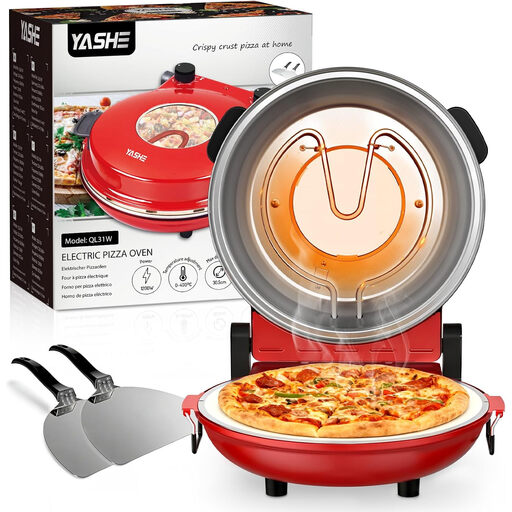
YASHE QL31W pizza oven, 1200 W, 30 cm ceramic stone
This model may be suitable for a mushroom tart if your tin fits and the heating setting works for the recipe.
The product name lists top and bottom heat, a built-in timer and a viewing window.
View at Joybuy
 No image available
WOLTU BF12sz mini oven, 32 litres
Before buying, check that your tart tin will fit and that there’s enough room for the appliance, including the required clearances.
The product name lists 1600 W, a timer, a removable crumb tray and a temperature range of 100 to 250 °C.
View at Joybuy
 No image available
WOLTU mini oven, 10 litres
The compact oven capacity could be useful in a small kitchen, but still compare your tin’s dimensions with the appliance specifications.
The product name lists a pizza setting and a temperature range of 100 to 230 °C.
View at Joybuy
 No image available
WOLTU mini convection oven, 28 litres
If you’re considering this appliance for a tart, check that your tin fits and that it has a suitable setting for your recipe.
The product name lists a temperature control and a timer.
View at Joybuy
 No image available
23-litre mini oven with dual-zone air fryer
For a mushroom tart, check specifically that the oven function and usable capacity suit your tin and recipe.
The product name lists an LED touchscreen and 15 programmes.
View at Joybuy
Frequently asked questions
Is the capacity in litres enough to tell me whether my tart tin will fit?
No. Compare the outside diameter and height of your tin with the details for the specific model. Rommelsbacher lists tins up to 25 cm in diameter for its 18-litre BG 1055/E oven; Severin lists tins up to 30 cm in diameter for its 20-litre TO 2067.
Can I put a mini oven under a wall cupboard?
It depends on the appliance and where you plan to put it. For certain models, including the BG 1055/E and BGE 1580/E, Rommelsbacher specifies a 4 cm clearance at the back and sides, with at least 100 cm of clear space above. Don’t apply these figures to appliances from other manufacturers; check the instructions for the specific model.
What makes an oven easier to clean after baking in a shared house?
Check whether the crumb tray or crumb drawer is removable, and follow the cleaning instructions. Rommelsbacher lists a removable crumb tray for the BGE 1580/E; Caso lists a removable crumb drawer for the TO 26 SilverStyle.
What does the CE marking mean on an electric mini oven?
For electrical products covered by the 1. ProdSV, CE marking is required before they can be made available. The Federal Institute for Occupational Safety and Health explains that the regulation transposes the European Low Voltage Directive into German law. The marking isn’t a verdict on how well an appliance bakes.
Are a guarantee and the statutory warranty the same thing?
No. The statutory warranty covers defects and applies to the retailer; a guarantee is an optional additional promise with its own terms. The Verbraucherzentrale distinguishes between these two rights and states that new goods have a two-year statutory warranty.


