If you’re making a nut roast in a small kitchen, first check your loaf tin and a safe place for the oven against the specifications for the exact model. The external dimensions and capacity in litres alone won’t confirm that your tin will fit or that there’s enough clearance. A larger appliance is only worth considering if you can make use of the extra capacity and have space to position it safely.
Who is this guide for?
Cooks short on counter space
If you want to use a freestanding oven on a small worktop, you’ll also need to allow for the required clearance around and above the appliance. Rommelsbacher and Steba include guidance on positioning in their manufacturers’ instructions.
Nut roast bakers using a loaf tin
If you want to keep using your loaf tin, check its dimensions against the usable oven cavity and shelf position. The recipe from eat.de gives an example of a tin measuring around 25 × 11 × 7 cm.
Versatile mini oven users
If you want to cook more than just nut roast, weigh up the heating functions and oven capacity against the space you have available. Rommelsbacher and Steba describe different heating and control options for their respective model ranges.
What should you look for when buying?
| Buying priority |
What to check before you buy |
Who it matters most to |
| A safe place to position the oven |
Measure your worktop and the clearance around the appliance; check the distances specified in the instructions for the exact model. For the BG 1055/E, Rommelsbacher specifies 4 cm at the sides and 1 m above. |
If my worktop is small, I need to make room for the required clearance as well as the appliance itself. Around 34% of consumers put safe positioning first. |
| Loaf tin fit |
Check your tin, including any handles, against the usable width, depth and height of the oven cavity, as well as the shelf position. CASO Design gives dimensions of 300 × 170 × 290 mm (W × H × D) for the TO 20 SilverStyle, while Steba lists 22 × 30 × 31 cm (H × W × D) for the KB 27 U.2. These measurements alone don’t confirm a safe fit. |
If I want to use a particular loaf tin, the usable space in the oven and the distance from the heating elements matter. Around 33% of consumers prioritise finding a tin that fits. |
| The right heating functions |
Check whether convection and, if needed, top and bottom heat can be selected. eat.de specifies 180 °C with convection for its nut roast recipe; LEBENSBAUM specifies 180 °C with top and bottom heat. |
If I make different nut roast recipes, I want to be able to choose the right heating function for each one. Around 20% of consumers prioritise flexibility in heating functions. |
| Controls, cleaning and running costs |
Check that the timer suits your recipe’s cooking time and that the cleaning options work for the way you’ll use the appliance. The Verbraucherzentrale recommends looking at actual electricity consumption rather than relying on the wattage alone. |
If I use the oven regularly, easy controls, cleaning and clear information about energy use are important to me. Around 13% of consumers prioritise these practical everyday considerations. |
Common buying mistakes
-
Measuring only the appliance beneath a wall cupboard
An appliance might fit on your worktop but still not have the clearance required for that model. Rommelsbacher specifies 4 cm at the sides and 1 m above the BG 1055/E.
Before buying, compare the instructions for the exact model with the space you actually have available.
-
Assuming a measurement for round tins means a loaf tin will fit
Rommelsbacher’s specification of “baking tins up to 25 cm Ø” doesn’t confirm that a rectangular loaf tin with the same dimensions will fit in the usable oven cavity.
Measure your tin and check the oven cavity, shelf position and guidance on clearance from the heating elements.
-
Using wattage or oven capacity to estimate electricity costs
The wattage alone doesn’t tell you how much electricity a particular cooking session will use. The Verbraucherzentrale recommends checking actual consumption.
Only compare consumption figures if they use the same unit and relate to a similar cooking session. Then calculate the cost using your electricity tariff.
Brands and model ranges to consider
The details below apply to the specified model ranges and aren’t blanket recommendations for each brand. Check the dimensions, heating functions and positioning guidance for the exact model.
Rommelsbacher
The BG 1055/E is listed as 18 l, while the BGE 1580/E is 30 l. Rommelsbacher describes both models as having top and bottom heat with optional convection.
- According to Rommelsbacher, the selectable heating functions give you the option to cater for different recipe requirements.
- For the BG 1055/E, Rommelsbacher specifies 4 cm of clearance at the sides and 1 m above. The stated limit for round baking tins doesn’t confirm that a loaf tin will fit.
CASO Design
The TO 20 SilverStyle is a freestanding mini oven with a capacity of around 20 l; CASO Design publishes its internal dimensions.
- CASO Design lists internal dimensions of 300 × 170 × 290 mm (W × H × D), as well as convection and several top and bottom heat settings.
- The internal dimensions alone don’t confirm that a tin can be positioned safely or that there’ll be enough clearance from the heating elements. Also check the instructions and the space where you plan to use it.
Steba
Steba lists the KB 27 U.2 as having a capacity of 20 l and publishes its internal and external dimensions.
- Steba lists internal dimensions of 22 × 30 × 31 cm (H × W × D), with top and bottom heat that can be switched on separately.
- According to Steba, convection runs continuously. If your recipe needs to be cooked without convection, check that this control setup will work for you.
Severin
The TO 2068 is a 20-l baking and toast oven with convection.
- Severin describes top and bottom heat and convection as selectable separately or together.
- Severin lists external dimensions of 29,5 × 44 × 39 cm (H × W × D). External dimensions are no substitute for the oven’s internal measurements or the required positioning clearances.
Joybuy product selection
This selection includes mini ovens and air fryer ovens described as suitable for baking or convection cooking. For each model, check that your loaf tin will fit and that you have enough space to position the appliance.
 No image available
WOLTU BF12sz mini oven, 32 l
The product details list baking and grilling. Check that the appliance and its oven cavity will suit your loaf tin and the space you have available.
32 l; 1600 W; timer up to 60 minutes; temperature range 100–250 °C; crumb tray.
View at Joybuy
 No image available
WOLTU mini oven, 10 l
The description says it bakes using top and bottom heat. Check the dimensions of your tin and the required clearance against the specifications for the exact appliance.
10 l; temperature range 100–230 °C; timer up to 60 minutes; stated external dimensions 37 × 26,5 × 21 cm. When comparing measurements, check which figure refers to height, width and depth.
View at Joybuy
 No image available
WOLTU mini convection oven, 28 l
The product title describes this as a convection oven; the description lists top heat, bottom heat and combined heat. Check that the settings suit your recipe.
28 l; 1600 W; temperature range 100–230 °C; timer up to 60 minutes.
View at Joybuy
 No image available
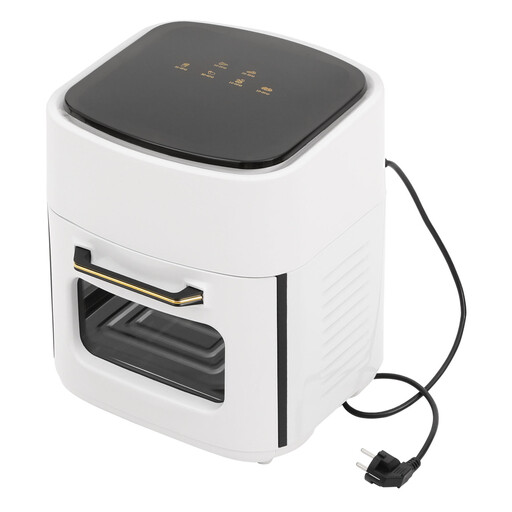
15L Smart Air Fryer Oven
The description mentions 360° circulating heat and preset programmes, including one for nuts. Check that the oven cavity and accessories can accommodate your loaf tin.
15 l; 1400 W; touch controls; viewing window.
View at Joybuy
 No image available
ROUNY 6.5L Air Fryer Oven
The description mentions hot air circulation and a temperature range that includes 180 °C. Before buying, check that your tin will fit in the oven cavity.
6,5 l; temperature range 80–200 °C; rotary controls; viewing window; stainless steel basket.
View at Joybuy
Frequently asked questions
Is the capacity in litres enough to choose the right loaf tin?
No. Compare the length, width and height of your tin, including any handles, with the usable internal dimensions and shelf position. Also follow the instructions on clearance from the heating elements. A recipe example from eat.de uses a tin measuring around 25 × 11 × 7 cm, but yours may be a different size.
Can I put a freestanding mini oven beneath a wall cupboard?
Only if the position meets the instructions for the exact model. For the Rommelsbacher BG 1055/E, Rommelsbacher specifies 1 m of ventilation clearance above the appliance. This guidance shouldn’t be assumed to apply to other models.
How should I cook my first nut roast using convection?
Choose the heating function and starting settings according to your recipe and the appliance instructions. eat.de specifies 180 °C with convection for around 60–70 minutes; LEBENSBAUM specifies 180 °C with top and bottom heat for around 50–60 minutes. These recipe timings aren’t guaranteed for every oven or mixture.
What are my rights when buying an oven online?
For a qualifying distance purchase from a business seller, you generally have 14 days from delivery to cancel, although exceptions may apply. Faulty goods are also covered by a statutory guarantee of at least two years from receipt. The European Union explains these rights on Your Europe; a voluntary manufacturer’s warranty is separate.


