Limited worktop space, smaller loaf
You’re looking for a compact countertop oven and can choose a nut roast tin to fit the usable cooking space. Remember to allow for the required clearance from walls and cupboards, too.


When choosing a mini oven for nut roast, first check the external dimensions and the required clearance. Then compare the width, depth and filled height of your tin with the usable cooking space. Capacity in litres alone isn’t enough: very compact models take up less worktop space but limit your choice of tin, while larger models need more room and may offer additional heating functions.
You’re looking for a compact countertop oven and can choose a nut roast tin to fit the usable cooking space. Remember to allow for the required clearance from walls and cupboards, too.
You want to keep using a tin you already own, so you need suitable internal dimensions and enough height for the filled loaf. The capacity in litres alone won’t tell you whether the tin will fit.
You’re considering a larger model if you want to cook other dishes as well as nut roast, or choose between several heating functions. Check that you have room for the extra space it will take up.
First, measure the available space, allowing for the clearances specified in the instructions for the model you’re considering. Then compare the dimensions of your tin with the cooking space, and decide which heating functions and controls you actually need.
| What matters when buying | What to check | Who is this important to? |
|---|---|---|
| Worktop space and positioning | Allow for the external dimensions, door opening and clearances specified in the instructions for the exact model. | If worktop space is limited, the oven and the required clearance need to fit where I plan to put it. Around 36% of consumers prioritise worktop space and positioning. |
| Tin and loaf height | Compare the width, depth and filled height of the tin with the internal dimensions and the clearance below the top heating element. | If I want to keep using my loaf tin, I need enough room for both the tin and the filled nut roast. Around 29% of consumers prioritise whether the tin and loaf will fit. |
| Heating function and controls | Check that the heating functions, timer and continuous operation setting suit the way you plan to cook. | If I want to cook other oven dishes as well as nut roast, I want a suitable choice of heating functions. Around 21% of consumers prioritise the heating function and controls. |
| Cleaning and operation | Check that the crumb tray and interior are easy to access; only compare energy consumption figures for similar cooking tasks. | If easy cleaning and straightforward operation matter to me, I want to take these points into account before buying. Around 14% of consumers prioritise cleaning and running costs. |
The oven may need more space than its dimensions suggest. The instructions for the Steba KB M9 require at least 10 cm of clearance all around the appliance, with the ventilation slots unobstructed.
Measure the space available, including the clearances required for your model, and check that the door can open there.
The capacity and stated maximum diameter don’t tell you whether a loaf tin and filled loaf will fit inside the oven.
Measure the width, length and filled height of the tin, then compare all three dimensions with the interior of the specific model.
The wattage alone doesn’t show how much energy it takes to cook a whole nut roast. The Verbraucherzentrale recommends taking the appliance’s actual energy consumption into account.
Only compare kWh figures when the cooking task and quantity are the same.
The BG 950 is a compact 10-l option for smaller tins and limited worktop space.
The KB M9 is a 9-l option with stated internal dimensions, making it easier to check against a tin you already own.
The TO 20 SilverStyle is an approximately 20-l option with convection, top heat and bottom heat.
The TO 2068 is an approximately 20-l countertop oven with several heating functions.
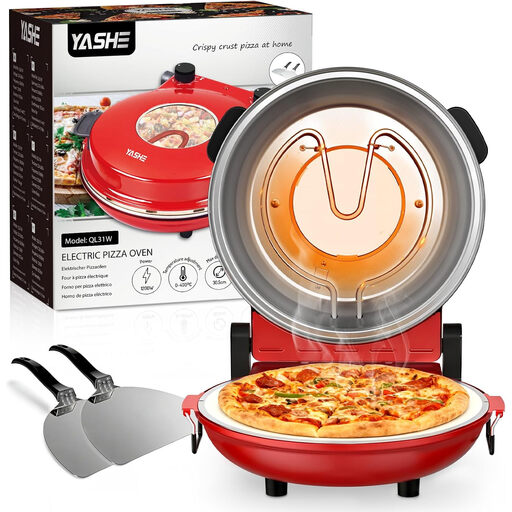
This selection includes a countertop pizza oven and mini ovens in various sizes. Whether a nut roast will fit in a particular tin depends on the internal dimensions of the appliance and the dimensions of the filled tin.
 No image available
If worktop space is tight, this countertop pizza oven is only an option if its stated footprint fits; check the internal dimensions against your tin first.
 No image available
This larger model is worth considering if your available space can accommodate its stated dimensions and the cooking space suits your tin.
 No image available
This compact model could be a good fit if its stated dimensions suit your available space. Also check that the tin and filled loaf will fit inside.
 No image available
This larger option is designed for cooking a range of oven dishes; check that you have enough worktop space and that your tin will fit inside.
Not as the only measure to go by. Rommelsbacher lists the BG 950 as having a 10-litre capacity and fitting dishes up to 20 cm in diameter. That doesn’t mean your loaf tin, filled loaf and the required clearance below the heating element will fit. Compare the width, depth and height of your tin with the usable cooking space.
There’s no single answer for every model. Steba’s instructions for the KB M9 require at least 10 cm of clearance all around, with the ventilation slots unobstructed. For other models, follow the positioning instructions provided by the manufacturer.
No. You can’t tell from the wattage and cooking space alone. Steba lists 0,240 kWh for the KB M9 during a specified 30-minute run at maximum temperature, not for cooking a whole nut roast. The Verbraucherzentrale recommends taking the appliance’s actual energy consumption into account, so compare kWh figures for the same cooking task.
The Umweltbundesamt lists local collection points and recycling centres as places where you can return old electrical appliances free of charge. Check with your local authority to find out how collection works in your area.
New 230 V electric mini ovens placed on the market in Germany and covered by the EU Low Voltage Directive must undergo the required conformity assessment, including CE marking. The European Commission describes the scope of the directive; according to EUR-Lex, the marking indicates the manufacturer’s declaration of conformity. It does not guarantee a particular cooking result or mean that every appliance has been independently tested.