For batch-baking onion tart, first check that your tin’s external diameter and the tray area it needs fit the space available. Capacity in litres alone isn’t enough to tell you. If space is limited, baking smaller batches one after another may be an alternative, provided you follow the clearance requirements for the specific appliance. A choice of heating modes can be useful for different types of dough, but having several shelf positions doesn’t mean the oven is approved for baking on two trays at once.
What matters to different bakers
Batch bakers using a large tin
If you want to bake as much onion tart as possible in one go, check your tin’s diameter, the tray size and the space available on your worktop together. Rommelsbacher lists round tins up to 31.5 cm and an original baking tray measuring 38.5 × 31.5 cm for the BG 1805/E.
Batch bakers with a small kitchen
If you can bake several smaller batches one after another, the appliance and the clearances specified in its manual need to fit on your worktop. Steba lists external dimensions of 45 × 37 × 31 cm for the KB M19; its manual requires a 10 cm gap between the back of the appliance and the kitchen wall.
Bakers who try different recipes
If you switch between different doughs and toppings, the available heating modes and how easy the oven cavity is to clean may matter. Steba lists separately switchable top and bottom heat for the KB M19; CASO lists fan-assisted cooking, top heat and bottom heat for the TO 26 SilverStyle.
What to look for when buying
First decide how much onion tart you want to fit in your tin per batch. Then compare the space available, the heating modes you need and the effort involved in baking several batches.
| What matters to you |
What to check before buying |
Who it matters most to |
| Tin size and quantity per batch |
Measure the outside of your tin, including the rim and handles; compare it with the tin size or internal oven dimensions listed for the exact model. |
If I want to bake as much as possible in one go, my tin needs to fit for real. Around 38% of consumers put tin fit and batch size first. |
| Worktop space and positioning |
Consider the appliance’s dimensions together with the clearances specified in the manual for the exact model. |
When worktop space is limited, the appliance’s size isn’t the only thing that matters to me: I also need to allow for the clearance required in the manual. Around 23% of consumers put available space and safe positioning first. |
| Heating mode for dough and toppings |
Check whether the model offers the combination of top heat, bottom heat or fan-assisted cooking you need; don’t assume this guarantees a particular baking result. |
If I switch between recipes with different types of dough, I want to be able to select the right heating mode. Around 23% of consumers prioritise the choice of heating mode. |
| Effort involved in baking several batches |
Check what’s included and which parts can be removed for cleaning; don’t take multiple shelf positions as a guarantee that you can bake on several trays at once. |
If I have several batches to bake, I want to be able to clean the trays and oven cavity afterwards without unnecessary effort. Around 16% of consumers put the effort involved in baking repeated batches first. |
Common buying pitfalls
-
Assuming the litre capacity tells you which cake tin will fit
Manufacturers may give the oven cavity volume, its internal dimensions or the diameter of suitable round tins. These figures aren’t interchangeable, and they don’t automatically tell you how much room a filled tin will actually take up.
Measure the outside of your tin, including the rim and handles, and compare it with the details for the exact model.
-
Planning to use two trays because there are several shelf positions
Shelf positions show where you can place items, but they don’t automatically mean you can bake on multiple trays at once. A reply from Rommelsbacher Support about multi-level operation mentions conditions such as preheating and fan-assisted cooking, but gives the model designation as “BG 1580/E” rather than “BGE 1580/E”.
Ask for confirmation that the manual applies to the full model designation and your intended use, and check separately whether a second tray is suitable.
If baking on multiple trays at once isn’t approved, you may need to bake extra batches and buy another compatible tray.
-
Measuring only the appliance’s external dimensions
The Steba KB M19 manual requires a 10 cm gap between the back of the appliance and the kitchen wall. The appliance is also not designed for built-in installation.
Check the available space against the positioning requirements in the manual for your chosen model.
An overview of notable brands
Rommelsbacher
The range includes mini ovens with different cavity capacities, including the 30 l BGE 1580/E and the 42 l BG 1805/E.
- Rommelsbacher lists round tins up to 29 cm and a baking tray measuring 32.5 × 28.5 cm for the BGE 1580/E; for the BG 1805/E, the figures are up to 31.5 cm and 38.5 × 31.5 cm.
- The BG 1805/E has larger external dimensions. The four shelf positions on the BGE 1580/E don’t mean it’s generally approved for baking two tarts at once.
Steba
The KB M19 is a mini oven with a 19 l cavity, designed for suitably sized portions.
- Steba lists internal dimensions of 31 × 25.5 × 23.5 cm (W/D/H) and separately switchable top and bottom heat.
- The manual says the KB M19 needs a 10 cm gap between the back of the appliance and the kitchen wall, and must not be used as a built-in oven. The internal dimensions don’t confirm that a larger tin you already own will fit.
CASO Design
The TO 26 SilverStyle combines a 26 l cavity with several heating modes.
- CASO lists round tins up to 30 cm in diameter, a baking tray, a grill rack and a removable crumb tray.
- The three shelf positions don’t confirm that you can use two trays for baking at the same time.
Severin
The TO 2068 is a 20 l option with top and bottom heat as well as fan-assisted cooking.
- Severin lists a 29 cm pizza stone as an accessory.
- The pizza stone’s diameter doesn’t tell you which filled cake tins will fit in the oven cavity.
Joybuy product selection
The following Joybuy mini ovens have different cavity capacities and offer a starting point for comparing your planned batch sizes and the number of baking rounds you may need.
 No image available
Woltu BF12sz mini oven, 32 l
With a 32 l cavity and a baking tray included, this model is worth considering if you check that your tin and available space are a good fit before buying.
Power: 1600 W; temperature range: 100–250 °C; timer: 60 minutes.
The crumb tray is removable.
View at Joybuy
 No image available
Woltu mini convection oven, 28 l
The 28 l cavity makes this a useful option to compare if you want to check your tin’s dimensions and choose between different heating modes.
The description lists three heating modes, three shelf positions and a 60-minute timer.
Three shelf positions don’t confirm that you can bake on multiple trays at once.
View at Joybuy
 No image available
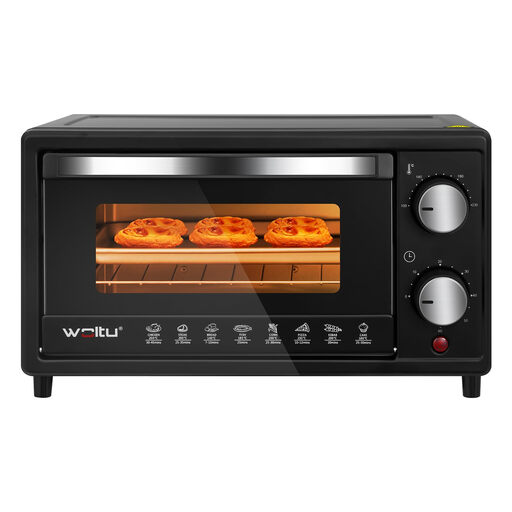
Woltu mini oven, 10 l
The description recommends this 10 l model for 1–2 people, so you may need to bake several batches if you’re making a larger quantity.
Temperature range: 100–230 °C; timer: 0–60 minutes; top and bottom heat, plus a pizza function.
External dimensions according to the description: 37 × 26.5 × 21 cm.
View at Joybuy
Frequently asked questions
Can I bake onion tart for the freezer on two shelves at once?
Not just because the oven has several shelf positions. A reply from Rommelsbacher Support about multi-level operation mentions conditions such as preheating and fan-assisted cooking, but gives the model designation as “BG 1580/E”. Before buying, check whether this information also applies to the BGE 1580/E and your intended use; don’t assume it applies to other models.
How long can I freeze portions once they’re baked?
The Verbraucherzentrale gives up to three months in the freezer as a general guide for prepared food, not as a quality guarantee specifically tested for onion tart. It recommends labelling containers with their contents and the date they were frozen. The German Federal Institute for Risk Assessment notes that chilling slows or stops the growth of most bacteria.
Does a mini oven in Germany need official CE approval?
No. According to the European Union’s Your Europe website, there is no central EU body that grants CE approval or issues a CE certificate. Electrical appliances covered by the relevant EU product rules must carry the CE marking; the manufacturer uses it to declare conformity. Check the marking on the specific appliance you’re buying, and don’t treat it as an independent quality mark.
What happens if my cake tin doesn’t fit after I buy it online?
For consumers in Germany, online purchases generally come with a 14-day right to cancel, starting from the day the goods are received; you need to notify the retailer that you wish to cancel. The Verbraucherzentrale also recommends checking the seller’s specific returns and customer service information.


