Several portions at once
If you want to roast parsnips for several meals in one go, compare the usable baking tray area with the amount you plan to cook. Rommelsbacher lists a tray size of 32.5 × 28.5 cm for the BG 1550 and BGE 1580/E models.


When you’re cooking parsnips for meals at different times, the main question is whether you’ll roast one batch to serve everyone or cook several fresh batches. First, check the usable baking tray area, then the heating options and timer. A keep-warm setting alone doesn’t guarantee that the food is at a safe temperature. The German Federal Institute for Risk Assessment (BfR) recommends keeping food at 60 °C or above throughout when holding it hot.
If you want to roast parsnips for several meals in one go, compare the usable baking tray area with the amount you plan to cook. Rommelsbacher lists a tray size of 32.5 × 28.5 cm for the BG 1550 and BGE 1580/E models.
If you’re planning separate batches, suitable heating options and a timer are important things to look for. The REWE recipe uses conventional heat at 200 °C for 30 minutes for its stated quantity; these settings are not a cooking test for mini ovens.
If space is tight, check the appliance dimensions, door clearance and the set-up instructions in the manual for the specific model. CASO Design lists internal dimensions of 300 × 170 × 290 mm (W × H × D) for the TO 20 SilverStyle; check these against your cookware.
When choosing a mini oven for roasting parsnips, four priorities come into play: cooking one batch, serving at different times, available space, and cleaning and running costs.
| Priority | What to check before buying | Who it matters to |
|---|---|---|
| One batch for everyone | Check the baking tray dimensions and what’s included against the quantity you plan to cook. Rommelsbacher lists a tray size of 32.5 × 28.5 cm for the BG 1550 and BGE 1580/E. | If I’m roasting several portions at once, the usable area needs to suit the quantity I’m planning. Around 36% of consumers put cooking one batch for everyone first. |
| Serving at different times | Check whether the model has a keep-warm setting or a suitable timer. The BfR recommends keeping hot food at 60 °C or above throughout until it is served. | If people are eating at different times, I want either to keep the food hot safely or plan to roast later portions fresh. Around 29% of consumers prioritise serving at different times. |
| Available space | Check the external dimensions, door clearance and set-up requirements in the manual for the specific model. | With limited worktop space, the oven needs to fit where you plan to put it, including room for the door to open and the required clearances. Around 21% of consumers prioritise a space-saving set-up. |
| Cleaning and running costs | Check whether crumb trays can be removed and read the cleaning instructions. Running costs can only be estimated using actual energy consumption in kWh and your electricity tariff. | If I’m cooking frequently, I want crumb trays that are easy to clean and a clear picture of how much electricity I use. Around 14% of consumers prioritise cleaning and running costs. |
An oven setting doesn’t prove that the food itself reaches the recommended temperature throughout. The BfR advises keeping heated food at 60 °C or above throughout until it is served.
For later portions, plan to keep the food hot safely or cool it promptly and reheat it later, rather than relying on the name of an oven programme alone.
The capacity in litres doesn’t tell you how much room there’ll be for parsnips on the usable baking tray. For the BG 1550 and BGE 1580/E, Rommelsbacher lists both the 30 l capacity and a specific tray size.
Before choosing an oven capacity, compare the tray area with the quantity you plan to cook, your cookware and the space available for the appliance.
An oven’s rated power doesn’t measure how much energy it uses to cook a parsnip recipe. Without an actual energy consumption figure, there isn’t enough information to compare costs for your use.
If you want to compare models for energy use, measure the kWh for the same cooking task and calculate the cost using your own electricity tariff.
Rommelsbacher offers two documented 30-l models with larger baking trays: the BG 1550 and BGE 1580/E.
According to CASO Design, the TO 20 SilverStyle is a mini oven with a capacity of around 20 l, fan-assisted cooking and separately selectable top and bottom heat.
According to Severin, the TO 2068 and TO 2058 have different oven capacities: 20 l and 42 l respectively.
According to Steba, the KB 27 U.2 is a 20-l oven with continuous fan-assisted cooking.
The product options below range from 10 to 32 l in capacity and offer a starting point for different batch sizes. Capacity alone doesn’t tell you how many parsnips will fit on the tray.
 No image available
A larger-capacity option for cooking one batch; check the usable baking tray area against the quantity you plan to cook.
32 l; 1600 W; temperature range 100–250 °C; timer; crumb tray; listed for baking and grilling.
 No image available
A compact 10-l model could work for small, separate portions; check your cookware against the usable internal space.
10 l; temperature range 100–230 °C; pizza function.
 No image available
A larger-capacity option for cooking one batch, but remember to check the usable baking tray area too.
28 l; temperature control; timer; listed for pizza.
 No image available
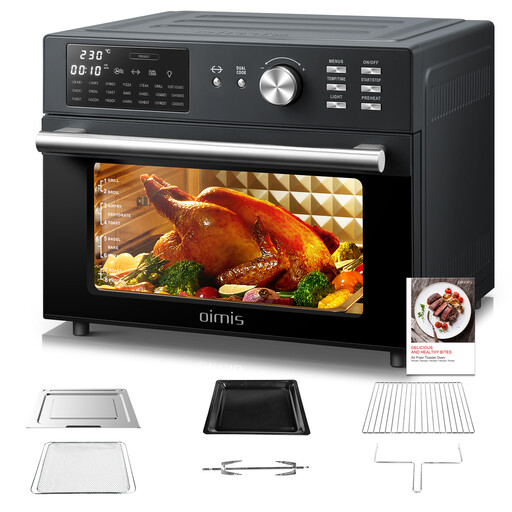
This 30-l oven is an option for cooking a larger batch. The 13-inch size refers to pizza and doesn’t confirm that it can hold a comparable quantity of parsnips.
30 l; 1800 W; 21 preset programmes; rotisserie and dehydrating functions; listed for a 13-inch pizza.
A switched-off oven doesn’t guarantee that food is being kept safely hot. The BfR recommends keeping heated food at 60 °C or above throughout until it is served; neither the oven setting nor a keep-warm function proves that the food is at this temperature. If you’re not keeping later portions hot, cooling them promptly is a more cautious plan. This is a BfR recommendation, not a general legal temperature requirement for private households.
Not without checking first. The REWE recipe uses conventional heat at 200 °C for 30 minutes for its stated quantity, turning the parsnips after 15 minutes. These settings are a starting point for this recipe, not a test of every mini oven or fan-assisted programme. Keep an eye on how well they’re browning and follow your model’s instructions.
Check the door clearance and the set-up and cleaning instructions in the manual for your specific model. Rommelsbacher lists a removable crumb tray and a door that can be dismantled for cleaning for the BG 1550; you can’t assume other appliances have the same features.
Your statutory rights for faulty goods are against the seller and are separate from any voluntary manufacturer’s guarantee. Under Section 438 of the German Civil Code (BGB), the limitation period for ordinary purchased goods is generally two years from delivery; the details depend on the individual case. The Verbraucherzentrale also explains the difference between statutory rights for faulty goods and a guarantee.