Picnic bakers catering for a crowd
If you want to prepare several batches of cookies, compare the tray area and work out how many baking rounds you’ll need.


Choose your mini oven based first on the usable tray area for your planned batches and a suitable place to put it, rather than on its capacity in litres alone. A compact oven with top and bottom heat may be enough for smaller batches. For larger quantities, a bigger tray and a choice of heating modes may be useful, but they’ll need more space. Before planning to use several trays at once, check the instructions, what’s included and whether the manufacturer explicitly confirms this is suitable for your model.
If you want to prepare several batches of cookies, compare the tray area and work out how many baking rounds you’ll need.
If you tend to bake smaller quantities, make sure the oven fits in your chosen spot, with the clearances required in the instructions.
If you plan to bake more than just cookies, check which heating modes and settings the specific model offers.
For picnic cookies, the usable tray area, available space and heating mode you want all affect how easily you can plan your baking rounds.
| What matters to you | What to look for | Who is this important to? |
|---|---|---|
| Usable tray area | Compare the dimensions of the tray that fits the oven with the quantity you plan to bake each round. Only plan to use several trays at once if the manufacturer explicitly confirms this is suitable. | If I’m baking for several picnic guests, I want to plan the portions and number of baking rounds in advance. Around 33% of consumers put tray area first. |
| A safe place to put it | Check the external dimensions, space needed to open the door and the set-up instructions for the specific model. | If I’m short on worktop space, I want to be able to position the oven safely, even if that means baking smaller batches. Around 25% of consumers prioritise where to put the oven. |
| Heating mode and control | Check whether you can select top and bottom heat separately or together, and whether fan-assisted cooking is available. Also compare the temperature range and timer for the exact model. | If I bake other recipes as well as cookies, I want to be able to choose the right heating mode. Around 25% of consumers put a choice of baking settings first. |
| Cleaning and ongoing costs | Check the cleaning instructions, included accessories and availability of replacement trays. Only compare energy consumption figures when they’re based on the same measurement method. | If I bake regularly, I want to know what cleaning involves and which accessories I’ll need. Around 17% of consumers prioritise cleaning and ongoing costs. |
The oven’s internal capacity doesn’t tell you directly how much usable tray space you have. Rommelsbacher lists a tray size of 38,5 × 31,5 cm for the BG 1805/E and 32,5 × 28,5 cm for the BGE 1580/E.
Start by working out how many cookies you want to bake in each round, then compare the dimensions of the tray that comes with the specific model.
Having certain functions or several shelf positions doesn’t, on its own, mean you can bake two trays of cookies at the same time.
Check the instructions, what’s included and whether the manufacturer explicitly confirms this is suitable for the exact model, heating mode and accessories you need.
Energy consumption depends on the baking process itself, and extra baking rounds will affect any comparison. The Verbraucherzentrale points out that the appliance’s actual energy use is what matters.
Only compare energy consumption figures when they’re based on the same measurement method. A single figure for power or oven capacity won’t tell you how much you’ll save per batch of cookies.
The BG 1805/E and BGE 1580/E models are worth considering if you’re looking for different tray sizes and controls.
The KB M19 may suit smaller baking rounds and those looking for a more compact oven.
The TO 2067 is an option if you want to choose between top and bottom heat for individual baking rounds.
The TO 20 SilverStyle is an option if you’d like a choice of heating functions.
The mini ovens featured at Joybuy vary in capacity and features. The usable tray area and the manufacturer’s guidance for each appliance remain key when planning how many cookies to bake.
 No image available
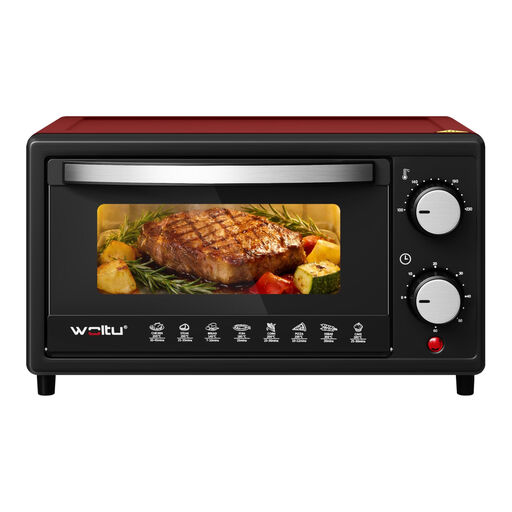
For baking rounds where you’d like to use an adjustable temperature and a timer.
32 l; 1.600 W; temperature range 100–250 °C; 60-minute timer; crumb tray.
 No image available
For smaller baking rounds when a compact oven matters more than making the largest possible batch of cookies.
10 l; temperature range 100–230 °C; top and bottom heat; baking tray included.
 No image available
For baking rounds where you’re looking for a convection oven with a temperature control and timer.
28 l; temperature control and timer.
 No image available
For shoppers considering a dual-zone set-up and a choice of programmes in a mini oven.
23 l; dual zone; LED touchscreen; 15 programmes.
No. Check the dimensions of the tray that fits the model and leave space between each portion of dough. The oven’s capacity alone doesn’t tell you how much of the tray you can use.
Not just because it has several shelf positions. Check the instructions or look for explicit confirmation that this is suitable for the exact model, heating mode and accessories you need.
Read the instructions for the model you’ve bought and follow its guidance on connecting and positioning the appliance. The Severin instructions for the TO 2058 require a properly installed earthed socket. They also say to unplug the appliance and let it cool before cleaning. These model-specific instructions don’t replace the guidance for a different oven.
The German Federal Institute for Risk Assessment recommends not eating cookie dough before it has been baked. This advice concerns food hygiene, not the performance of any particular oven.
Only compare energy consumption figures when they’ve been measured on the same basis. The Verbraucherzentrale highlights the appliance’s actual energy use: a single wattage or oven capacity figure doesn’t tell you the energy cost or savings for each baking round.