Pork tenderloin for several guests
If you want to use an oblong roasting tin or cook side dishes as well, compare the usable interior dimensions with the size of your tin, including its handles – not just the oven’s capacity.


For cooking pork tenderloin in a holiday cottage, the mini oven needs to suit your roasting tin and the space you actually have available and can use safely. Capacity in litres alone is not enough to tell you whether it will fit. A compact oven cavity may be big enough for a small tin, while more interior space and a choice of heating functions give you room for larger tins or side dishes. Check the instructions for the specific model, and measure the meat’s core temperature separately: the oven setting does not tell you what temperature the meat has reached.
If you want to use an oblong roasting tin or cook side dishes as well, compare the usable interior dimensions with the size of your tin, including its handles – not just the oven’s capacity.
If worktop space in your holiday cottage kitchen is limited, check that the oven’s external dimensions and the clearances and connection requirements in its instructions are all suitable for the space available.
If you’ll use the oven for other dishes too, check whether the baking tray and crumb tray can be removed after cooking and cleaned as directed in the instructions.
First check that your roasting tin fits inside the oven, then consider the space and connection it requires. Heating functions, cleaning and running costs are other factors to compare.
| What matters when buying | What to check | Who should pay particular attention |
|---|---|---|
| Roasting tin fit | Measure your tin, including its handles, and compare it with the oven cavity and shelf positions. Steba lists interior dimensions of 23,5 × 31 × 25,5 cm (H × W × D) for the KB M19; Rommelsbacher says the BGE 1580/E accommodates baking tins up to 29 cm in diameter. | If I’m cooking an oblong tenderloin or side dishes for several guests, the tin needs to fit in the oven; around 31% of consumers put fit first. |
| Space and connection | Check the external dimensions, ventilation clearances and connection requirements in the instructions for the specific model. The instructions for the Steba KB M19 specify a 10 cm gap between the back of the appliance and the kitchen wall, as well as an earthed socket. | With limited worktop space, I need to allow room for both the appliance and the required clearances; around 31% of consumers prioritise a suitable location and connection. |
| Heating functions and accessories | Check that the heating functions and included accessories suit the dishes you actually plan to cook. Extra programmes alone do not guarantee a particular cooking result. | If I regularly cook other holiday cottage meals as well as pork tenderloin, the functions that suit those dishes matter; around 23% of consumers prioritise versatility. |
| Cleaning and running costs | Check the cleaning instructions and whether accessories can be removed. When comparing running costs, equivalent energy consumption figures in kWh are more useful than rated power alone; the Verbraucherzentrale points out that the appliance’s actual energy consumption is what matters. | If I want to remove cooking residue easily and keep running costs in mind, I look for accessible parts and relevant energy consumption figures; around 15% of consumers give cleaning and running costs the greatest weight. |
The oven’s capacity does not tell you whether an oblong roasting tin will fit or whether there will be enough space between it and the heating elements.
Measure your tin, including its handles, and compare the dimensions with the usable interior space and permitted shelf positions.
Rated power does not tell you how much energy a complete cooking session will use. Preheating and cooking time also affect consumption.
Compare kWh figures only on a like-for-like basis, and factor in your electricity tariff rather than relying on wattage alone.
An oven temperature setting or programme does not show what temperature the centre of the pork tenderloin has reached.
Choose a heating function to suit the dish you’re cooking, and check the core temperature separately with a suitable food thermometer.
The BGE 1580/E is a 30-l option to consider if you’re comparing larger tins and a choice of heating functions.
The KB M19 has a compact 19-l oven cavity, with published interior dimensions you can compare with your roasting tin.
The TO 2068 is a 20-l oven and toaster with fan-assisted cooking.
The Design Ofen Air Fry & Pizza 42815 may be worth considering if you’re planning to cook dishes other than pork tenderloin too.
These Joybuy listings range from compact mini ovens to larger appliances for cooking other holiday cottage meals. Compare your roasting tin and available space with the specifications for the particular model, and check that the CE marking required for the appliance is present on the product being offered. The oven setting does not confirm the tenderloin’s core temperature.
 No image available
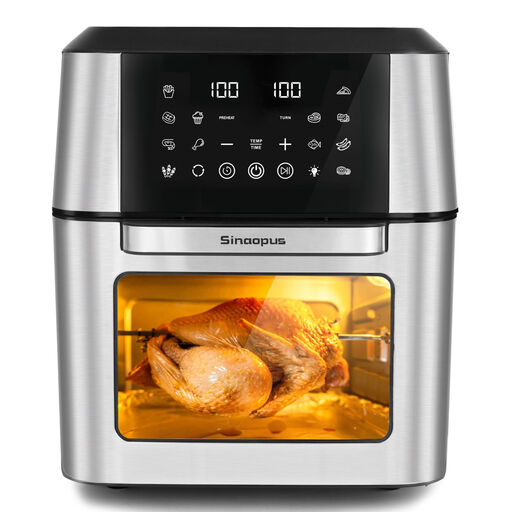
For anyone who wants to cook other holiday cottage meals as well as pork tenderloin in one combination appliance.
The product name lists a 12 l capacity, 1.800 W, touchscreen, timer, 12 programmes and accessories.
The oven setting is no substitute for measuring the core temperature separately. Check the label on the specific appliance being offered.
 No image available
For anyone who wants to cook roasts and grilled dishes, and check whether the oven capacity suits their own tin.
The product name lists a 32 l capacity, 1.600 W, a temperature range of 100 to 250 °C, a timer and a crumb tray.
The oven temperature setting does not tell you the tenderloin’s core temperature. Check the label on the specific appliance being offered.
 No image available
For anyone planning to cook pizza as well as pork tenderloin in their holiday cottage; check that the features of the specific listing suit the dishes you have in mind.
The product name lists a 28 l capacity and a black finish.
Compare your roasting tin with the usable interior space and check the label on the specific appliance being offered. The oven setting is not proof of the core temperature.
 No image available
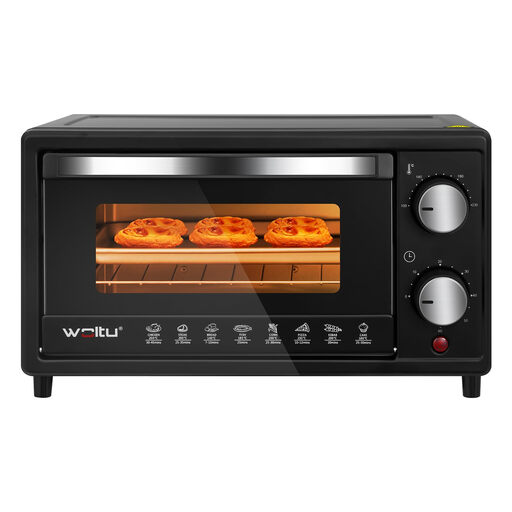
Could be an option for anyone with a small holiday cottage kitchen, provided the roasting tin and available space are suitable for the specific model.
The product name lists a 10 l capacity, a pizza function and a temperature range of 100 to 230 °C.
Check the dimensions of your tin and the label on the specific appliance being offered. You’ll need to check the tenderloin’s core temperature separately.
Use a suitable food thermometer to measure the temperature at the thickest part. In its guidance dated 15 September 2025, the Verbraucherzentrale recommends heating meat to a core temperature of 70 °C for at least two minutes; the oven setting is not the core temperature. Keep raw meat separate from ready-to-eat food, and clean your hands and any surfaces you’ve used.
Don’t decide based on the external dimensions alone. The Steba KB M19 instructions require, among other things, clear ventilation slots and a 10 cm gap between the back of the appliance and the kitchen wall; other models have their own positioning requirements. Use an accessible, properly earthed socket and follow the rules of your holiday cottage.
For new electrical equipment designed for 230 V AC and covered by the 1. ProdSV, the required CE marking must be in place before the product is made available on the market, as explained by the Bundesanstalt für Arbeitsschutz und Arbeitsmedizin and the Bundesnetzagentur. Check the marking on the specific appliance being offered, along with the manufacturer’s information and safety instructions. Information about a different model variant does not confirm that this listing carries the required marking.
If a product is faulty, your statutory rights are initially against the seller; a guarantee is a separate, voluntary promise. The Verbraucherzentrale explains the difference. Waste electrical equipment must not go in household rubbish; take it to an authorised collection point instead. A retailer is not automatically required to take back a larger appliance free of charge when you haven’t bought a new one, solely under the general 25-cm rule; the Bundesumweltministerium explains the rule’s limited scope.