What should you look for when choosing one?
For a group potato bread baking session, make sure the tin, recipe temperature, safe position and baking process are all suited to the specific oven.
| Priority |
What to check before buying |
Who is it important to? |
| Tin size and amount of bread |
Compare your tin’s external dimensions and height with the oven’s usable interior height and shelf positions. |
If I’m planning a loaf for several people, the tin and rising dough need to fit in the oven. Around 29% of consumers prioritise loaf size and the amount they can bake for a group. |
| Recipe temperature and heating method |
Compare the recipe’s starting and finishing temperatures with the temperature range and heating methods of the specific model. |
If I want to stick to the method in my potato bread recipe, I need to know whether the oven reaches the stated starting temperature. Around 29% of consumers prioritise following the recipe’s baking method. |
| Safe positioning |
Allow for the appliance’s external dimensions and the clearances specified in its instructions, and keep the ventilation slots unobstructed. |
With limited worktop space, I need to be able to position the oven safely with the required clearances. Around 21% of consumers prioritise safe positioning. |
| Controls and cleaning |
Check the details for each model, including the timer, interior light and removable crumb tray. |
For a group baking session, I want to keep an eye on the baking time and make it easier to catch crumbs afterwards. Around 21% of consumers prioritise ease of use and tidying up. |
Joybuy products for your baking session
This selection includes mini and countertop ovens with stated baking functions. For each model, check that the temperature range, tin size and usable interior height are right for your potato bread.
 No image available
WOLTU BF12sz mini oven, 32 l, Black+Red
The stated temperature range goes up to 250 °C, but make sure your tin and amount of dough will fit in the oven.
32 l; 100–250 °C; 1600 W; timer and removable crumb tray.
Shop at Joybuy
 No image available
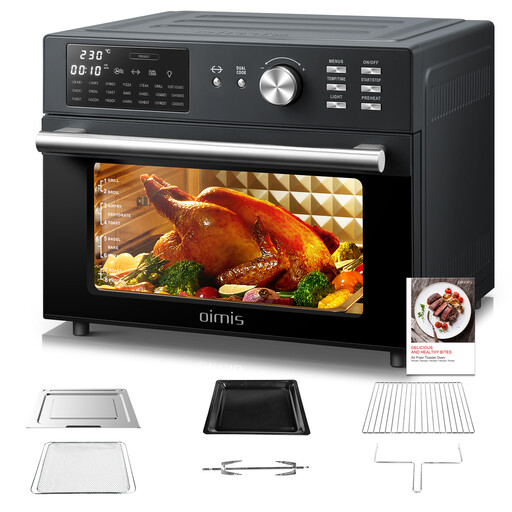
OIMIS air fryer toaster oven, 30 l
The description lists a baking function; check that the interior height is sufficient for your bread tin and rising dough.
30 l; 1800 W; 21 presets; rotisserie and dehydrator functions; the product name states that it fits a 13″ pizza.
Shop at Joybuy
 No image available
WOLTU mini oven, 10 l, White
The description lists bread baking as one of its uses. Its compact size is best suited to smaller tins and smaller amounts of dough.
10 l; 100–230 °C; top and bottom heat; 60-minute timer.
Its maximum temperature won’t reach the 250 °C starting temperature in Plötzblog’s example recipe. Check whether you can adapt the baking method accordingly.
Shop at Joybuy
 No image available
WOLTU mini convection oven, 28 l, Black
Top heat, bottom heat and combined operation are listed; check which heating method suits your recipe.
28 l; maximum temperature 230 °C; 60-minute timer; external dimensions 47.5 × 38 × 28.5 cm.
If your recipe starts at 250 °C, check whether you can adapt the baking method.
Shop at Joybuy
Frequently asked questions
Can I bake a potato bread recipe that starts at 250 °C unchanged in a 230 °C mini oven?
No. An oven with a maximum temperature of 230 °C won’t reach the stated starting temperature. Plötzblog describes adaptations for standard bread doughs at 230 °C, but notes there may be drawbacks with very soft doughs and large loaves. Compare the recipe, tin and appliance, and make sure any accessories are suitable for the oven too.
Are two or more shelf levels enough to bake two loaves at once?
The number of shelf levels alone doesn’t confirm that two rising loaves will fit at the same time or bake evenly. Check the dimensions of both tins, the usable height and the space available in the specific oven.
What should I bear in mind when positioning the oven and baking as a group?
Follow the instructions for your chosen model: they may specify clearances, ventilation slots must remain unobstructed, and hot surfaces need to be taken into account. The instructions for the Steba KB 41 include relevant warnings; its model-specific details don’t automatically apply to other ovens.
Can I work out the electricity cost from the wattage or an EU energy label alone?
No. To calculate the cost, you need a consumption figure in kWh measured on a comparable basis, as well as your electricity price. Wattage alone isn’t a measured consumption figure per baking session. Rommelsbacher explains that its mini ovens weighing under 18 kg don’t carry this type of EU energy label. The absence of a label therefore isn’t, in itself, a way to compare energy consumption.
What are the rules on labelling and complaints in Germany?
Mains-powered ovens covered by the EU Low Voltage Directive must have the required CE marking and clear safety information. CE marking isn’t an independent quality seal for baking results. If a product is faulty, statutory consumer rights against the seller are separate from a voluntary guarantee, as explained by the Verbraucherzentrale.


