What should you look for when buying?
First, measure the space where you plan to put the oven and check the tray dimensions. Then compare the temperature and heating mode with your recipe, and finally check how easy it is to clean the trays and crumb tray.
| Buying consideration |
What to check |
Who it matters most to |
| Tray space and number of batches |
Compare the usable tray dimensions with your planned arrangement of twists. |
If I’m preparing twists for several lunchboxes, I want to be able to plan how many will fit on the tray. Around 36% of consumers put baking capacity first. |
| Heating mode and baking process |
Check the temperature range, top and bottom heat, convection and timer against your recipe and pastry instructions. |
If I regularly bake a particular recipe, I want to know that the temperature and heating mode are suitable. Around 29% of consumers prioritise baking settings. |
| Space for the oven |
Allow for the external dimensions, door opening and the clearances specified in the manual for that model. |
If I’m short on worktop space, I need somewhere that also allows for the required clearances. Around 21% of consumers make space the main consideration. |
| Cleaning |
Check what’s included, whether there’s a removable crumb tray and what the manual says about cleaning. |
If I bake several times a week, I want to be able to reach the trays and crumb area easily and clean them after use. Around 14% of consumers prioritise ease of care. |
Brands to consider
The models below differ in capacity, heating modes and published dimensions. The details relate to the specific model ranges and aren’t a substitute for comparing baking results.
Rommelsbacher
Rommelsbacher lists a 30 l capacity, a 32.5 × 28.5 cm tray and several heating modes, including convection, for the BG 1550.
- The stated tray dimensions help you check how your planned twists might fit.
- A rotisserie and pizza stone aren’t essential reasons to buy an oven for puff pastry twists. They don’t guarantee a particular number of twists or baking performance.
Steba
The KB M19 is listed with a 19 l capacity, published internal dimensions and switchable convection.
- The internal dimensions and selectable heating modes can help you narrow down your options.
- The internal dimensions don’t confirm the usable area of the supplied tray or how your own twists will turn out.
Severin
The TO 2068 is listed with a 20 l capacity, top and bottom heat and convection. Its manual specifies clearances for this model.
- The heating modes and placement requirements can help you plan for your recipe and available space.
- The clearances specified for the TO 2068 don’t apply to all mini ovens.
Clatronic
The MB 3746 is listed with an 8 l capacity, top and bottom heat, a baking tray and a crumb tray.
- Its compact size may suit a few twists, provided the tray fits the portion you have in mind.
- There’s no evidence that this model has a convection function or can bake a particular number of twists per batch.
Mini ovens at Joybuy
This selection features mini ovens with specifications relevant to baking puff pastry twists and planning your batches.
 No image available
Woltu BF12sz mini oven, 32 l, black
The listed baking function and temperature range of 100–250 °C give you a starting point for matching the oven settings to your recipe.
Capacity: 32 l; power: 1600 W; temperature range: 100–250 °C; timer: 60 minutes.
External dimensions: 52.3 × 36 × 32.2 cm. A baking tray, rack and crumb tray are listed.
View at Joybuy
 No image available
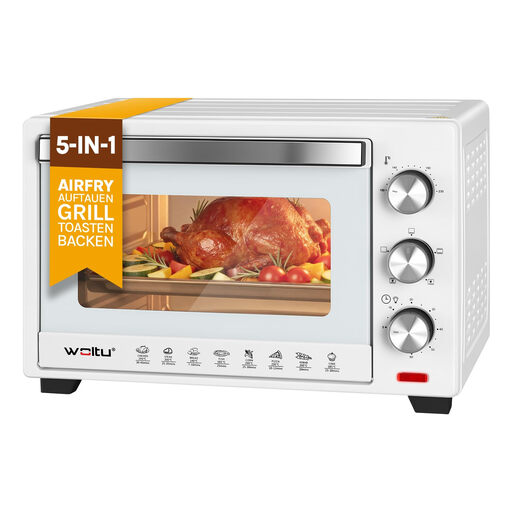
Woltu mini oven with convection, 28 l, white
The listed heating modes include top heat, bottom heat and combined heat, which can help you choose a setting to suit your recipe.
Capacity: 28 l; temperature control up to 230 °C; three adjustable shelf positions; timer: 60 minutes.
A removable crumb tray and dishwasher-safe accessories are listed. Check which accessories are included with the specific version before buying.
View at Joybuy
Frequently asked questions
Can I bake twisted puff pastry without convection?
Yes, as long as the temperature, tray and recipe work well together. Tante Fanny gives an example recipe with a baking time of around 20 minutes at 220 °C using conventional top and bottom heat. This is a recipe example, not a guaranteed setting for every filling or mini oven.
Can I put a mini oven in a tight shelf recess?
Always follow the manual for your specific model. The manual for the Severin TO 2068 specifies 12 cm of clearance on both sides and at the back, and 30 cm above. It also states that the appliance must not be built into a cupboard. Don’t apply these clearances to other models.
How should I clean the oven after baking twists with filling that’s leaked out?
Follow the cleaning instructions in the manual for your model. For the Severin TO 2068, the manual says to unplug the appliance and let it cool before cleaning. It must not be immersed in liquid. Several of the models mentioned here are listed with a removable crumb tray.
Can I bake filled twists in the morning and take them to work unrefrigerated for my lunch break?
It depends on the ingredients. The German Federal Institute for Risk Assessment recommends keeping perishable foods as cold as possible until they’re eaten, including during transport. Check the filling and arrange suitable chilling if it contains perishable ingredients.
What rights do I have when buying a mini oven online in Germany?
The Verbraucherzentrale says that online purchases generally come with a 14-day right of cancellation. When the period starts and whether any exceptions apply depend on the contract and the goods. If a product is faulty, the seller is generally responsible for the statutory warranty. This is separate from any voluntary guarantee.


