Baking on two trays
You want to bake two shallow quark cheesecakes in one go. Measure both trays and check how much clearance there is between them.


Choose a mini oven based first on the actual dimensions of your trays or tins and the clearance between two loaded shelf positions – not just its capacity in litres. Baking two cheesecakes at once is only an option if the manual allows you to use multiple loaded shelves with the fan setting on that specific model. For a delicate or tall quark cheesecake, baking one after another using top and bottom heat may be a better fit for the recipe.
You want to bake two shallow quark cheesecakes in one go. Measure both trays and check how much clearance there is between them.
You care more about using the shelf position specified in the recipe and achieving a gentle golden finish than baking both cakes at once.
You need a freestanding oven and must check its external dimensions and the required safety clearances against the space where you plan to put it.
The key question is whether the manual for the specific appliance allows two loaded shelves; the capacity in litres and number of shelf positions alone won’t tell you.
A good fit if: The manual allows you to use two loaded shelves and both cheesecakes suit the same settings.
The trade-off: The fan setting can dry out a delicate cake or make it rise unevenly; Dr. Oetker highlights these possible effects.
A good fit if: The recipe specifies a particular shelf position or the cheesecake is delicate.
The trade-off: You’ll need two baking sessions; in the meantime, store the second batch as instructed in its recipe.
| What you need | What to check before buying | Who it matters to |
|---|---|---|
| Two usable shelf positions | Check the tray dimensions, clearance between shelves and whether the model is approved for use with two loaded shelves. | If I want to bake two shallow cheesecakes in one go, I need room for both trays and a suitable setting. Around 36% of consumers put baking on two trays at the top of their list. |
| Heating settings and how the cake bakes | Check whether the appliance has separate fan and top-and-bottom heat settings, and follow the recipe instructions. | If getting the right result for my quark cheesecake matters more than baking both cakes at once, I’ll follow the recipe and use the specified shelf position. Around 29% of consumers prioritise the result of their cheesecake. |
| Tins and space for the oven | Measure the outside of the tin and check it against the usable shelf area, the appliance’s external dimensions and the clearances specified in the manual. | If my baking tin needs to fit and the oven needs to sit safely on the worktop, I need reliable measurements for both the appliance and its location. Around 21% of consumers put fit at the top of their list. |
| Second baking tray | Check what’s included, which model the tray is compatible with and whether a suitable second tray is available. | If I want to use two trays, the extra one must fit the appliance exactly. Around 14% of consumers prioritise accessories and the option to buy extras later. |
The number of shelf positions doesn’t tell you how many trays can be used at once or whether there’s enough room between two cheesecakes.
Check the manual for the exact model and measure your trays, including the height of the cakes.
You may also need to buy a second compatible tray.
For a good fit, check the external dimensions of both the tin and the appliance, as well as the usable shelf area and the clearances required where you plan to put the oven.
Measure your tin, including its rim, and compare it with the model specifications and manual.
You may need a smaller baking tin or a different spot for the oven.
Dr. Oetker notes that the fan setting can dry out delicate cakes or make them rise unevenly. One of Dr. Oetker’s cheesecake recipes specifies a shelf position in the lower third of the oven.
Check the recipe and manual first. If your appliance isn’t approved for use with two loaded shelves, or the recipe specifies a particular position, bake the cheesecakes one after another.
Baking them one after another means a second baking session, and you’ll need to store the second batch according to the recipe in the meantime.
The BGE 1580/E and BG 1805/E models are countertop ovens with different-sized cooking compartments.
The TO 2073 is a larger countertop oven option if you’re looking for a spacious cooking compartment with a fan setting.
The KB M19 is a more compact option if you’re mainly planning to bake smaller cakes one at a time.
The TO 20 SilverStyle and TO 26 SilverStyle ranges may suit buyers who plan to bake and reheat a variety of foods, as well as cakes.
The following mini ovens are described as suitable for baking. Before choosing one, check your tray dimensions and the manual to see whether the specific model allows you to use two loaded shelves.
 No image available
Baking is specifically listed as a function; check the manual to see whether this model allows you to use two loaded shelves.
Specifications include a capacity of 32 l, 1600 W and a temperature range of 100–250 °C.
The listed accessories include a baking tray and wire rack; the product name also mentions a timer and crumb tray.
External dimensions: 52,3 × 36 × 32,2 cm.
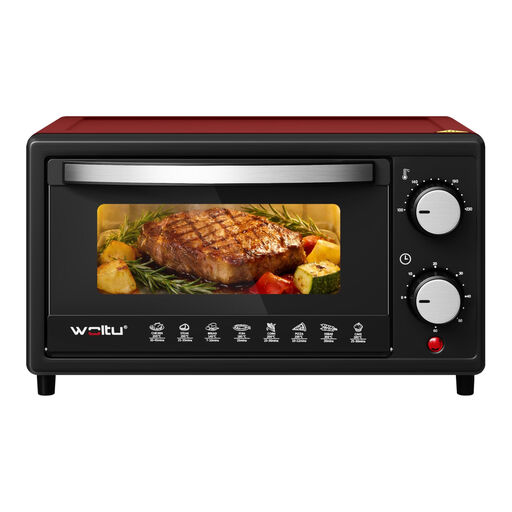 No image available
Baking cakes is listed as a use; check the dimensions against your tin and consult the manual to make sure it suits your plans.
Specifications include a capacity of 10 l, two heating elements and a temperature range of 100–230 °C.
The listed accessories include a baking tray and wire rack.
Dimensions: 37 × 26,5 × 21 cm.
 No image available
Baking is listed as a function. Check the manual to see whether the appliance allows you to bake two cheesecakes on loaded shelves at the same time.
Specifications include a capacity of 23 l and 2200 W.
The listed accessories include several trays and three wire racks; this alone doesn’t mean you can bake two cheesecakes at once.
Not necessarily. What matters is whether the manual for your specific oven allows two loaded shelves and whether there’s enough clearance between the trays, cheesecakes and heating elements. If you swap their positions, follow the manual and check each cheesecake separately to see if it’s cooked through.
Measure the outside diameter of your tin and compare it with the specifications for the exact model. For example, a Dr. Oetker recipe uses a 26 cm springform tin; Rommelsbacher lists tins up to 29 cm for the BGE 1580/E and up to 31,5 cm for the BG 1805/E. These figures don’t show that two tins will fit one above the other.
No. Using two loaded shelves is only an option if the manual for your oven allows it and the cheesecakes have enough clearance. Dr. Oetker notes that the fan setting can dry out delicate cakes or make them rise unevenly; a recipe may specify a particular shelf position instead.
Check what’s included with the specific model and make sure the tray is compatible. One baking tray is listed for each of several Rommelsbacher and Severin models; Rommelsbacher states that compatible trays are available to buy separately.