First, measure the space available and your casserole dish. A small oven cavity is only useful if your filled dish will fit inside and you can position the oven with the clearance specified in the instructions. Larger dishes may call for roomier appliances, which take up more worktop space. Heating options and removable parts for cleaning are other factors to consider.
Who is a mini oven suitable for?
People cooking with limited worktop space
Check that the appliance will fit in the space you have in mind, allowing for the clearances specified in the instructions. For example, the Steba KB M19 user manual specifies a 10 cm gap between the back of the appliance and the kitchen wall.
People cooking with a larger casserole dish
The key factors are the cavity’s internal dimensions and the size of your dish, including its handles and height. The capacity in litres alone won’t tell you whether the dish will fit.
People who often make casseroles
As well as checking that your dish will fit, look at the available heating options and which trays or crumb trays can be removed for cleaning.
What should you look for when buying?
First, check the space available and the size of your dish. Then look at the heating options and cleaning features to make sure any extra functions will suit the way you cook casseroles.
The percentages below show the main buying priorities for a mini oven used to make sausage casserole when worktop space is limited.
| Buying criterion |
What to check before buying |
Who it matters most to |
| Worktop space and positioning |
Measure the worktop’s width, depth and height, and allow for the clearances specified in the instructions for the exact model. |
If space is limited, there needs to be room not just for the appliance but also for the required clearance around it. Worktop space is the top priority for around 36% of consumers. |
| Whether your casserole dish will fit |
Measure your dish, including its handles and height, then compare it with the usable internal dimensions and any guidance on suitable dishes. |
If your existing dish or the portion size you want to cook is the deciding factor, compare measurements rather than litre capacities. Dish fit is the top priority for around 29% of consumers. |
| Heating options and cooking control |
Check whether the model offers top and bottom heat, switchable fan assistance or any other heating options you need. |
If choosing the heating setting and controlling the cooking matter more to you than having the smallest possible appliance, the right features are essential. This is the top priority for around 21% of consumers. |
| Cleaning and upkeep |
Check which trays or crumb trays can be removed and what care instructions apply to the model. |
If you want easy access to the parts that need cleaning after a casserole boils over, check the specific features. Cleaning and ongoing upkeep are the top priorities for around 14% of consumers. |
Common buying mistakes
-
Measuring only the appliance itself
The instructions may specify extra clearance and open ventilation areas. That means the space you need will be larger than the appliance itself.
Before buying, check the positioning requirements in the instructions for the exact model and measure the full area needed.
-
Assuming the litre capacity tells you whether your dish will fit
The cavity capacity won’t tell you whether a particular dish will fit with its handles and height. For example, Rommelsbacher specifies baking dishes up to 20 cm in diameter for the BG 950; this won’t necessarily apply to every dish.
Measure your dish and compare its dimensions with the usable internal dimensions and the manufacturer’s guidance on suitable dishes.
If your existing dish won’t fit, you may need a smaller casserole dish or have to cook the casserole in several batches.
-
Assuming wattage or double glazing means lower energy use
The connected load isn’t a measurement of the energy used to cook a particular casserole. Without comparable readings, you can’t use it to compare electricity costs.
To compare costs, you need the consumption in kWh for a comparable cooking cycle and your electricity rate.
Relevant brands and model examples
Rommelsbacher
The examples range from the compact BG 950 to larger appliances such as the BGE 1580/E.
- For the BG 950, the manufacturer specifies a 10-litre capacity and baking dishes up to 20 cm in diameter. The BG 1055/E has an 18-litre capacity, takes dishes up to 25 cm and offers switchable fan assistance.
- The dish-size guidance doesn’t replace checking your own dish. The larger BGE 1580/E measures 48.5 × 39.5 × 34 cm externally, so it needs more space.
Steba
The KB M19 is an example of a model with specified internal dimensions and fan assistance.
- The manufacturer gives internal dimensions of 31 × 25.5 × 23.5 cm and lists a crumb tray.
- The user manual requires a 10 cm gap between the back of the appliance and the kitchen wall. You’ll therefore need enough space for the clearance as well as the appliance itself.
Severin
The TO 2067 is a 20-litre oven and toaster oven that the manufacturer also recommends for casseroles.
- The manufacturer says you can choose between top and bottom heat.
- No fan-assisted cooking function is listed for this model. Check whether the available heating options suit your recipe.
Caso Design
The TO 26 SilverStyle is a larger model for households where the dish size and available space are a good match.
- The manufacturer specifies a 26-litre capacity, several heating options and internal dimensions of 35 × 20 × 30 cm (W × H × D).
- The external dimensions are 48 × 30 × 40 cm (W × H × D). Caso lists CE and GS marks; this information from the manufacturer doesn’t replace checking the specific appliance on offer.
Joybuy mini oven products
These mini oven options from Joybuy have a range of stated capacities and features. If worktop space is limited, compare the full area needed for the appliance with your dish measurements and the requirements for the specific model.
 No image available
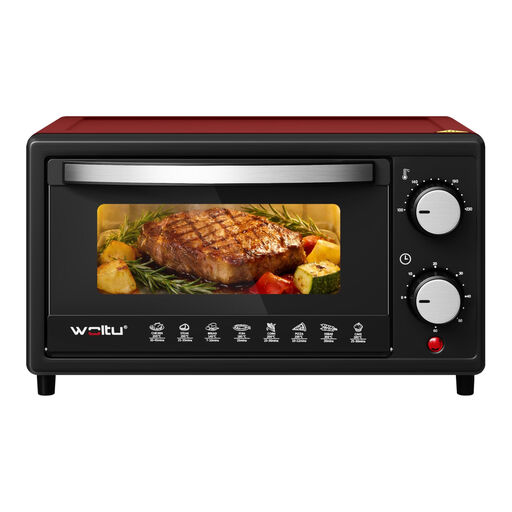
WOLTU 10-litre mini oven with pizza function
The stated external dimensions help you check how much space it will take up on a limited worktop.
- Capacity: 10 l
- External dimensions: 37 × 26.5 × 21 cm
- Power: 800 W
- Temperature range: 100–230 °C
- Top and bottom heat, timer, baking tray and wire rack listed
Before buying, compare your dish measurements and the positioning requirements for the specific model with the space you have available.
View at Joybuy
 No image available
WOLTU 28-litre mini convection oven
Being able to choose top heat, bottom heat or both can be useful when you want to select the right setting for your recipe.
- Capacity: 28 l
- Top heat, bottom heat or both listed
- Timer up to 60 minutes
- Accessories, including the crumb tray, stated to be dishwasher-safe
Check in advance that the available space and oven cavity will accommodate your casserole dish.
View at Joybuy
 No image available
WOLTU BF12sz 32-litre mini oven
This model is described as suitable for baking and grilling. If worktop space is limited, plan carefully around its stated external dimensions.
- Capacity: 32 l
- External dimensions: 52.3 × 36 × 32.2 cm
- Power: 1,600 W
- Temperature range: 100–250 °C
- Timer and removable crumb tray listed
Also allow for the clearance required in the instructions for the specific model.
View at Joybuy
Frequently asked questions
Is 10 litres enough for my sausage casserole?
Don’t decide on capacity alone. Rommelsbacher specifies baking dishes up to 20 cm in diameter for the BG 950. Also measure the width of your filled dish, including the handles, and its height. The manufacturer’s guidance doesn’t guarantee that every dish will fit.
Can a mini oven sit right next to a wall?
Only if the positioning requirements for the specific model allow it. The Steba KB M19 manual specifies a 10 cm gap between the back of the appliance and the kitchen wall, and requires the ventilation slots to remain clear. Don’t assume the same clearance applies to other appliances without checking.
What should I bear in mind when adding raw sausages to a casserole?
The oven timer alone doesn’t prove that a raw ingredient has been heated thoroughly enough. The German Federal Institute for Risk Assessment warns that germs can spread from raw food via hands, appliances and work surfaces. Keep raw ingredients separate from ready-to-eat foods and check that the sausages are thoroughly cooked. You can’t use this information to establish a single cooking time for every type of sausage.
Can I compare electricity use by looking at the wattage?
No. The connected load isn’t the same as the measured energy used to cook a particular casserole. To compare costs, you need the consumption in kWh for a comparable cooking cycle and your electricity rate in euros per kWh.
What should I check about compliance when buying a mini oven in Germany?
Mains-powered appliances covered by the EU Low Voltage Directive must meet the relevant safety and conformity requirements, including CE marking. The directive applies to electrical equipment with a rated voltage of 50 to 1,000 V AC. Check the details for the specific appliance on offer; a general product description doesn’t prove that an individual item complies.
How can I find out whether accessories or spare parts are available?
Check the information provided by the manufacturer and seller for the specific model. Steba lists a baking tray, grill rack and crumb tray as accessories or spare parts for the KB M19; Severin lists a repair service for the TO 2067. This doesn’t provide general information about costs or the terms for individual cases.


