Bakers sharing an oven
You need your own time slot for small batches of crackers while the shared oven is being used for something else. A freestanding mini oven could be a good option, provided it can be set up safely in the space you have.


If you want to bake savoury crackers without relying on the schedule of a shared oven, choose a mini oven that can be set up safely in the space you have and has a tray suited to your batch. For larger quantities, usable tray area matters more than oven capacity; having several shelf positions alone doesn’t mean the oven is suitable for baking on two trays at once.
You need your own time slot for small batches of crackers while the shared oven is being used for something else. A freestanding mini oven could be a good option, provided it can be set up safely in the space you have.
You want to prepare plenty of pieces of dough and keep the number of baking rounds to a minimum. To do that, compare the tray size that fits and its usable area, rather than looking at oven capacity alone.
You need a spot that also leaves room for the door to open and for the clearances specified in the relevant instructions. Compact external dimensions alone aren’t enough to plan your setup.
First decide whether having your own baking time slot or keeping the number of baking rounds to a minimum matters more to you. Then check the tray size and available space; the heating method should suit your recipe.
| What you need | What to check before buying | Who is it important for? |
|---|---|---|
| Your own baking time slot | Check whether the freestanding appliance can be used safely in the space you have, in line with its instructions, and whether its timer and heating settings suit your recipe. | When the shared oven is in use, I need my own time slot for baking crackers. Around 36% of consumers put having independent baking times first. |
| Quantity of crackers per baking round | Compare the tray that fits with the size and arrangement of your pieces of dough. Rommelsbacher gives the dimensions of the original tray for the BGE 1580/E as 32.5 × 28.5 cm; this doesn’t guarantee that the entire area can be used. | When I have a larger batch of dough, I want to bake as many pieces as possible in one round. Around 29% of consumers prioritise the number of crackers per baking round. |
| A safe place to set it up | Measure the space for the appliance and the room needed for the door to open. The instructions for the Steba KB M19 specify a 10 cm gap between the back of the appliance and the kitchen wall; check the requirements for the specific model. | In a shared kitchen, I need to be able to position the oven safely, with all the necessary clearances. Around 21% of consumers check the available space first. |
| Heating method and running costs | Check that the heating settings on the specific model suit your recipe. To compare electricity costs, you need consumption figures measured on a like-for-like basis; Verbraucherzentrale points out that the rated power alone isn’t enough. | When I’m weighing up crispness and running costs, I want to choose a heating method that suits my recipe and avoid estimating consumption from the wattage. Around 14% of consumers put this first. |
The number of pieces of dough you can bake at once depends on the tray size and how you arrange them, not just the oven capacity.
Compare the tray specified for the exact model and plan your batch around the actual pieces of dough.
The number of shelf positions doesn’t confirm that a suitable second tray is included or that the oven is suitable for baking on two trays at once. A Rommelsbacher service note also refers to a different model designation: BG 1580/E.
If baking on two trays at once is essential, ask for confirmation that it’s suitable for the full model designation and the relevant trays. Otherwise, plan to bake successive batches.
The required clearances and the space needed for the door to open can reduce the room available for your setup.
Allow for the door opening, socket, ventilation and all clearances specified in the instructions for the particular model.
The rated power alone doesn’t show how much electricity a particular baking session uses.
Only compare consumption figures measured on a like-for-like basis, then factor in your electricity tariff.
The BGE 1580/E is a 30-l oven with top and bottom heat and switchable fan-assisted cooking. Rommelsbacher gives the original tray dimensions as 32.5 × 28.5 cm.
The KB M19 is a compact 19-l oven with top and bottom heat, switchable fan-assisted cooking and a tray included.
The TO 2068 is a baking and toast oven with around 20 l of capacity. According to Severin, top and bottom heat and fan-assisted cooking can be switched on separately or together.
According to the manufacturer, the MBG 3728 has a 30-l capacity, top and bottom heat, fan-assisted cooking and a baking tray.
The TO 26 SilverStyle is a 26-l countertop oven with a baking tray, fan-assisted cooking and top and bottom heat.
The Joybuy options below are mini ovens for baking separate batches. When choosing, check that the tray area suits your needs and that the heating method is right for your recipe.
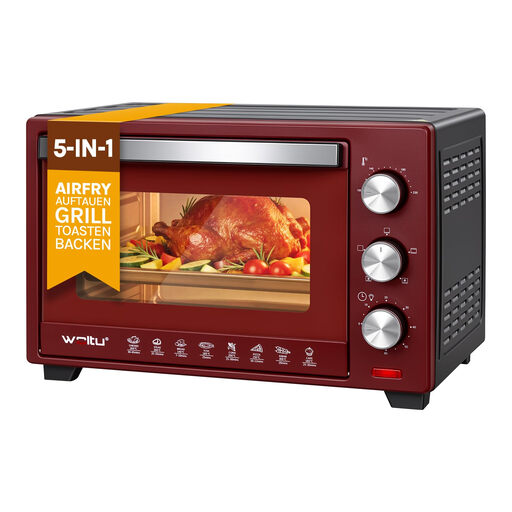 No image available
Described as a mini convection oven for the worktop, this appliance could be suitable for a separate batch of crackers. Check that the usable tray area is large enough for your pieces of dough.
The product title lists a 28-l capacity, a temperature control and a timer.
 No image available
This mini oven is designed for baking a separate batch. If you want to bake several crackers at once, check first that the included baking tray suits your batch.
The product title lists a 32-l capacity, 1,600 W, a timer, a crumb tray and a temperature range of 100 to 250 °C.
No. Four shelf positions alone don’t confirm that the oven is suitable for baking on two trays at once. The Severin TO 2068 is listed as having four positions, but that doesn’t guarantee the results when using two trays. A Rommelsbacher service note about multi-level cooking mentions fan-assisted cooking and keeping the airways clear, but refers to the appliance as BG 1580/E rather than BGE 1580/E. If using two levels is essential, check that it’s suitable for the full model designation and your trays.
Follow the instructions for the specific appliance and keep the ventilation openings clear. The instructions for the Steba KB M19 warn that surfaces get hot, say to supervise the appliance while it’s in use, recommend unplugging it after use and require a 10 cm gap between the back and the kitchen wall. This clearance doesn’t automatically apply to other models.
No. The wattage alone doesn’t tell you how much electricity a baking round will use; to estimate the cost, you need consumption figures measured on a like-for-like basis and your electricity tariff. Verbraucherzentrale says that new goods sold in Germany are generally covered by a two-year statutory guarantee against the seller; this is separate from any manufacturer’s guarantee.
New electric mini ovens sold in Germany that fall within the scope of the EU Low Voltage Directive must meet the relevant conformity requirements. Check the appliance itself for the CE marking, manufacturer details and German-language instructions with the required usage information and warnings. The European Commission describes the scope of the directive; Germany’s Federal Network Agency lists the German-language instructions as something to check. A CE marking isn’t proof of an independent product test.