For cooks with very little space
If you only bake a small batch of spinach parcels now and then, make sure you can fit the oven’s depth, door opening and required clearance on your worktop.


Choose your mini oven first by checking that you have a safe place to put it, with the clearances specified in its instructions. Then check that the usable tray area suits your usual portion. EDEKA’s spinach parcel recipe calls for a preheated oven at 200 °C conventional heat or 180 °C fan oven. Whether these settings give you the result you want in a mini oven also depends on the particular appliance and pastry. A larger oven cavity may give you more room to bake a batch, but you’ll still need a suitable place for the oven. For example, Rommelsbacher specifies 4 cm clearance at the sides and 1 m above the BG 1055/E.
If you only bake a small batch of spinach parcels now and then, make sure you can fit the oven’s depth, door opening and required clearance on your worktop.
If filled pastries are a regular feature on your menu, compare the heating functions and usable tray area with your recipe. Check the settings for the specific appliance you choose.
If you want to bake several parcels in as few batches as possible, a larger oven cavity could be worth considering – as long as the oven and its required clearance will fit in the space you have.
First measure the space where the oven can be placed safely. Then compare the tray area with the size of your parcels, the batch you want to bake and your recipe’s instructions.
| What matters when buying | What to check | Who it matters most to |
|---|---|---|
| A safe place to put it | Check the external dimensions, door opening and clearances in the instructions against the space available. | If there’s little room on my worktop, the oven needs to fit safely, including space for the door to open and the required clearance. Around 36% of consumers say space is their top buying priority. |
| The right heating function | Compare the heating functions and temperature range with the recipe you’re using; place the parcels on the right tray with space between them. | When I bake spinach parcels, I want to be able to set the heating function and temperature specified in the recipe. Around 29% of consumers say suitability for the food they’re baking is their top priority. |
| Room per batch | Compare the interior and tray dimensions with your parcels; don’t assume the capacity in litres or number of shelf positions tells you how much you can bake at once. | If I want to bake my usual quantity in as few batches as possible, I need enough room on the tray. Around 21% of consumers say batch size is their top buying priority. |
| Cleaning and costs | Check the cleaning instructions and whether the crumb tray can be removed; don’t treat the wattage alone as a measure of the cost of each baking session. | If cleaning, spare parts or running costs will affect my decision, I want to be able to assess them in advance. Around 14% of consumers say care and costs are their top buying priority. |
The required clearance varies by model. Steba requires at least 10 cm of space around the KB 9.2. For the BG 1055/E, Rommelsbacher specifies 4 cm at the sides and 1 m above; the manufacturer says it is not designed for built-in installation.
Before buying, measure the entire space where you plan to put the appliance, including the clearances specified in the instructions for your chosen model.
The oven’s capacity doesn’t tell you how many of your homemade parcels will fit on the tray with enough space between them. A small tray may mean you need to bake in several batches.
Compare the interior and tray dimensions with the size of the parcels you plan to make.
Power consumption alone doesn’t show how much electricity a baking session will actually use. The Verbraucherzentrale points out that the specific appliance is what matters when it comes to energy consumption.
When comparing costs, use only consumption figures measured under clearly comparable conditions.
The KB 9.2 is a documented 9-litre model for small batches. Check the interior dimensions and where you’ll put it before buying.
According to Severin, the TO 2052 is a 9-litre model with switchable top and bottom heat.
The BG 950 and BG 1055/E illustrate different oven cavity sizes among the documented models.
According to the manufacturer, the OV-3615 is another 10-litre model for smaller kitchens.
This selection includes compact mini ovens and larger countertop ovens for different batch sizes, as well as an air-fryer oven as an alternative appliance. Before buying, compare the features listed with your available space and your recipe’s requirements.
 No image available
For smaller batches, if the 10-litre size and pizza function suit the way you plan to use it.
Features listed in the product name: 10 L and a temperature range of 100 to 230 °C.
 No image available
For a larger batch, if a 28-litre oven and the required clearance will fit on your worktop.
Features listed in the product name: 28 L, temperature control and timer.
 No image available
A compact air-fryer oven option if you’re considering this type of appliance for the batch size you have in mind.
Features listed in the product name: 6,5 L, stainless steel basket, inner pot, rack and viewing window.
 No image available
For larger batches, provided you can make room for this model.
Features listed in the product name: 32 L, 1600 W, timer, crumb tray and a temperature range of 100 to 250 °C. Its stated external dimensions of 52,3 × 36 × 32,2 cm mean it will take up a corresponding amount of space.
 No image available
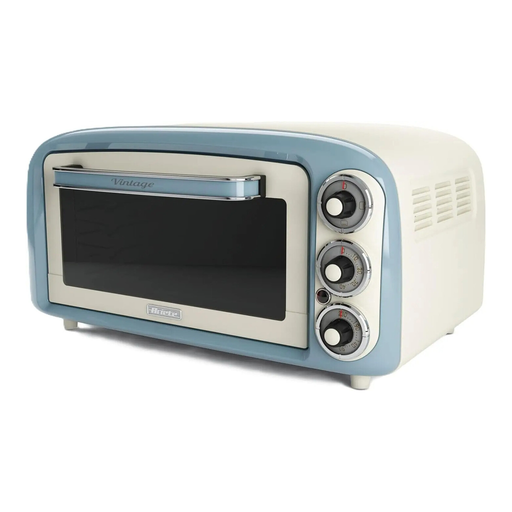
For small to medium-sized batches, if the 18-litre oven cavity and the space it needs suit your kitchen.
Features listed in the product name: 18 L, 1380 W, aluminium baking tray and 60-minute timer. Remember to allow for the stated external dimensions of 47,5 × 40 × 24,5 cm when measuring up.
For EDEKA’s recipe, yes: it calls for a preheated oven at 200 °C conventional heat or 180 °C fan oven, with a baking time of around 20 minutes. Don’t apply this timing without checking if you’re using a different pastry, parcel size or mini oven model.
Don’t decide based on the appliance’s dimensions alone. Steba requires at least 10 cm of clearance all around the KB 9.2. Rommelsbacher says the BG 1055/E is not suitable for built-in installation and specifies 4 cm at the sides and 1 m above. Always follow the instructions for the model you choose.
Switch off the appliance, unplug it and let it cool completely before following the cleaning instructions. The instructions for the Severin TO 2052 warn against immersing the appliance in liquid.
Your statutory rights against the seller are separate from any additional voluntary guarantee. The Verbraucherzentrale explains that repair or replacement is initially the remedy for putting things right; the seller is responsible for the associated transport, labour and material costs.
No. The German Federal Ministry for the Environment explains that old electrical appliances should be disposed of properly, not put in household rubbish. Check the collection and disposal options available locally or through the retailer.