Fair bakers making larger batches
If you want to have several batches ready in good time, first compare the usable area of the tray or dish with the space you have available.


For stuffed mushrooms at a fair, choose your oven based on the usable area of your dish and the number you plan to cook in each batch – not just the oven’s capacity. A compact oven is better suited to small batches and limited counter space. A larger model may offer more room for your dish, but it needs more space, and you’ll need to test how many mushrooms fit on your tray. Plan separately for keeping food at the right temperature until serving: a keep-warm function doesn’t guarantee that the food stays hot enough throughout. The German Federal Institute for Risk Assessment (BfR) recommends keeping hot food at a minimum of 60 °C throughout.
If you want to have several batches ready in good time, first compare the usable area of the tray or dish with the space you have available.
If you’re more likely to bake one batch at a time, check that your dish will fit and that you can place the appliance safely on your worktop.
If there’s a wait between baking and selling, plan cooking and temperature control separately rather than relying on a keep-warm function alone.
Start by checking your dish and batch size, then look at the heating options and counter space. Plan how you’ll serve the food separately from your choice of oven.
| What matters | What to check when buying | Who should consider this? |
|---|---|---|
| Batch size and cooking area | Compare the quantity you plan to make and the size of the mushrooms with the internal dimensions and the tray or dish you’ll actually use. | If I want to bake several stuffed mushrooms at a time for a fair, the usable area matters to me. Around 33% of consumers put batch size first. |
| Cooking and browning | Check the heating modes and temperature control available. Try your recipe with a small batch first. | If I want the filling and topping to cook as my recipe requires, I look for selectable heating modes so I can check the results for myself. Around 27% of consumers prioritise cooking control. |
| Counter space and cleaning | Check the appliance dimensions and the setup instructions in the manual. Look for removable parts and check how they should be cleaned. | If my worktop is short on space or I need to tidy up between batches, the space needed and easy-to-handle parts are important. Around 20% of consumers focus mainly on counter space and ease of use. |
| Temperature until serving | Decide in advance whether the food will be served hot or kept chilled. Plan the temperature and how you’ll transport it accordingly. | If the mushrooms won’t be sold until later, I need to plan for the time before serving and how they’ll be stored. Around 20% of consumers prioritise serving arrangements. |
The oven’s capacity or the stated size of a dish doesn’t tell you how many stuffed mushrooms will fit on your tray. Mushroom size, filling and the shape of your dish all affect the usable area.
Before buying, consider the dish you plan to use and the size of your mushrooms. Check that the tray fits inside the oven.
Cooking several batches will take longer. If you’re serving the food later, you’ll also need to plan how to store it and control its temperature.
A programme name doesn’t guarantee that the food reaches the recommended temperature throughout. The BfR recommends keeping hot food at a minimum of 60 °C throughout.
Plan the serving time and check the actual temperature of the food separately. For longer storage, the BfR recommends cooling hot food quickly to below 7 °C and keeping perishable food chilled while travelling.
The appliance’s dimensions alone don’t take account of the setup instructions for the specific model. Hot exterior surfaces and accessories may also affect where you place it.
Before buying, check the manual for the model you’re considering and measure the space available on your worktop.
The specifications available for these mini ovens show differences in capacity and the stated sizes of dishes they can hold.
The KB M19 is a more compact option with stated internal dimensions.
The TO 2068 is a baking and toast oven with a 20 l capacity.
The Express Air Fry Mini Oven 26680-56 combines a 20-litre oven with air-frying functions.
This selection includes mini ovens for baking or grilling, from compact models for small batches to larger options.
 Image unavailable
It could suit larger batches, provided its external dimensions fit your available space and its usable area accommodates the dish you plan to use.
The product details list 1.600 W, a temperature range of 100–250 °C and a 60-minute timer.
External dimensions: 52.3 × 36 × 32.2 cm. A baking tray, wire rack and removable crumb tray are included.
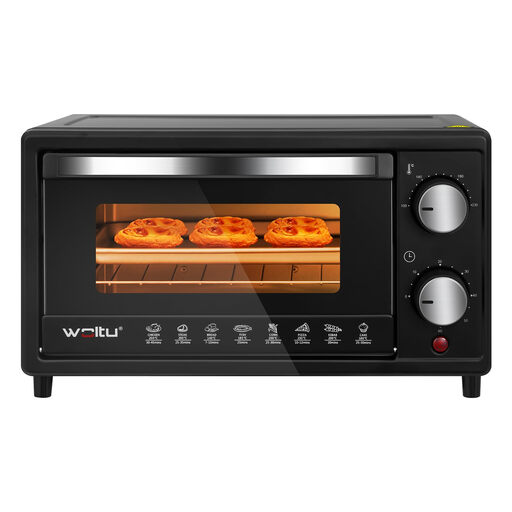 Image unavailable
This compact option could suit small batches, as long as your dish fits and the smaller cooking area works for your needs.
The product details list top and bottom heating and temperature control from 100–230 °C.
External dimensions: 37 × 26,5 × 21 cm. A timer from 0 to 60 minutes, baking tray and wire rack are listed.
 Image unavailable
This larger option could suit you if you need more oven space and have enough room for it. The size of each batch will still depend on the dish you use.
The product details list top heat, bottom heat and combined heating, with a temperature range of 100–230 °C.
Three shelf positions and a 60-minute timer are listed. The baking tray, wire rack and crumb tray are described as dishwasher-safe.
No, not as a general rule. The size and filling of the mushrooms, as well as the dish you use, can vary. Try your recipe with a small batch and check the results.
Plan cooking and storage separately. The BfR recommends keeping hot food at a minimum of 60 °C throughout. For longer storage, hot food should be cooled quickly to below 7 °C, and perishable food should be stored at between 2 °C and no more than 7 °C, including while travelling. An oven’s keep-warm setting doesn’t guarantee this temperature.
Removable crumb trays and baking trays can make things easier. Let hot parts cool down safely, and follow the cleaning and setup instructions in the manual for the model you buy.
There’s no general answer that applies to every event. Guidance from the European Commission describes occasional preparation and serving by private individuals at school, church or village events as outside the scope of Regulation (EC) No 852/2004. The Commission also notes that the guidance does not have formal legal status. The organisers and the way the event is run are relevant to how it is classified.
For the regular supply of unpackaged food by food businesses or in communal catering, the Verbraucherzentrale describes a requirement to provide allergen information. Whether and how this applies to a specific occasional private fair depends on how it is organised. Keep a clear record of ingredients and potential allergens, and check the rules with the event organiser.