What should you look for when choosing one?
Baked version
Suitable if: Your recipe specifically calls for baking in an oven. Good Food’s baked version calls for 180 °C with conventional heat or 160 °C with a fan.
Consider: The recipe temperature isn’t the only thing that matters. The tin, usable interior height and clearance around the specific appliance all need to be suitable too.
Classic steamed version
Suitable if: Your recipe calls for a covered pudding mould steamed in a steamer or in a pan of simmering water. Good Food describes this cooking method for its steamed version.
Consider: A standard mini oven won’t automatically let you cook a pudding in a water bath. Consider using a suitable pan or steamer instead.
Start by choosing your recipe and cooking method. For a baked version, check the tin, oven interior and available space. For a steamed version, focus on finding a suitable way to steam it.
If you want to make treacle sponge in a small kitchen, the most important things to check before buying are your recipe, tin and available space.
| What matters when buying |
What to look for |
Who it matters most to |
| Recipe and cooking method |
Check whether your recipe calls for baking or steaming, and whether the required heating function or cooking method is available. |
If you want to follow your recipe without changes, first check whether it calls for baking or steaming. Around 31% of consumers prioritise having the right cooking method. |
| Tin and available space |
Measure the tin’s diameter and height, as well as the space on your worktop. Also check the clearance requirements for the specific model. |
If you have limited worktop space, you’ll want to make sure there’s room for both the appliance and the tin. Around 31% of consumers prioritise the available space and a suitable cooking cavity. |
| Other oven dishes |
Compare only the heating functions and removable parts you’re likely to use, such as a crumb tray. |
If you want to cook other small oven dishes as well as dessert, useful functions and easy cleaning are important. Around 23% of consumers prioritise versatility. |
| Running and ongoing costs |
Compare energy consumption on a like-for-like basis. The rated power alone doesn’t tell you how much energy a baking session will use. |
If you’re weighing up the purchase price, electricity use and possible replacement parts, assess each cost separately. Around 15% of consumers prioritise the total cost. |
The Verbraucherzentrale (German consumer advice centre) points out that the appliance’s actual energy consumption is what matters when assessing electricity use. A wattage figure alone doesn’t show how much energy a baking session will use.
Joybuy products for baked recipes
The mini ovens below are suitable for baked recipes. Before choosing one, check that your tin fits with enough room for the mixture to rise, and find out how much clearance the specific appliance needs when set up.
 No image available
Woltu BF12sz mini oven, 32 l, 1600 W, black
Described as a mini oven for baking. Check that your tin’s height and the required clearances are suitable for the space where you plan to put it.
The product name lists a capacity of 32 l, a power rating of 1600 W, a timer, a crumb tray and a temperature range of 100 to 250 °C.
View at Joybuy
 No image available
Woltu mini oven, 10 l, with pizza function, white
Described as a compact mini oven for baking. Before you buy, check that your tin fits inside the usable cooking space.
The product name lists a capacity of 10 l and a temperature range of 100 to 230 °C.
View at Joybuy
 No image available
Woltu mini convection oven, 28 l, black
The product name describes it as a convection oven for baking. For treacle sponge, you’ll still need to check that your tin and the clearance from the top heating element suit the actual interior height.
Features listed include a capacity of 28 l, a temperature control and a timer.
View at Joybuy
 No image available
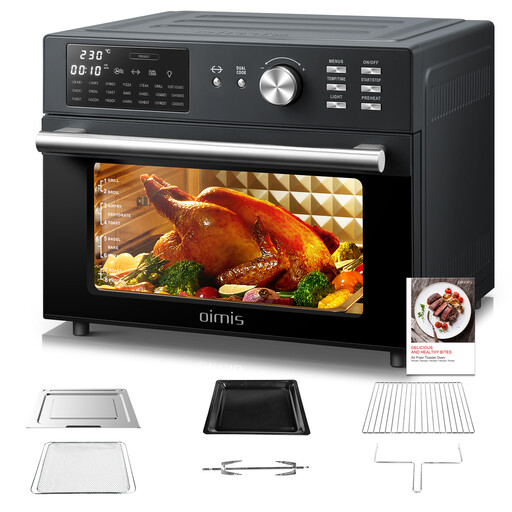
OIMIS air fryer toaster oven, 30 l, grey
Baking is listed as one of the toaster oven’s functions. For your recipe, also check that the pudding mould fits inside, with enough room for the mixture to rise.
The product name lists a capacity of 30 l, a power rating of 1800 W, 21 preset functions, a rotisserie function and a dehydrator function.
View at Joybuy
Frequently asked questions
Can I make any treacle sponge recipe in a mini oven?
No, because not every recipe is baked. Good Food describes a classic version made by steaming a covered pudding mould in a steamer or pan, as well as a separate oven-baked recipe. Choose the cooking method for your recipe first, then pick the right appliance.
What temperature and cooking time should I use for the baked version?
Good Food’s baked recipe calls for 180 °C with conventional heat or 160 °C with a fan, and a baking time of 35 to 40 minutes. These are recipe instructions, not measurements for every mini oven. Check whether it’s cooked as directed in the recipe.
How should I position a mini oven in a small kitchen?
Follow the clearances specified in the instructions for your particular model. Severin specifies 12 cm at the sides and rear, and 30 cm above the TO 2068. Don’t apply these measurements to other appliances. Also make sure there’s room for your baking tin.
Does a countertop mini oven need an EU energy label for ovens?
Not necessarily. The European Commission excludes small and portable ovens from the scope of its energy labelling rules for domestic ovens. Whether a particular appliance is covered depends on the definitions in the applicable regulations. The absence of a label doesn’t, by itself, tell you how much electricity the appliance actually uses.
What should I know about warranties and returns when buying online?
If there’s a fault, statutory rights against the seller are different from a voluntary guarantee. The Verbraucherzentrale (German consumer advice centre) says online purchases generally come with a 14-day right to cancel. Changing your mind and returning faulty goods are different matters. Check the terms that apply to your purchase, including any exceptions.


